You Tilt at 2am, Your Wrist Hurts, and the Grind Isn't Working
Being hard-stuck is usually a session-management problem, not a mechanics one. A hard stop rule that survives 2am, a review ratio, and what to do about the wrist.


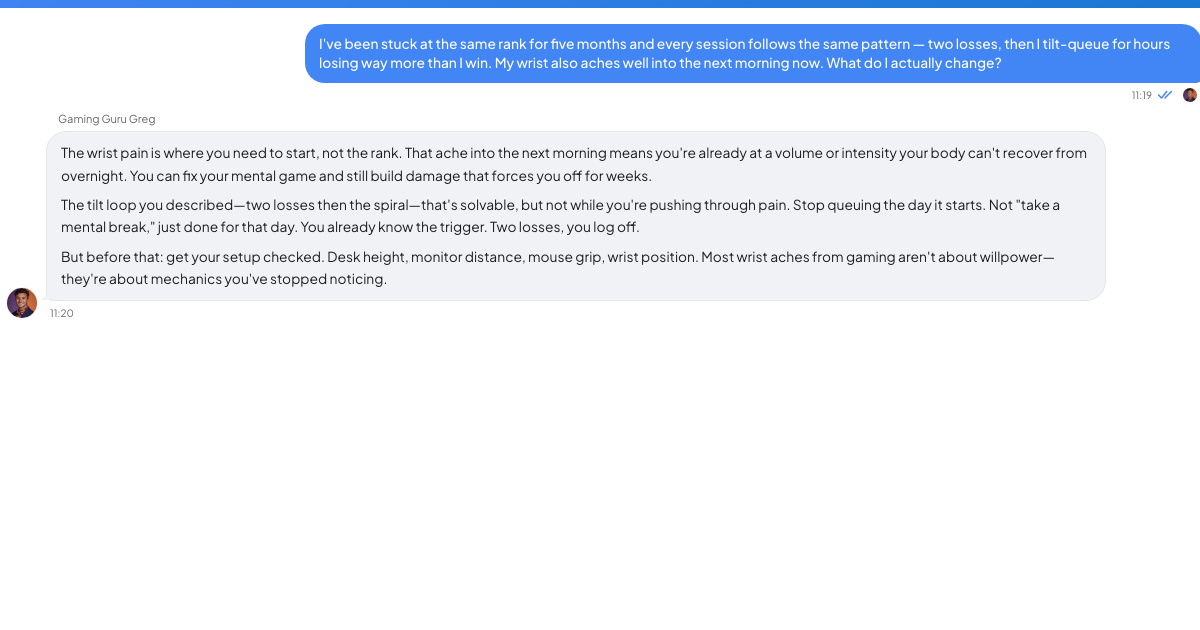
1:58am, cursor hovering, not clicking
The lobby timer has reached six minutes while you sit there.
You know exactly how tonight goes, because it went this way on Tuesday and it went this way last Thursday. You lost twice early, and the second loss was a coin flip you lost at eighteen minutes and you are still narrating it in your head. Then eight or nine more, each played slightly worse than the one before, and somewhere around game six you stopped making decisions and started reacting.
Your rank has not moved in five months. Your wrist has that dull ache it gets after hour three, the one that is now still there in the morning.
You are hovering rather than clicking because pressing play costs something now, and you can feel it.
The arithmetic nobody makes you look at
Start by calculating what happens across your own night.
Say a win moves you twenty points and a loss takes twenty. Say your genuine ability, fresh and paying attention, wins you a bit over half your games — that is what sitting on the edge of a rank-up means. Now say that after two losses in a row your play drops off enough that you are winning three of ten.
The first two games were roughly a coin flip, unlike the next nine. On a night like that it is not close, and if that is your standard night, five months of it is exactly the flat line you are looking at.
Those numbers are invented for illustration — I have no idea what yours are. But you can find yours out. Your client keeps your match history. Open it, and for the last twenty sessions write down the result of your first two games and the result of everything that came after a second consecutive loss. Use two columns; the work takes fifteen minutes.
You may find something uncomfortable sitting in those two columns: that games one and two look nothing like games six through eleven, and that the number you are stuck at is a number you keep climbing towards and then handing back. Or you may not, and the fix is somewhere else entirely. That is what the columns are for.
If it is the session, then more mechanics guides were never going to move you, which would explain why they haven't.
The stop rule has to be mechanical, because willpower at 2am does not exist
"Just do not queue when you are tilted" is worthless advice, and I would guess you have already tried it about forty times. The state that makes you queue is the same state that removes your ability to decide not to.
Make the decision before 2am and build friction now.
The rule is that two consecutive losses end the session, rather than merely any two losses that night. No exceptions for "but that one was not my fault" — especially not that one, because that is the exact loss that triggers everything else.
The friction is what makes it hold. Pick some of these and set them up while you are not tilted.
Log out of the client and close it, even though that sounds trivial. The gap between "press play" and "type your password, wait for the patcher" is where your decision comes back.
Stand up and leave the room. The chair is part of the problem. You are not going to talk yourself down while sitting in the exact position you tilt in.
Put a hard clock on the session before it starts. An alarm at the end of it, in another room.
Tell the one friend you duo with, so the rule exists somewhere outside your own head.
If you break it, skip the self-loathing and write down the trigger as data.
Review to play, at a ratio you'll actually keep
Another reason five months goes flat is that playing tests your skills rather than practising them.
You cannot see what you did while you are doing it. The replay is where that information lives, and it is the only place it lives, so cap the games and put a review block in the session.
In one game, watch only your own deaths, or your own losing fights, and pause thirty seconds before each one. Say out loud what you thought was true at that moment and what was actually true. Those spoken comparisons complete the exercise. Usually the answer is boring and repeats: you did not have information you could have had, and you took a fight on someone else's terms.
Write the pattern in one line, then make that line your only goal in the next session.
The wrist, and the part where I stop being helpful
Start here: an ache that used to arrive after three hours and now hasn't gone by morning is a change, and changes are the thing to pay attention to.
If you have numbness, pins and needles, tingling in the fingers, weakness, or pain that wakes you up, see a doctor. The NHS carpal-tunnel guide lists hand or finger pain, numbness, tingling or pins and needles, and weak-thumb or gripping difficulty; it also says symptoms are usually worse at night. Not a subreddit and not a new mousepad. Those symptoms can mean a nerve is involved, and nerve problems get harder to fix the longer they run. I cannot tell you what yours is, and neither can anyone else who hasn't examined you.
What is reasonable to do meanwhile, while you get that seen to:
Cap the hours before you cap anything else. Duration is the biggest lever you have got, and the four-game session you just built conveniently serves as the wrist prescription too.
Before playing, warm up. Spend two or three minutes on easy wrist and forearm movement, opening and closing your hands. It rarely makes it into a gaming routine.
Stand up every forty-five minutes. Set the timer that you are going to ignore, then ignore it, then set it again.
Then check the geometry. Government of Canada CCOHS keyboard guidance recommends a neutral wrist aligned straight with the forearm, with the keyboard in front, shoulders relaxed, elbows close to the body, wrists straight and in line, and elbows at approximately ninety to 110 degrees. That supports your original check: forearm supported and roughly level, wrist not bent up off the desk, and chair height so your elbow sits near ninety degrees. And if you play at a sensitivity that means your hand does everything from the wrist, dropping it so you aim from the elbow and shoulder spreads the work across bigger joints. It'll feel terrible for a week.
That is load management around something you should still get looked at. It is not treatment and it does not replace the appointment.
Queue anxiety is fear of the number
Here's the tell. You are not scared of playing. You'll play customs, you'll play with friends, you'll do a whole aim routine happily. The thing you cannot press is the button that changes a number attached to your name.
That is what happens when the only feedback you get is a score and you have watched it not move for five months. The game stopped being a game and turned into a nightly verdict.
The standard advice is to go play unranked instead, which fails because it deletes the thing you care about. You do not want to stop competing. You want to stop being judged nightly.
So change what the session is scored on. Before you queue, write two process goals: the pattern you found in your replay, and one behavioural one like "no chat, muted, all game". At the end, the session is a success if you did those, whatever the results were. Rank goes back to being what it always was, which is a slow output of a great many sessions.
TrueTalk's Gaming Guru Greg is an AI persona, not a coach and not your duo. What it is, is awake at 1:58am in the lobby, which is the ten minutes where this gets decided and where nobody else is around to say anything. The free tier includes ten conversations and one hundred messages per day.
Use the result of the experiment
You have been running an experiment for five months. The independent variable was "more games". The experiment returned a clear result: on Thursday, play no more than four games, stop after two consecutive losses, and review one replay.