Your Closet Is Full of a Body You No Longer Have
Empty the rail, separate grief from fit, test clothes while sitting, and rebuild a small wardrobe for the body you have today.

Take everything off the rail
Take every garment off the rail and put it on the bed until the rail is bare.
Do not skip this instruction, because the empty rail makes a rebuild possible and prevents the jeans from surviving another edit.
Choose a Saturday when nothing is scheduled afterward. Not at 7:12 in the morning, on the fourth attempt at an outfit, with three others already on the bed and the trousers doing up in the way where you'll spend the whole day aware that they do up. That version ends in the black leggings and the long cardigan, the way it did yesterday.
Pile one: what fits today
Test one item at a time.
Count an item as fitting today only if you could wear it and forget it by ten in the morning. Sit in it, because most of your life happens in a chair and clothes are judged there. A motionless mirror check tells you nothing you will still believe at lunchtime.
Expect this pile to look pitifully small; its size is expected, carries no bad news and gives you the honest inventory you need. Put that small pile back on the empty rail. That rail is now your actual wardrobe, and it's the first honest picture of it you've had in a year and a half.
Pile two: what hurts to look at
Put here anything that produces a feeling: the jeans from before, the wedding dress, the item someone complimented you in and the two tagged pieces bought at the exact size you were about to become.
Place those pieces in a bag, then store it in the loft, under the bed or in a friend's garage. You do not have to make a permanent decision about any of them today, including choosing the charity shop or eBay; getting them out of sight is the whole objective. Revisit in a year, feel completely differently, lose nothing but some storage space.
Permanent disposal carries grief, so there is no reason to decide it during an afternoon when you are already sad.
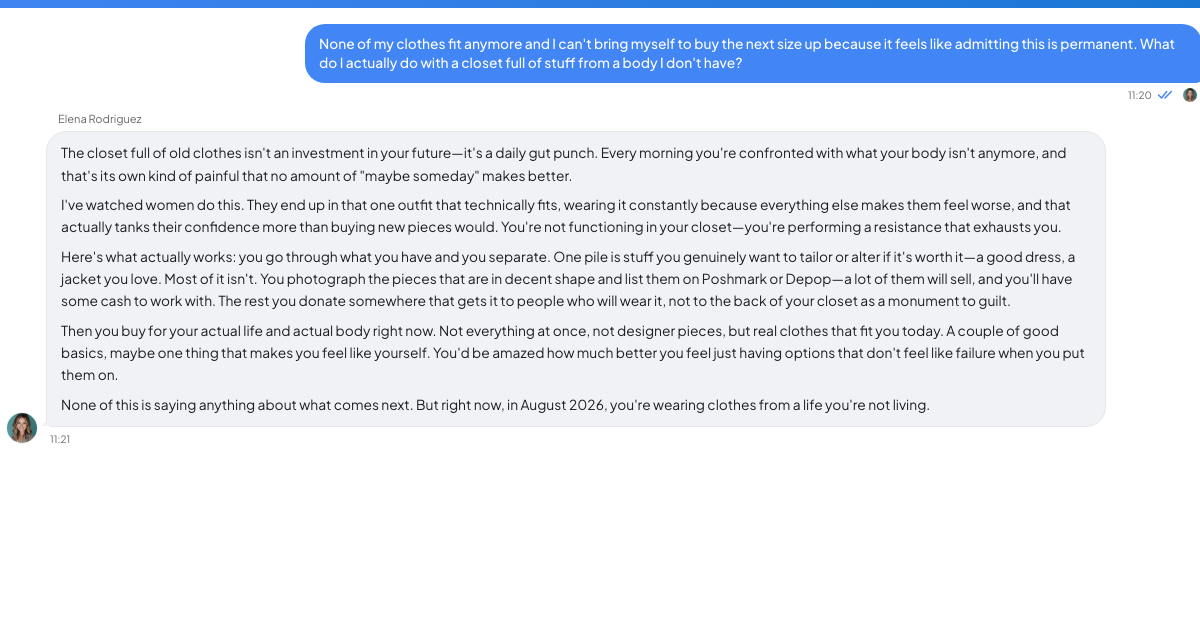
That grief makes the job hard alone and often worse with company. A friend will say you look great, which is kind and useless; family will have opinions about the wedding dress. TrueTalk has an AI persona called Elena Rodriguez, listed under styling, colour theory and body positivity — it can't see the clothes or check the fit, but it's there while the pile is on the bed. The free tier includes ten conversations and one hundred messages per day.
Somewhere around the twentieth hanger
Around the twentieth hanger, notice what the room has been doing to you. You have been dressing every morning among forty garments functioning as evidence. You wouldn't hang a photograph of yourself mid-argument on the bedroom wall.
By this point, you have reached the real obstacle: the meaning attached to buying a larger size, while the silhouettes are already familiar.
Every article on this subject says dress the body you have now and follows with ten shapes, including wrap dresses, A-lines and something about vertical seams. You know that advice already. You could write it yourself. A study of twenty women aged 18 to 45 recorded their speech during dress try-ons and found themes spanning functional fit, body confidence, clothing dimensions and size coding (PubMed). What's standing between you and a wearable outfit is that buying the next size up feels like signing something — conceding that this is the body now, not a situation you're passing through.
Eighteen months ago, you would not have believed that there is no standard: women's clothing sizes are not defined by regulation. Each brand grades to its own block, adjusts it for its own customers and shifts it between seasons and product lines. Hackney Museum's garment-label record likewise notes that UK clothing sizes are not standardized and brands determine sizing for their customer profiles (Hackney Museum). Two size 14s from two shops on the same high street are routinely different garments, and a 14 from that brand a decade ago may be different again. The number is a manufacturer's internal filing reference that got printed on the outside.
The size you are refusing to buy is not a verdict. It's another shop's arbitrary integer.
Expect to own more than one number across different brands permanently, which is normal when unrelated companies use unrelated blocks.
If the printed number interferes, cut out the label. Plenty of people do. Nobody has ever, once, seen the inside of your waistband.
The handful worth taking to an alterations place
Use a second bag and keep it honest, because this is where hope gathers dust.
Skirts and trousers can usually be let out a little, but only by the seam allowance the maker left, which is often almost nothing on cheap clothing; hems are easy and waistbands are doable. Taking something in is nearly always simpler than letting it out. Knitwear and anything with stretch generally isn't worth paying for, and altering across the shoulders or the bust is skilled work that can cost more than the garment did.
In practice, this bag holds two or three things, one of them a good coat; that is fine because a coat is most of what anyone sees in winter.
Then buy five things, on a Tuesday
You are not buying a wardrobe; buy five things that work with the small pile already on the rail.
Buy them for the body you have on an ordinary day — not the day you feel least bloated, not the day you feel worst. Buy the size that's comfortable sitting down.
When five are unaffordable, buy two. Two things that genuinely fit get worn more than a rail of near-misses ever did. Five purchases plus one good item from the clothes you kept give you six reliable options, and getting dressed from options that fit takes about four minutes instead of becoming another long search.
Because this timeline includes body change, take a sudden change or unexplained symptoms to a GP rather than treating them as a styling problem. The NHS specifically advises seeing a GP when weight keeps falling without changes to diet or exercise (NHS). Postpartum, perimenopause and medication all shift bodies in entirely ordinary ways; ordinary changes can still be worth mentioning to a doctor.