138,000 Wishlists. 581 Sales. Now What?
A launch that misses badly asks two separate questions: which link between wishlist and purchase actually broke, and whether the next six months belong to this game.


Wednesday night, and the sales number has stopped moving
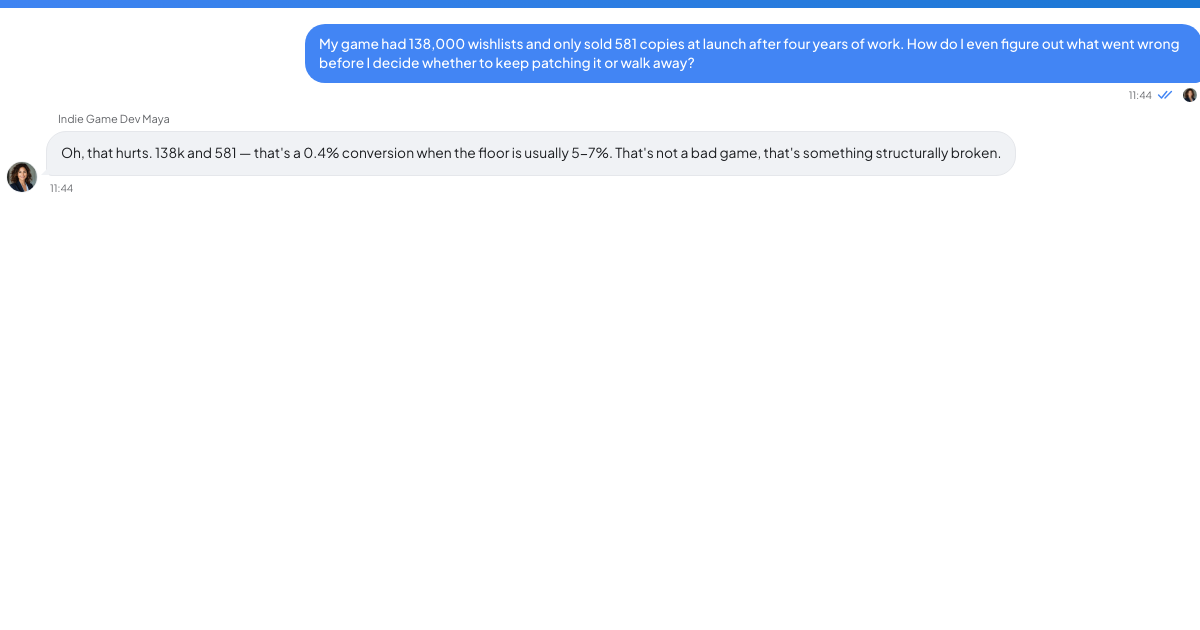
Say you have 138,000 wishlists and 581 sales in launch week. Whatever your actual figures are, you have divided one by the other four times, as if a different calculator might produce a kinder answer.
For four years, every marketing talk, post, and Discord conversation told you to build the list. You did exactly that. The launch result still missed the prediction you thought the list contained.
Now one Discord friend says "just discount it," another says to fix the launch bugs, and your partner is asking what comes next. You scheduled a Monday review because midnight is a poor time to decide whether four years of work should continue.
Separate the questions before you answer either one. Start by using the data you already have to locate the broken handoff. Decide separately whether six more months of your life should go to this game.
Trace the handoff, one report at a time
Treat wishlist-to-sale as a sequence of checks rather than a single conversion rate.
Did the notification reach a useful audience? Steam says launch wishlisters receive an email and/or mobile push notification, but the age of the wishlist still matters. Someone who saved the game twenty-two months ago after one trailer is not the same prospect as someone who added it three weeks ago after playing your demo. In the Steamworks wishlist report, inspect when additions happened and how many deletions followed. If one old spike — a viral tweet, festival, or bundle for another game — dominates the curve, many launch notifications went to people who had forgotten you.
Where are those people? Country-level wishlist figures are in Steamworks' Regional sales report, not the wishlist report. Compare the largest regions with your local prices: a game costing a substantial share of a day's earnings will behave differently from one priced like a coffee. A list concentrated in regions where your price is high by local norms can explain a weak-looking conversion without proving the game is unwanted.
What competed for the same week? Write down releases in your genre within the few days on either side of launch, plus any overlapping major sale event. List those nearby releases and sale events, then compare your daily traffic with the days before and after each one. Steam gives new releases visibility, but that attention is shared with other games rather than guaranteed.
What happened after the click? Steamworks traffic breakdown gives you launch-week arrivals and the fraction who bought. If many people reached the page and few purchased, recruit five people who have never seen the game. Give them only the store page, ask what they think they would do in the game, and record their answers before you explain anything. Pay special attention to the first two screenshots and whether the trailer promises the same experience; a visitor should understand the basic action in roughly a second and a half.
What did buyers say? Read the review text instead of stopping at the aggregate score. The score is an average of a few hundred strangers. Refund rate matters more than that score, and it is visible: buying-and-refunding is a different problem from never-buying. Record the refund rate beside the recurring review themes so you can compare the two problems.
Several links can fail at once, so test the store page even when your first theory is notification age or competition.
Before accepting the discount advice, check the dates in Steamworks. Valve says there is no one-size-fits-all discount solution; the plan should fit the game's content, community, and marketing (Valve's discount guidance). Generally, a discount cannot run within 30 days of release or within 30 days after a launch discount ends. If the date has arrived, still diagnose the problem before changing the price; otherwise you may sell the same unclear offer for less.
The wishlist ratio is not a failed exam. Valve explains that people wishlist for different reasons, so no formula accurately predicts sales from wishlists (Valve's wishlist documentation). Discord conversion percentages are self-reported by developers with different genres, prices, audiences, and reasons to publish their results. Record your reports as the baseline and treat Discord anecdotes as context.
A second set of eyes
This week, you need a person who will inspect the Steamworks numbers and make a case for which handoff is weakest. Ask them to compare the page, price, audience, and product evidence rather than offering general encouragement.
Indie Game Dev Maya is a TrueTalk persona: an indie developer and creative director character whose areas are indie game development, game design and the creative process. An AI, not somebody who has shipped a game. The free tier includes ten conversations and one hundred messages per day. Spend an hour at 11pm walking through the reports with her if that helps you say the numbers aloud and answer a concrete question such as what your first screenshot shows.
Decide what six months can buy
The four years are behind you. Patching Tuesday or shelving Monday will not return them. Compare the next six months on this game with the other uses you have for that time.
Ask one practical question: is continuing this game the best available use of that six-month block?
Continuing is defensible when the evidence gives you a bounded experiment:
- Buyers are writing good reviews. If 581 people liked the game, there is something worth protecting; if those 581 were lukewarm, the next move is different.
- You can name a cheap, specific break. A store page that misrepresents the game may be a weekend repair, not another year.
- A second visibility opportunity has a date: a festival-style event, platform port, sale window, or content update that gives people a genuine reason to notice you again.
Stopping can be the sound choice even when the build is good. You may have no runway, or six months may require savings you need, or continued work may be covering the pain of admitting the launch failed. Treat those constraints as part of the decision alongside the build's merits.
If you are no longer sleeping, or Monday feels heavier than ordinary launch disappointment, contact a GP or therapist before adding another task to the store page. Developers write openly about how difficult the post-launch weeks can be; do not try to solve that strain by adding more work, because it can cost you a year.
Games fail to find a later audience far more often than they find one. A sale, streamer, port, update, or a year of slow word of mouth can still change a game's reach. The success stories travel farther precisely because they succeeded, so do not build a budget around being the exception. If you continue, list the specific event, update, or time window you would test instead of budgeting for an unnamed later audience.
Choose two or three fixes, set a six-week window, and define the number that would count as movement before Monday. Put the fixes, deadline, and number in a written note. Let that six-week test bind Monday's decision after you have reread the reviews, because Monday-you will have read them again.