A Year of Streaming to Four People and You're Wondering When to Stop
Average concurrent viewers is the least useful number you own. Five checks in a twelve-month export, plus one eight-week experiment, can settle whether to continue.


The file you have never opened
Twelve months of streaming, and you have watched only the number on the second monitor. The average concurrent-viewer figure is four.
That is the least useful number you own. It is a summary of a summary, it moves for reasons that have nothing to do with you — one regular changing shift pattern will swing it — and a year of watching it has taught you precisely one thing, which is what it feels like to watch it.
Your dashboard contains an export. It lists every stream you have done, row by row. Four nights each week for fifty weeks comes to around two hundred rows.
You have not opened that export. Partly because you think you know what it says, and partly because you fear you do.
Open the export. After twelve months this is no longer a mystery, and half past midnight is no place to settle it by feel.
One paragraph about the advice, then we'll drop it
Most growth guides were written by somebody it worked for. That's very nearly the entire sample — the channels that were exactly as consistent as you and went nowhere deleted the account and wrote nothing at all. Abraham Wald, working for the Statistical Research Group during the Second World War, made the famous version of this point about bullet holes in bombers: the armour belongs where the holes aren't, because the planes hit there didn't come home. This is survivor bias: growth advice mostly comes from channels that succeeded, while the channels that stayed consistent and went nowhere rarely publish their stories. That doesn't make consistency wrong — it makes it a necessary condition being sold to you as a sufficient one. And it means the answer to your question isn't in anybody's video. It's in your file.
Five things in the export, and average viewers isn't one
New unique viewers, month by month. Not followers or concurrents: people who watched this month and had not watched before. YouTube defines new viewers as first-time viewers in the selected period (YouTube Analytics).
This is the one to look at first because it separates two situations that feel identical from inside the stream. A flat concurrent count sitting on top of rising uniques means the door works and something inside the room doesn't. A flat concurrent count sitting on top of flat uniques means almost nobody is finding you at all, and no amount of being better on camera touches that. The same four viewers can therefore represent completely different problems.
What happens in the first ninety seconds. Your platform may not provide a clean live retention curve; VOD figures can stand in. YouTube's live metrics include average concurrent viewers and traffic sources and can be downloaded as CSV (YouTube live metrics). You can also watch one stream by hand. Mark each upward tick. Check whether it falls again within two minutes.
Say ten strangers land across four hours and nine of them are gone inside a hundred seconds. Reach is not your problem; every hour spent chasing it is wasted.
Variance across two hundred streams. Sort the export by peak viewers and look at the top ten rows.
Did a single stream break the pattern? Perhaps one night reached nineteen. Perhaps one VOD produced unusual numbers, or one clip somebody shared without telling you. When the top ten rows look like the bottom ten, the export shows that no stream has distinguished itself from another. You haven't run two hundred experiments. You've run one experiment two hundred times, which produces one data point and a lot of tiredness.
And if there is a spike, go and find out what that night was. It's the only lead you've got that came from your own channel rather than somebody else's.
Check whether anything travels beyond the live room. Does any part of this survive leaving the live context — a clip, a VOD, a short? If nothing you make works outside the room, the room must fill itself, and rooms rarely do. That's a sentence, not a section, because it's the one thing everybody already tells you.
Whether followers return. Followers rising while live numbers stay flat is not encouraging. It means people liked a moment and didn't adopt a habit. That gap is one of the few genuinely fixable things on this list, and the fix is unglamorous: consistent start time, a reminder people actually receive, and a reason to be there live rather than later.
Put the readings together
Flat uniques, no variance, and nothing that travels indicate a discovery and format failure. Another twelve months of the same approach will produce the same outcome.
Rising uniques, poor first-ninety-seconds retention — the front door works, the room doesn't, and this is the most fixable version of your situation.
Good retention, flat uniques — the room is fine and nobody's finding it, which is a distribution problem and gets solved off-platform rather than by adding hours live.
Here's the part you won't like: none of this gives you a probability. Nobody can tell you what your odds were, or are. Discovery on these platforms has a large luck component, and anybody claiming to have modelled it is selling something. The export tells you what has happened. It does not tell you what will.
If you change something, change it like an experiment
A usual pivot is drift. It can mean playing a different game some weeks, adding a new overlay, or privately resolving to be more energetic on camera. A year later you can't tell what did what, so you've learned nothing and you're a year older.
Run the change as a real experiment. Four parts, and skipping any of them wastes the eight weeks.
Choose exactly one variable, not three. If you change the category and the format and the schedule at once and uniques double, you don't know why, and you can't do it again.
Set a fixed window: eight weeks is long enough for a change in discovery to show up in a monthly unique count and short enough that you'll survive it.
Name one metric before you start. New uniques per month is the most likely metric, since that's the one that moves first.
Write the decision before starting. If you later stop without a named date, the channel can fade and become the version you carry around for years afterwards. Not "did it feel better" — a line you set in advance and don't move afterwards, because you will want to move it in week seven. A change you can see without squinting, decided while you're still calm. Any threshold you pick is arbitrary; the number isn't doing clever work. Its only job is to be fixed before you have feelings about the result.
The variable is yours to choose. You could choose a smaller category with fewer people streaming into it. You could choose a format that manufactures clippable moments instead of four hours of ambient competence. Or you could move the front door off-platform entirely and let the live stream become the place people arrive at rather than the thing they're supposed to stumble on.
If three properly run tests produce no movement in the metric you chose, that is the result, and it is worth more than another year of hoping.
The bit that isn't about analytics
If the flatness has spread past the stream — if it's Wednesday afternoon and the rest of the week feels like this too — that's a GP or a counsellor conversation, not a growth-strategy one. A spreadsheet is the wrong tool for that, and so is any advisor, AI or otherwise.
Somebody to read the file with at midnight
Reading the export is straightforward; saying the numbers where other people can hear them is harder. Your partner has heard about the channel for a year. Say two of the four regulars are people who've been showing up since week three — call them Dan and Priya — and they're exactly the people you can't be honest in front of. Small-streamer Discords tend to run on enforced optimism, and "I think I should stop" gets you a wall of encouragement nobody asked for.
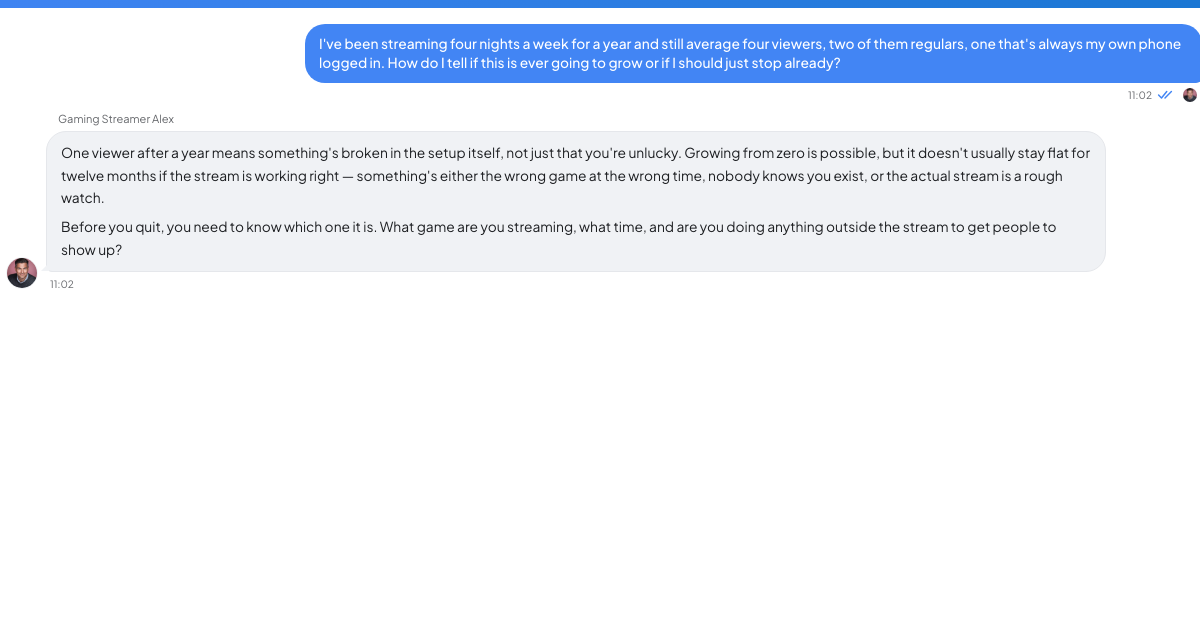
TrueTalk offers an advisor for this. Gaming Streamer Alex, a Content Creator & Gaming Influencer persona whose areas are live streaming, content creation and gaming culture. Alex is an AI persona, not a person with a channel, and that's worth being straight about: he can't raid you, he doesn't know what your category looked like last Tuesday, and he has no line into anybody's algorithm. What he is, is available at half twelve when the stream's just ended and you want to say the twelve-month numbers out loud to something that won't reflexively reassure you. The free tier includes ten conversations and one hundred messages per day.
Whatever you decide, decide it from the file
You've spent a year making this decision four nights a week without ever once actually making it.
Make this decision once. Run the export, read the five things, pick your one variable, write the line down. Eight weeks from now you'll have an answer that came from your own channel instead of somebody else's video.
Write down the decision and the date it takes effect. If you stop, name the stop date to prevent the schedule from fading into nothing; small channels often do not end cleanly, and that uncertainty can linger. If you continue, state the reason for continuing.
That gives you a defined decision and a way to evaluate it, rather than repeating the last twelve months by habit.