Your Manager Slid a PIP Across the Desk and Wants a Signature. Should You Sign?
Signing a PIP usually means you received it, not that you agree with it. Here is how to sign safely, what to write next to your signature, and when to ask for time or a lawyer first.


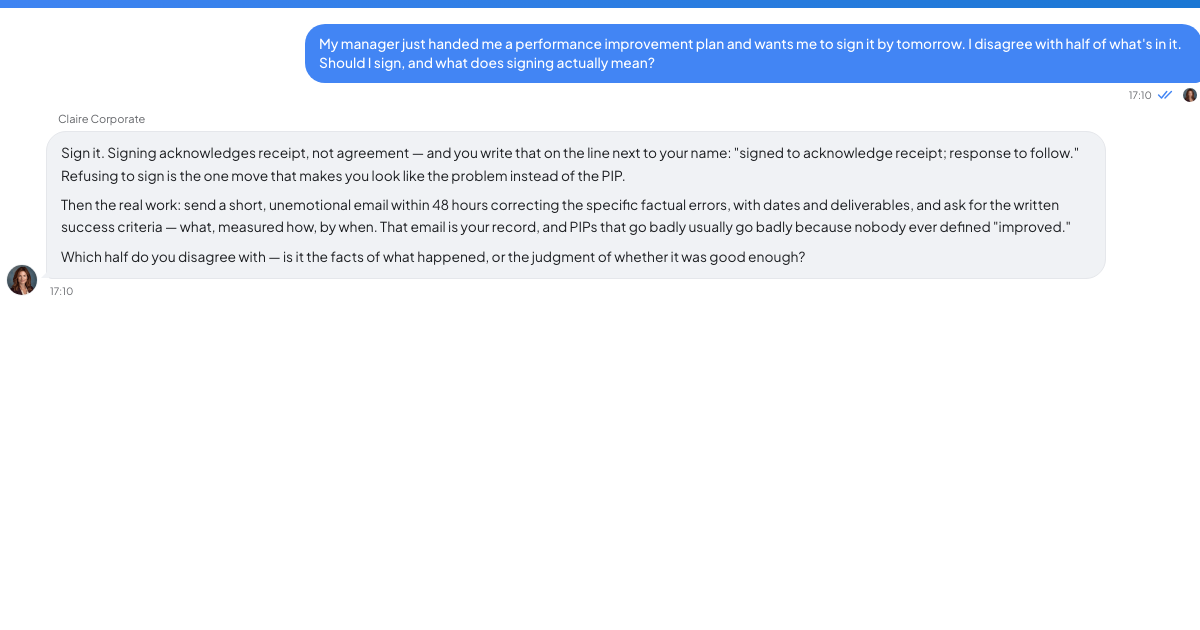
In most US workplaces, signing a performance improvement plan (PIP) only acknowledges that you received and read it, and refusing rarely stops the process. It tends to be recorded as a refusal, which makes you look uncooperative. A better move is to ask for time to review it, then sign with a note saying you acknowledge receipt but do not agree with the contents, and send your written response within a day or two. If the PIP involves a disability, leave, or a complaint you made, speak to an employment lawyer before you sign anything.
What does my signature on a PIP actually mean?
Usually less than it feels like. Look at the wording above the signature line. "I have received and discussed this plan" is an acknowledgement. "I agree with the findings and commit to the objectives" is an agreement, and that one is worth hesitating over, because it can be quoted back to you later as evidence that you accepted the criticism. If the form has only an agreement and no acknowledgement option, ask HR whether a receipt-only version exists. Asking is not unreasonable.
The form itself will not tell you your legal rights. Whether your employer may fire you after a PIP, with or without a signature, depends mostly on your contract and your state. The general rule in most of the US is that employment is at-will, which the Legal Information Institute describes as the employer being able to end it for any reason as long as the reason is not unlawful. The signature rarely changes that.
Can I refuse to sign a performance improvement plan?
You can, but think about what it buys you. A refusal is typically noted on the document ("employee declined to sign"), and the plan proceeds anyway. In practice you get the downside of seeming defensive with none of the protection. The exception is where the document contains statements you believe are false or an agreement to something unlawful. Then do not sign as is. Ask for a corrected version, or sign only after adding a written objection.
What should I say in the meeting itself?
Keep it short and level. You will be tempted to argue, and the meeting is the wrong place to do it. Try:
- "Thank you for walking me through this. I would like to read it carefully before I sign. Can I have until the end of tomorrow?"
- "Can you send me a copy of the document and any examples it is based on?"
- "When is the first check-in, and who will assess the objectives?"
If they say it must be signed now, you can still sign as an acknowledgement and add a line below your signature. Then follow up in writing the same day.
What do I write next to my signature?
A clear, short sentence is enough: "Signed to acknowledge receipt only. I do not agree with the assessment and will respond in writing." Date it. Take a photo of the signed page before you hand it back, or ask for a signed copy. Do not write an essay on the form. Put your longer rebuttal in a separate email.
How do I write a rebuttal that helps me?
Within one or two days, send a calm, factual reply to your manager, with HR copied if your company's process involves HR. Four elements:
- What you agree with. Naming one fair point makes the rest more credible.
- What you dispute, with facts. Dates, tickets, metrics, emails. "The report was submitted on 3 March, not 12 March; the email is attached."
- Questions about the objectives. What counts as success, measured how, assessed by whom, by when.
- What support you need. Training, clearer priorities, a lower workload during the period, regular one-to-ones.
Keep copies of your own record. Do not forward confidential company or customer material to a personal account, because that creates a different problem. For how to read the plan's wording and decide between repair and exit, see does a PIP mean you are fired.
When does a PIP become a legal question?
The EEOC's guidance on applying performance and conduct standards to employees with disabilities is useful here. It says an employee with a disability must meet the same production standards as others, and that reasonable accommodation never requires excusing poor performance. It also says the ADA does not require you to request accommodation at a particular time, but an employer need not excuse performance problems that happened before the request, so once you know about performance concerns, ask for what you need promptly. One example in the guidance describes a federal employee on a 60-day PIP whose supervisor postponed the start while processing her accommodation request.
The DOL's FMLA protections fact sheet adds that an employer may not use an employee's request for or use of FMLA leave as a negative factor in employment actions. If your PIP arrived soon after leave, a medical diagnosis, a pregnancy announcement, or a complaint about harassment or pay, write down the timeline and get advice from an employment lawyer in your state before you sign. Many offer an inexpensive first consultation.
What if I think I should quit instead?
That is a legitimate choice, and you do not have to decide in the meeting. Before you resign, ask about severance (see do laid-off employees get severance for how those negotiations work, since a negotiated exit is sometimes possible), check what you would lose in benefits and vesting, and start your search while you are still employed.
Claire Corporate, an AI advisor on TrueTalk who focuses on corporate politics and career advancement, can help you draft the rebuttal email or map your options. She can help you think, but your contract and the facts of your case go to a lawyer.