Six Weeks Laid Off and Your Partner Still Thinks You Have a Job
You were laid off six weeks ago and nobody at home knows. The problem is no longer the layoff, it's the concealment, and it's draining the job search.


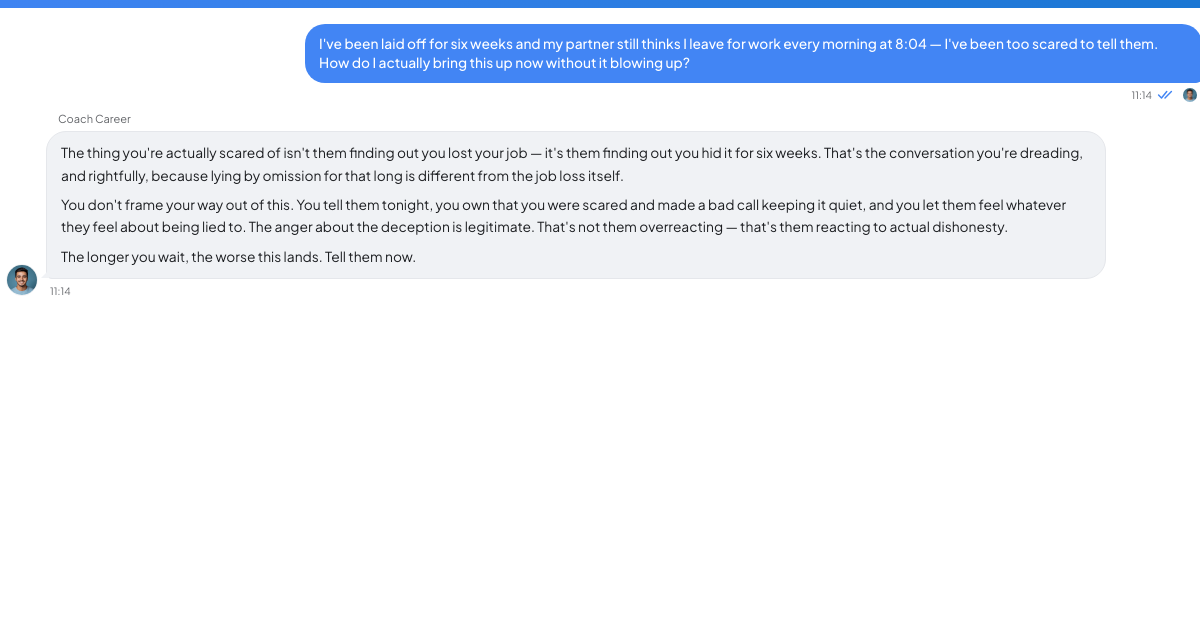
The commute you perform
At 8:04, you put on the shirt, pick up the bag, and say goodbye. You drive to a garden-centre parking space or coffee shop two towns away, then open a laptop on a job board instead of a work inbox. It has been six weeks, maybe nine. The layoff took twenty minutes; staging a workday has taken forty-one mornings.
Most advice assumes day one: tell your support system, update your profile, and handle paperwork. You are on morning forty-one. You already know honesty matters, but hearing that has not moved you from traffic-light rehearsal to the kitchen. The concealment is using time, sleep, and nerve you need for the search: you cannot take a recruiter call at home or conduct a video interview in your study.
Name the two costs
The missing job is difficult but manageable. The secret at home is another problem. You cannot meet a former colleague without worrying that the news will travel, and fuel, parking, and coffee buy privacy. In longitudinal data from 815 recently unemployed job seekers and partners, Vinokur, Price, and Caplan found financial strain affected depressive symptoms in both partners; those symptoms reduced support, increased undermining, and harmed relationship satisfaction (PubMed, PMID 8708998). Include your household finances in this conversation.
A study of 2,973 couples found unemployment lowered life satisfaction for both members, more for the unemployed person, and reactions were more negative where couples had children (Luhmann, Weiss, Hosoya, and Eid, PubMed, PMID 24956318). The school trip, mortgage, and car matter. Tell your partner before the search is fixed, because disclosure lets you take recruiter calls, conduct video interviews, and use the search openly; bring the balance, monthly outgoings, and cash-runway calculation.
Prepare the facts before the feeling
Write down the layoff date, severance, account balance, and monthly outgoings; calculate how many weeks remain. Add applications and conversations. Check unemployment, health-cover, and severance deadlines, which vary by country and state.
Say: “I was laid off. It happened on the twelfth of June.” Then: “I haven’t told you until now. I’ve been leaving the house every morning and not going to work.” Give the arithmetic, then describe the live search. Do not apologise for being laid off; you did not choose it. After the figures and search update, apologise for the six weeks: “I’m sorry about the six weeks.”
What to do when they react
After those sentences, stop. The next ninety seconds may involve silence, anger, or the school-trip deposit, car payment, or booked holiday. Let your partner calculate.
If they panic, answer with the numbers: the mortgage is 2,140 a month and the true figures leave about eleven weeks of cash, if that is your worksheet. A conversation in week seven gives more options than the same discovery in week twenty after the buffer is gone. A missing payslip, tax document, bank notification, neighbour, or mutual friend can reveal it anyway, so make the disclosure yourself while you control the timing. Tell one adult first; discuss the children on another day with less detail.
The next morning
The mortgage is the same size on Saturday as Friday, and the search still needs routine. Keep the library or coffee-shop working-day shape if that routine helps, or work from the kitchen; take the recruiter’s call at home and meet a former colleague without maintaining a second life. Review the balance and outgoings, confirm deadlines, and agree on the next job-search block.
Rehearse without outsourcing the truth
The person who normally helps practise is the one you misled. Coach Career is one of the 164 advisors on TrueTalk, specialising in career counselling around job loss and the middle of a search. It is an AI, not a human counsellor, so it can help you rehearse without being disappointed in you or giving a verdict on the six weeks. The free tier includes ten conversations and one hundred messages per day.
If you have stopped sleeping altogether or your thoughts have gone somewhere dark, contact a doctor or crisis line today. This article and an app are not substitutes for that help.