Can Negotiating Your Salary Backfire? What the Research Says and How to Lower the Risk
Yes, it can, and the evidence says the risk is not evenly spread. Here is what one well-known study found, and the wording that keeps an ask collaborative and hard to rescind over.


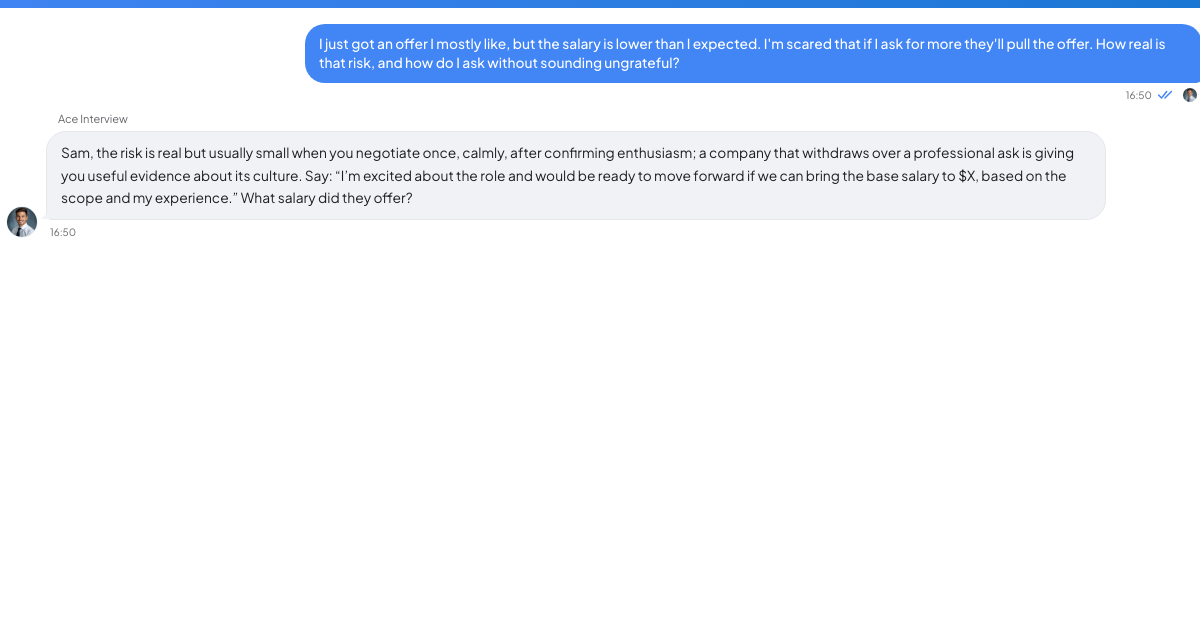
Yes, negotiating a salary can backfire, but outright rescinded offers are rare when you ask politely and the ask is reasonable. The more common cost is a small loss of goodwill, and research suggests that cost is not shared equally. A well-cited study found women were penalized more than men for asking. You can lower the risk with wording, timing and a clear reason for your number, and for most people the bigger risk is staying silent.
What does the research say about the risk?
In 2007, Bowles, Babcock and Lai ran four experiments on how people react to candidates who negotiate. The Harvard Kennedy School's Gender Action Portal summary reports that evaluators were less willing to hire both men and women who negotiated, but the penalty for women was more than twice as large. When evaluators judged willingness to work with a candidate, a man who negotiated saw no decline, while the negative effect for a woman was 5.5 times greater. Evaluators described the women as too demanding and not nice.
Two cautions apply. These were experiments using written profiles and videos, not real hiring decisions, so they show a bias in how people react and not a rate of rescinded offers. And the paper is from 2007, so apply it as a warning about how an ask is perceived rather than as a prediction for your specific employer.
A separate study on real workers points the same direction. Artz, Goodall and Oswald (2018, Industrial Relations), using matched employer-employee data, found that men and women ask equally often for raises and promotions, yet women do not get the same outcomes. Asking is not where the gap opens.
The practical takeaway: if you expect to be read as demanding, frame the ask as shared problem-solving, tied to the job and to market evidence, not to your own needs.
How likely is it that an employer pulls the offer?
I could not find reliable data on how often employers withdraw offers after a negotiation, so I will not quote a number. What I can say is that the reports of this happening tend to involve one of a few patterns: an ultimatum ("I will not come unless you give me X"), a long string of new demands after acceptance, or a large jump that the candidate could not justify. An employer reads those as a preview of working with you. A single, specific, well-reasoned request reads as engagement.
If the employer does withdraw over a polite ask, that tells you something about the team. It is also worth knowing that a verbal offer gives little protection; see is a verbal job offer legally binding before you resign from anything.
How do I ask without sounding demanding?
A few principles keep the tone right:
- Start with enthusiasm. Say plainly that you want the job.
- Ask one question, not a list of demands. "Is there flexibility on the base salary?" lets them respond.
- Give the reason for your number. Market data, scope of the role, or a competing figure you can state honestly.
- Offer a range for movement. You may trade base for a signing bonus, equity, an earlier review or extra leave.
- Make the next step easy. "Could you let me know by Thursday?"
A script that works on the phone: "Thank you, I am excited about this role and the team. Based on the scope and what I am seeing for similar roles, I was hoping for a base of $92,000. Is there room to get closer to that?" If the answer is no, ask: "Is there anything else, such as a signing bonus or a six-month salary review, that you could do?"
Should I negotiate by email or by phone?
Email gives you time to word it and leaves a record. Phone gives faster feedback and conveys warmth. If the recruiter has been calling you, call back, then confirm the agreed numbers by email afterward. If you are nervous, email first: "Thank you for the offer. I am very interested. Before I accept, could we discuss the base salary? I was expecting something closer to $X given [reason]."
What if my situation is high-stakes?
If you cannot afford to lose the offer, you can still ask. The cost-benefit is different, so narrow the ask: one number, backed by evidence, with a clear fallback you would accept. Our post on negotiating when you are the only earner covers that case in detail. If you have more than one offer, that gives you real leverage, and you can say so honestly.
When is it better not to negotiate?
There are a few cases: a role advertised with a fixed, published pay scale (some public-sector and union jobs work this way, and the recruiter will say so), an offer already at the top of your researched range, or an employer that has told you clearly no negotiation is possible. In those cases ask about non-salary items instead, such as start date, schedule or training budget.
What do I do after a no?
Thank them. Then decide: accept as is, accept and ask for a review at six months, or decline. You are allowed to say, "I understand. I would like to accept, and I would like to discuss a salary review after six months based on agreed goals." Get that review date in writing in the offer or in a follow-up email.
If you want to rehearse, Ace Interview, one of TrueTalk's AI advisors with a background in career transition and salary negotiation, can play the recruiter and let you practise saying the number out loud until it stops feeling strange.