They Offered You the Job on the Phone. Is a Verbal Job Offer Legally Binding?
In most US states a verbal job offer is not much protection, because employment is at-will. Here is what it does and does not give you, and what to do before you resign anywhere.


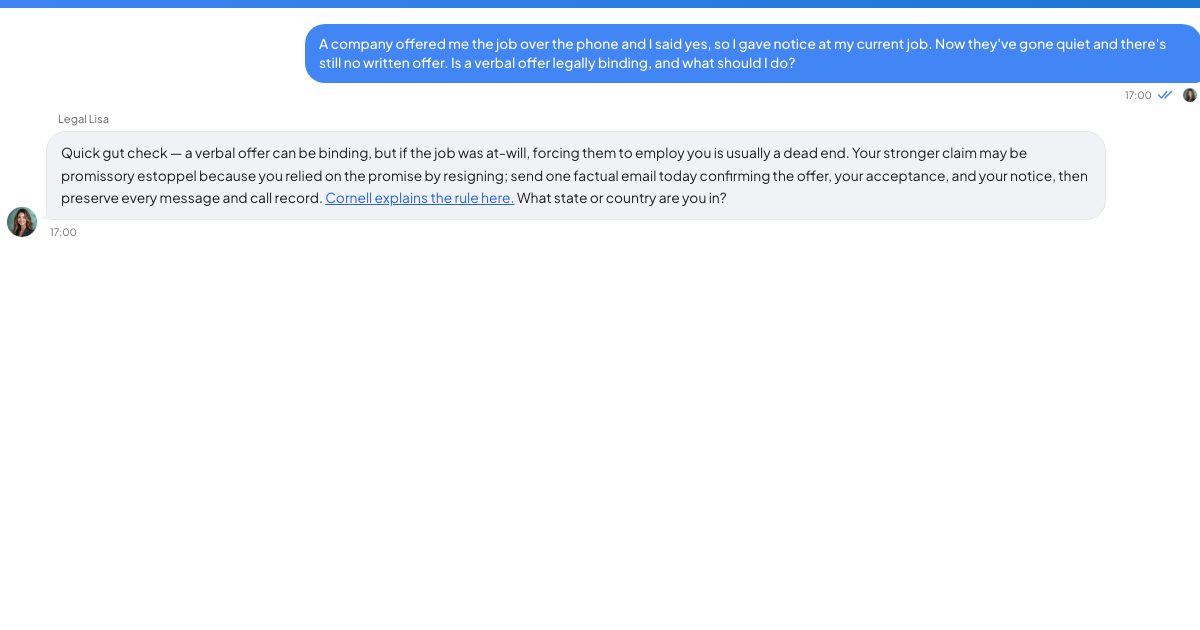
In most of the United States, a verbal job offer is not a guarantee of a job. Employment is presumed to be at-will, which means the employer can end it, or withdraw an offer, for almost any lawful reason, and a phone call usually does not change that. Courts in some states will enforce a clear promise if you reasonably relied on it to your detriment, but that is a narrow and fact-heavy exception, and it is no substitute for a signed letter. This is general information on US law, not legal advice for your state.
Why is a verbal offer weak protection?
The Legal Information Institute's summary of at-will employment says the employer may end the job "for any reason and at any point," as long as the dismissal is not for an unlawful reason such as discrimination, retaliation or exercising a legal right. It also says employment is presumed at-will absent an express or implied agreement to the contrary. Montana is described there as the one state where an employer generally needs good cause after probation.
A verbal offer typically leaves out start date, pay structure, duration and conditions, and most offers state they depend on background checks or references. Without those terms it is hard to argue anyone agreed to a definite contract. The offer also rarely promises how long the job lasts, and an at-will job that lasts a day is still consistent with the deal.
Can an employer rescind a job offer?
Generally yes, with limits. A company cannot withdraw an offer because of your race, sex, religion, disability or another protected characteristic, or in retaliation for protecting a legal right. Short of that, an employer that changes its mind because of budget, a hiring freeze or a better candidate is usually within its rights, which is painful but common. If you have a written offer with a condition (a background check, say), the employer can also withdraw if the condition fails, though it should be a real failure rather than a pretext.
What is promissory estoppel, and could it help me?
Promissory estoppel is a doctrine courts use to enforce a promise when no formal contract exists. The Legal Information Institute's page on promissory estoppel describes the pieces: the person reasonably and detrimentally relied on the promise, the promisor could have foreseen that reliance, and enforcing the promise is necessary to avoid injustice.
Applied to a job, that might mean you resigned from a stable position, turned down another offer, or moved cities because the employer clearly told you the job was yours. Results vary a lot by state, and courts in some places reject these claims. I could not find a reliable single source summarizing the rule state by state, so if you are in this position, ask an employment lawyer in your state.
What should I do before I resign from my current job?
This is the moment where people get hurt, so slow down. A sequence that protects you:
- Ask for the offer in writing. Say: "Thank you, I am very excited. Could you send the formal offer letter with the title, salary, start date and any conditions? I will give notice as soon as I have it."
- Read the conditions. Background check, references, drug screen, work authorization, board approval. Ask whether each is complete.
- Confirm the start date in writing. A written start date turns a vague hope into something you can plan on.
- Do not resign until the letter is signed on both sides and the conditions are cleared. If they push you to resign first, ask why. Urgency without paperwork is a signal.
- Do not turn down other interviews yet. Keep options warm until the start date arrives.
- If you have a relocation or sign-on bonus, get those terms in the letter too, including what you owe if you leave early.
If you have a written offer and negotiate it, remember that asking for more is normal. The social risk of doing so differs by person; see can salary negotiation backfire for what the research found.
Does it matter who made the offer, and how?
It can. An offer from the person who actually has authority to hire, such as the hiring manager or an HR representative, carries more weight than a casual remark from a future teammate. A message that names a title, a salary and a start date is easier to point to later than a comment that "we would love to have you." If the offer came by phone, send a short recap the same day: "Just to confirm what we discussed: the role of Senior Analyst at $85,000, starting 3 November. Please tell me if I have misunderstood anything." Their reply, or their silence, is useful either way.
What if the offer is rescinded after I already resigned?
Do the following, in order: ask the employer to confirm in writing why it was withdrawn; save every message, including texts and recruiter emails, that showed what was promised and when; write down the dates you gave notice and any money you lost; file for unemployment if your state allows (rules differ, so ask your state labor department); and speak to an employment lawyer in your state about reliance and discrimination. Do not threaten anyone in the meantime. A calm, factual email gets more than an angry one.
While you do all that, look for work in parallel; a rescinded offer is usually unrelated to your ability. The same shape applies to an offer you get when you are the only earner, where the cost of the offer falling through is higher.
If you want a second pair of eyes on wording, Legal Lisa, an AI advisor on TrueTalk with a business-law background, can help you draft the email asking for the written offer. She cannot tell you whether your state would enforce a promise to you. A lawyer licensed where you live can.