Cleared at Six Weeks — Cleared to Do What, Exactly?
A six-week postnatal check does not assess a heavy lift. Use symptoms and pelvic health physio to plan a safer return to the barbell.


One word, and nobody asked what it meant
A blood-pressure check. Questions about bleeding and mood. Contraception gets discussed. Then: "you're cleared for normal activity." The appointment lasted roughly twelve minutes.
No one asked what normal meant for you.
Eighteen months ago, your normal was a 100kg deadlift for five, with a plan to reach 120. Say you're now four months past that appointment and you have not been under a barbell since before the bump got in the way. There is a gap you can feel down the middle of your stomach if you press. You leak if you sneeze, and sometimes if you laugh properly. By nine in the evening there is a heaviness low down that you do not have a word for and have not said to anyone.
Meanwhile you have been reading that your core is ruined, that a gap down your midline is permanent damage, and that going near a heavy bar again is asking for trouble. Whoever wrote that has never watched you move, never assessed your pelvic floor, and has no idea what your midline does under a brace.
What the six-week check actually cleared
It is worth being precise, because the word "cleared" is doing enormous work here and it was never meant to.
The postnatal check looks for problems after birth: bleeding, infection, wound healing, blood pressure, mood, and contraception. ACOG describes postpartum care as an ongoing process, recommends contact within the first three weeks, and says the comprehensive visit should occur no later than 12 weeks after birth (ACOG, Optimizing Postpartum Care). If you had a caesarean, it is confirming that a surgical incision has healed enough that ordinary daily life will not disrupt it. That is a real and useful thing to establish.
What it is not is an assessment of your abdominal wall or your pelvic floor under load. Almost nobody at that appointment tested whether your midline holds when you brace, or what your pelvic floor does at the bottom of a squat with weight on your back. They were not ignoring it. That assessment is not what the appointment is for, and it takes far longer than the appointment lasts.
So you were cleared from surgical and healing risk. Nobody in that room looked at what your pelvic floor does under a loaded bar.
The specialist for what you have described is not a personal trainer
Before anything about barbells: leaking when you sneeze, and a heaviness or dragging sensation low down, both belong in front of a pelvic health physiotherapist. That is the profession that exists for this and it should be the first appointment you make.
Leaking after birth is extremely common. A 2025 systematic review specifically evaluated pelvic-floor rehabilitation training for postpartum stress urinary incontinence (PubMed, PMID 40069127). Common is not the same as something to work around quietly, and it is not something to fix by wearing a pad to the gym and hoping. UK guidance puts a supervised programme of pelvic floor muscle training first in line for stress incontinence — supervised being the operative word, because a meaningful proportion of people doing pelvic floor exercises from a leaflet are doing something other than what the leaflet describes, and only an assessment tells you which group you're in.
The heaviness deserves its own sentence. A dragging or bulging feeling, particularly one that gets worse through the day or with lifting, is something a pelvic health physio needs to look at. It may be nothing much. It may be a symptom that changes what you should be loading and how. Say it out loud at the appointment; every clinician in that field has heard it several times already this week.
In some areas you can self-refer; in others the GP does it; going private is an option if the wait is long. Ask specifically for a pelvic health physiotherapist rather than general musculoskeletal physio.
The rest of this is about the training, and it assumes that appointment is booked.
Replace the calendar with criteria
Six weeks, twelve weeks, six months — every number you have been given is a proxy for something nobody measured. Criteria are better, because your body is reporting continuously and for free.
Four signals. Learn what each one means and what to do about it, and you have a system that works whether you're four months or four years out.
Leaking. During a set, or on the effort part of a rep. It usually means the load or the pressure demand exceeded what your pelvic floor is currently managing. It does not automatically mean stop training — reduce the weight, slow the rep down, or stop holding your breath through it. But if it is new, or getting worse, that goes to the physio before you decide anything yourself.
Doming or coning. Look down at your midline during the hard part of a movement. If a ridge or a tent shape pushes out along the middle of your stomach, regress that particular movement rather than dropping it. Less weight, less range, exhale on the effort, then check whether the shape disappears.
Heaviness or dragging. Worse through a session, or worse for hours afterwards. Stop that session, and take it to the physio rather than to the internet.
Pain. Sharp, in the scar, in the pubic bone, or new in the low back. Soreness is a different animal and you will know the difference. Pain gets assessed.
Notice the pattern. Three of the four are instructions to regress, which means to make a movement easier and keep doing it, and that is the option nobody online offers you. Your choice you have been handed is lift or do not lift. The useful choice is at what load, in what range, with what breath.
Regressing is a real skill and it is mostly four dials: less weight, less depth or range, fewer reps per set, and change the position — the same hip hinge done leaning on a bench, the same press done on an incline, the same squat to a box.
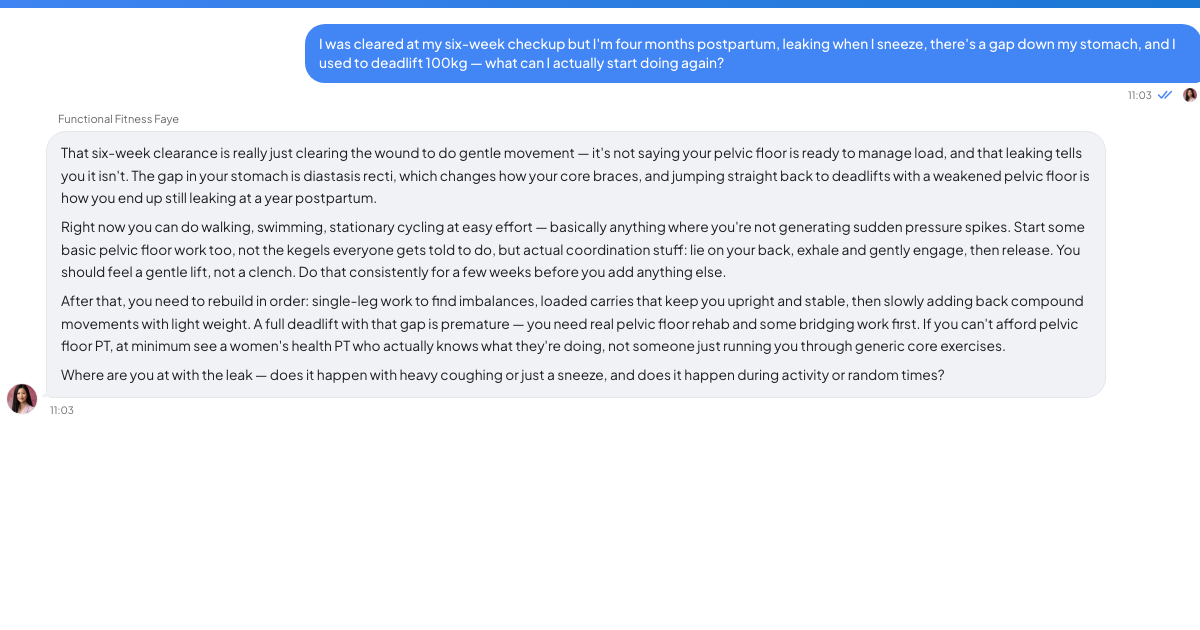
Between appointments those calls land on you alone, mid-set, with the baby monitor on. Was that doming or is that just what my stomach looks like. Do I repeat this week or add a kilo. TrueTalk's Functional Fitness Faye is an AI persona built around strength and conditioning, and it is somewhere to think out loud about what you noticed and whether it is worth raising at the appointment. It is not a pelvic health physiotherapist, and leaking and abdominal separation still belong with one.
Twelve weeks, roughly, and only roughly
This is illustrative. A real programme should come from someone who has watched you move, and if your physio gives you something different, theirs wins.
The first three weeks are breathing and pressure management before anything else: exhale on effort, ribs down, no bracing against a held breath. Bodyweight patterns only — box squats to a chair, hip hinges to a bench, incline push-ups against a kitchen counter, split-stance work, light loaded carries with one weight in each hand and a normal walking gait. Nothing in that block should produce any of the four signals. If something does, you have found your starting point for regression rather than a failure.
Weeks four to six add external load to whichever patterns stayed quiet. Goblet squats, Romanian deadlifts with a light kettlebell, rows, heavier carries. Sets around eight to twelve, always a couple of reps short of failure, still exhaling on the effort.
Around week seven the barbell comes back, and it comes back embarrassingly light. Deadlifts from blocks or a rack at a fraction of what you used to pull — if you were at 100, start somewhere near 40 and be pleased about it. Sets of five to eight. The job in that block is technique and confidence rather than load.
The last three weeks add weight gradually, with the four signals as the ceiling. No maxes, no testing. The number comes back faster than you expect once the base is there, and it does not come back at all if you skip to it and spend a fortnight symptomatic.
If you had a caesarean, expect the scar area to feel odd for longer than the rest — numbness, tightness, a strange non-feeling when you press. Front-loaded movements may be uncomfortable for a while after everything else is fine. Mention it at the physio appointment; scar mobility is something they work on.
The part that makes all of this harder than the schedule suggests
You're doing this on broken sleep. Possibly on four hours in pieces, possibly while feeding, possibly with a toddler as well.
Recovery is different under those conditions and progress will not be a line. You will have a session at week seven that feels worse than one at week four. That is usually what four hours in pieces does to a session. A common failure mode is not training too hard — it is reading a bad Tuesday as evidence the whole thing is hopeless and stopping again for two months.
What four months of nothing has already cost
The gap in your training did not come from your body. It came from an appointment that used a phrase meaning one thing while you heard it meaning another, and then from four months of not knowing who online to believe.
You do not need permission from any of them. What you need is one appointment with someone who can assess a pelvic floor, and a first session light enough to be boring.