This Is the Sixth Time You've Started Over
You know how to lose the weight — you've done it five times. The part nobody writes about is month seven, which is where every one of your attempts actually ended.


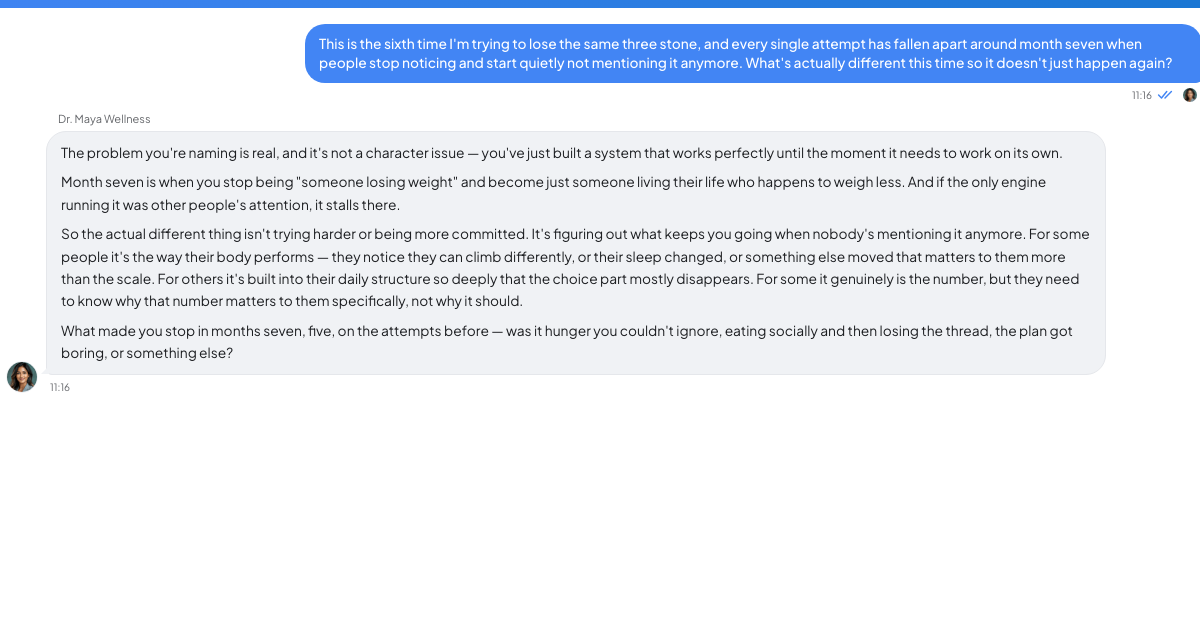
Sunday, half nine, and you are not thinking about the chicken
The shop is done. The app is reinstalled. You have told yourself Monday.
And you are sitting on the edge of the bed thinking about your sister-in-law in August, and about the person at work who said something nice in month four last time and then, around month nine, stopped saying anything at all — which was worse.
You know how to lose three stone. You have done it five times. That's the problem. You are not afraid of the diet. You are afraid of the part after it, in public, again.
Nearly everything you can buy stops writing at week twelve: the plan, the first thirty days, the shopping list, the before photo. Months four to nine barely exist, which is remarkable, because that's where all five of yours died. The advice that does exist for that stretch is stay consistent and make it a lifestyle — restatements of your problem at the emotional temperature of a motivational poster.
So do not buy a sixth beginning. You own five. Spend this week reading them instead.
Get a piece of paper. One column per attempt, five questions down the side. It takes about forty minutes and it is the only thing in this article.
1. What month did it stop, and what else was happening?
The rest of your life, not the diet. A job change, a house move, a bad winter, someone ill, a relationship ending.
Nobody has ever asked you this. Everyone asks how you did it. Nobody asks how it stopped, because stopping gets treated as a character flaw rather than an event with a cause — and it had a cause, probably the same one, five times over.
If something shows up in four of the five columns, that's the actual subject of this attempt, and it may have almost nothing to do with food.
2. What was the first thing to go?
Tracking, cooking, weighing, walking. They do not fall at once. One goes first and it is usually the same one, and it is usually the one that costs the most time on the worst day.
That's your early warning. Not the scale — the scale tells you weeks later. The tracking going quiet on a Wednesday tells you now.
3. Were you still losing when it stopped, or had it flattened out?
Different failures entirely. Quitting during a plateau is a story about expectations. Quitting while it is still working is a story about something else, and the something else is usually in column one.
4. What did people say to you in the two weeks before?
Include compliments, especially compliments.
This is the part that's keeping you on the edge of the bed at half nine, and no article about calories will touch it. You have been publicly congratulated and then publicly, silently un-congratulated, five times. A sixth round of that is a genuinely unpleasant thing to sign up for. It is not vanity and it is not fragility.
So do not sign up for it. Nothing here requires an audience. You can decide tonight that precisely one person knows, and that it is somebody who has never once commented on your body. You can decide nobody knows. You can decide that when someone asks what you are doing differently, the answer is that you are sleeping better, followed by a change of subject. None of that is dishonest. Your weight is not public information and you never agreed to run a commentary on it.
The cost is real, though. Some of those five attempts were partly powered by being seen, and this one won't be. It'll feel flatter. Plan explicitly for that flatter stretch.
5. What were you eating when you were not following the plan?
Write down where you were standing and who else was in the room. Record whether you were alone or with people, and whether it happened in the evening or all day.
The worst hour is the one right after — you have eaten everything in the house, you are in the kitchen at eleven, and the conversation you need is now, not Thursday, and not with anyone whose face is going to change. TrueTalk has an AI persona called Maya Wellness, listed under weight management, nutrition planning and exercise routines. Maya is neither a doctor nor a dietitian, but the persona is available at eleven when neither professional is. The free tier includes ten conversations and one hundred messages per day.
Then plan the month it ends in
Before you decide a single thing about breakfast, decide what happens in the bad month.
Say the forensic turns up that every attempt ended within a fortnight of something going wrong at work. Then the question is not what do I eat, it is what does this look like during a fortnight of coming home at nine. Answer it now, in writing, while you are calm. What's the minimum version? Which things do you keep, and which do you drop deliberately, in advance, without it counting as stopping?
Pick a smaller target while you are there. Three stone needs a good year, and a good year is exactly what your history says you do not reliably get. A stone, or twelve weeks of a specific behaviour rather than a weight at all, has the property that a bad month does not invalidate it. A goal that can absorb a bad month is the only kind your own evidence says survives one.
I will be straight about what that costs: smaller target, smaller and slower visible change, and less of the fuel that came from people noticing. You are trading that away on purpose, for the thing not ending.
The bit that needs someone with a licence
A long history of losing and regaining the same weight is worth a GP appointment, as is anything that resembles a binge pattern — eating a large amount fast, alone, past comfort, with shame afterwards. The NIDDK's clinical overview defines binge eating by a large amount in a short time with loss of control; regular episodes at least weekly for 3 months may indicate binge-eating disorder. It lists talk therapy, behavioral weight-loss treatment, and medication among treatments, with assessment by a mental-health professional. A better meal plan alone does not address that clinical picture. A referral to a registered dietitian is a different and more useful thing than another programme, and in a lot of places you can also self-refer for talking therapy.
Whether repeated weight cycling itself causes long-term physical harm remains disputed. Mehta and colleagues' 2014 review retained 20 human studies and seven animal studies; only 12 human studies accounted for whether weight loss was intentional, and the authors found evidence for adverse effects sparse while emphasizing inconsistent definitions and study limitations. Anyone who says the causal question is settled in either direction goes beyond that evidence. Do not let it be used to frighten you into starting on Monday.
About Monday
Nothing about a Monday makes weight come off. It is a convention, and one reason tonight feels so heavy is that you have handed a normal weekday the job of delivering a verdict on you.
Use Sunday evening for the five-column review, then carry its early-warning sign and bad-month minimum into whichever next step you choose.