Twenty Minutes, No Childcare, and You're Already Exhausted
Build exercise around an unguarded twenty-minute window: write a sick-week protocol, set a four-minute floor, attach it to household events, and protect recovery.


Both children are in bed, though neither is asleep. The younger one is shouting through the door about a sock. Someone else's half-eaten pasta sits on the sofa arm, and the PE bag by the front door needs a name by morning.
On nights when a window exists, it runs roughly from 8:40 to 9:00. You have already used eleven minutes deciding in the kitchen whether tonight counts.
Write the following plan instead; it takes four minutes and is not a workout.
The sick-week protocol, written now, while nobody's ill
Make three decisions while rested and store them somewhere visible at two in the morning.
While a child is ill: the floor session, or nothing. Neither option breaks the plan; both are built into it.
When it's over: you rejoin where you left off, or one notch back. Never restart at week one because this plan has no full reset.
The trigger to rejoin is an event, not a date. Use an event such as the first morning both children return. A missed calendar date can feel like personal evidence, while the event simply occurs.
Keep the protocol to those three lines.
Why it goes before the exercises
A typical programme asks for four weekly sessions of forty-five minutes plus warm-up and makes week five depend on completing weeks one through four. Its introduction says consistency is key, merely restating your constraint as advice.
Progressive plans require a second adult in the building, although the cover never says so. Rest days assume you control which days are difficult, and overload assumes uninterrupted weeks. Even just twenty minutes! means an uninterrupted block, unlike twenty minutes in which a six-year-old may appear.
Advice to find time misreads your constraint. You know the 8:40-to-9:00 window; it is unguarded, and nobody else will guard it.
List all four restarts and mark the event that ended each.
The likely causes were neither boredom nor bad exercises. One ended with a temperature at two in the morning; another ended when nursery called at eleven. Four broken nights create a week off. Once the house recovers, the programme gap looks like failure, and returning to week one feels like restarting a board game you were winning.
Childhood illness is routine in a home with two young children, occurs several times yearly and cannot be scheduled. A programme without that contingency belongs to another household, not yours.
Now the session, and it should embarrass you slightly
Set a floor so small that calling it a workout feels generous.
Use ten squats, ten incline press-ups with hands on the sofa arm, and one imperfect minute of plank. Complete two rounds on a good night and one on a bad night. It takes four minutes, requires no kit, fits between the coffee table and radiator, and remains possible during the sock complaint.
Use the floor on your worst night. On better nights, extend the time, add a set or take a walk. Do not raise the floor; it must survive an unavoidable fortnight.
Older advice often says otherwise, but the World Health Organization's 2020 guidelines removed the requirement that activity occur in bouts of at least ten minutes (WHO). Activity of any duration now counts toward the weekly total. The adult targets remain substantial: 150 to 300 minutes of moderate weekly activity plus muscle strengthening on two or more days. Four Tuesday minutes remain far below them. Those four minutes still count. CDC guidance says any amount has some benefit and that the 150-minute total can be divided across the week (CDC).
Hang it off something that already happens
Clock-based plans require a punctual household, which you do not have.
Attach exercise to an existing event. Use the bath filling, the kettle boiling and the tea brewing. Another option is the fifteen minutes after taking bins out but before sitting, because sitting ends the window.
Keep the limitation explicit: event stacking supports brief strength or mobility work, not an activity requiring continuous time. A kettle cannot hold a long run. If running is your goal, reserve a different, rarer window and expect it less often than you want.
What four minutes won't do
Four minutes cannot compensate for five broken hours of sleep. Exhausted training moves slower, feels worse and progresses less. Anyone promising otherwise is selling something.
It also cannot change childcare arithmetic. When gym childcare exceeds the membership cost, that gym is not a viable option; repeatedly considering it only creates guilt. If you can spend anything, resistance bands cost less than one month of most memberships and fit under the sofa. CDC includes resistance bands and body-weight press-ups among muscle-strengthening options (CDC).
If you are recently postnatal, or pain differs from ordinary tiredness, consult a GP or physiotherapist before choosing a programme.
Some weeks, do not train. When one child is ill and work is on fire, either hold the floor or do nothing else. Your written four-minute protocol already authorises that decision.
It's 8:52
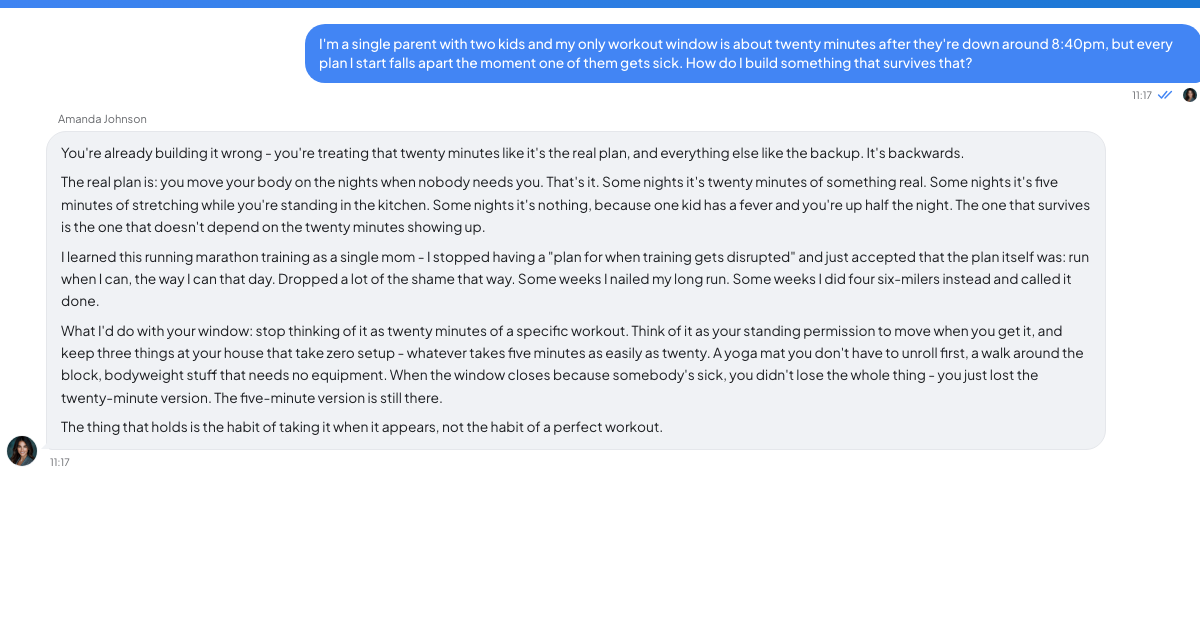
At nine o'clock, accountability is harder than the squats. Nobody sees either completion or omission, so missed nights accumulate until they resemble evidence about your character. TrueTalk includes Amanda Johnson, an AI single-mother-and-bakery-owner persona. It cannot observe your form or medically clear you. The free tier includes ten conversations and one hundred messages per day.
Tonight's plan is not twenty minutes.
Set a four-minute timer, keep your socks on and complete one round with the television still playing.