Since the Fall, You Haven't Been Past the Front Gate
Fear after a fall is a rational update, not a phobia. But exercise is the thing shown to cut falls, and staying in is the one way to get none of it. A ladder that starts indoors.


Fourteen steps to the gate
You know the number because you have counted it from the window. Fourteen steps from the front door to the gate, and you have not done them since February, six months ago.
Nothing broke. That is the maddening part — you went down on an uneven kerb outside the newsagent, a man in a hi-vis helped you up, you had a cup of tea when you got home and you thought that was the end of it. Nothing was broken. Nothing was even sprained.
But you do not walk to the shop now. And somewhere in the last few months you started putting a hand on the sideboard when you cross your own living room, which you did not use to do, and you have noticed you do it without deciding to.
Your daughter says you need to get out more. She says it in a particular voice.
The fear is not the irrational part
Most advice for this skips straight to exercises. Sit-to-stands, heel raises, a printout with line drawings on it. All of it perfectly sound, all of it landing nowhere, because it's answering a question you did not ask.
You know how to walk. You have been doing it for seventy-odd years. The obstacle is that you fell, and falling turned out to be sudden in a way you had not understood before it happened, and now the pavement outside the newsagent is a different pavement than it was in January.
That response is grounded in something that happened. Your fear is an accurate update based on evidence. Anyone telling you there is nothing to be afraid of is arguing with something that actually happened to you.
The problem is what the fear does next.
The loop, said plainly
Strength and balance are use-dependent. Leg muscle isn't a reserve you built up in 1974 and get to keep; it is maintained by being used, and it drops off when it is not. Balance is the same — it's a skill, and skills that are not practised get worse.
So: you stop walking to the shop. The legs get weaker. The weaker legs make you less steady, which you feel, and feeling less steady confirms that staying in was the right call. Now you're holding the furniture indoors, which reduces the demand further.
Fear of falling, and the activity restriction that follows it, is a well-recognised pattern. What the evidence actually establishes is the other direction: exercise reduces the rate of falls. Nobody can hand you a figure for what staying indoors does to your own risk. What can be said is that staying in is unlikely to be the protection it feels like, because the thing it removes is the thing that's been shown to help — and it takes your legs with it.
It's a horrible loop because every individual step in it is sensible.
The good news is that it runs both ways, and this is the part with real evidence under it. Sherrington and colleagues' 2019 Cochrane review pooled 59 trials with 12,981 people living in the community and found that exercise reduced the fall rate by 23%, a high-certainty result. Balance and functional exercise reduced the rate by 24% across 39 trials involving 7,920 people; the review's wider evidence base comprised 108 randomized trials and 23,407 participants in 25 countries.
Before any of that: two phone calls
Please make these before you start doing anything I say.
The GP, for a medication review. Blood pressure tablets, sedatives, sleeping pills, anything for the heart — several common medicines can cause light-headedness or a drop in blood pressure when you stand, and if that put you on the ground in February then leg strengthening does not address the cause. The CDC's STEADI medication guidance says dizziness, sedation, confusion, blurred vision, and orthostatic hypotension are among the medication effects linked to falls, and tells clinicians to review prescription drugs, over-the-counter medicines, and herbal supplements. Mention the fall specifically, and say whether you ever feel swimmy standing up. While you are there, ask about your eyes and feet because both can affect fall risk.
And a physiotherapist assessment, which your GP can arrange, or a falls service if there's one locally. Somebody watching you stand up and walk across a room will see things in ninety seconds that you can't see from inside your own body.
If you've had more than one fall, or you went down without knowing why, or you blacked out even briefly, that isn't a confidence problem at all. That is a medical question and it needs answering first.
A ladder that starts too easy to be frightening
Assuming you've been checked over, the way back is graded, and the first rung should feel almost insultingly small. The small scale is deliberate. A rung that produces a flicker of fear is still too large, because fear is what stops you doing it again on Wednesday.
Start indoors, holding something solid.
Stand at the kitchen counter with both hands resting on it and your feet together. Just stand. A minute, if you can. When that becomes dull, do it with one hand. Then with fingertips. Then with your hands hovering above the counter, ready but not touching. Four separate rungs, and the counter never moves.
Sit-to-stands from a dining chair, using the arms as much as you need, then less, then not at all. This is the single most useful thing on the list — it is the movement that gets you off the floor, out of a car, and up from the toilet, and it is usually the first thing to go.
Then the hallway, walking with a wall within reach on one side. Not holding it. Within reach. That distinction is the whole exercise.
Then the garden path, on a dry day. Then the path to the gate and back — the fourteen steps — and then the gate to the postbox.
Change one variable at a time; that rule makes the whole ladder workable. If you are going farther, do not also go somewhere unfamiliar. If you are going somewhere new, keep it short. Change the distance or the surface or the time of day, never two at once.
Do it at the same time each day so it stops being a decision. And go out when there are people about rather than when the street is empty, if that helps; there is no prize for doing it alone.
Some days you will not want to. Do the counter minute anyway and count it as done.
What to say to your daughter
She's frightened. That fear is what you hear in her voice. It comes out as instruction because worry usually does, and she probably does not know how she sounds.
Two things you could say, and they work better said calmly at a table than in the moment.
I know you're worried. When you tell me I need to get out more, what I hear is that I've become a problem. I'm working on it, and I'd rather tell you how it's going than be asked.
And then give her something to do, because people who are frightened need a job: Come and walk to the postbox with me on Sunday. Just the postbox. Don't hold my arm unless I ask.
For her, if she is reading this over your shoulder: stop narrating the risk out loud. "Careful" and "mind that step" and "are you alright?" every few minutes do not help balance — they interrupt it, and they tell your parent that you're watching them the way you would watch a toddler. Offer to be a walking companion with a stated destination and a stated end. Then talk about something else the whole way.
Somewhere to ask the same question five times
The awkward truth about all of this is that the person you would most naturally talk to about being frightened is the person whose worry you are trying to manage.
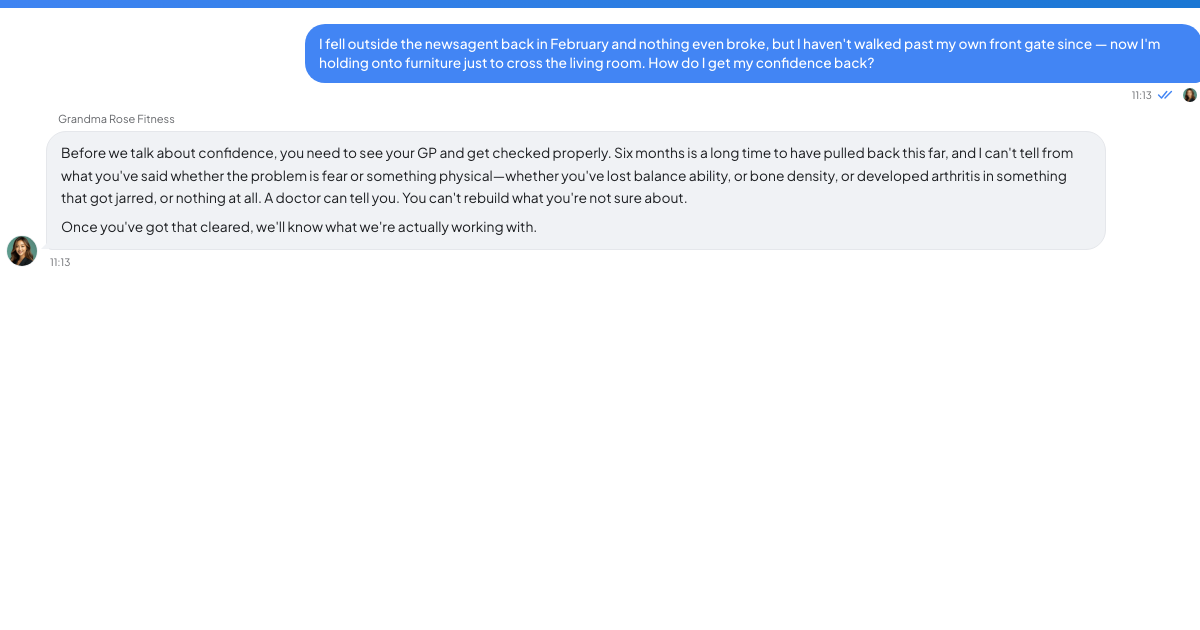
TrueTalk has an advisor called Grandma Rose Fitness — an AI persona specialised in senior fitness, healthy ageing and low-impact exercise. It is an AI, not a physiotherapist and not a nurse, so the GP and the physio assessment come first and nothing here replaces them. What it can do is answer at two on a Tuesday afternoon, and work through the same worry for the fifth time without a sigh. It is not someone in your life whose worry you then have to manage afterwards. TrueTalk's free tier includes ten conversations and one hundred messages per day.
Your plan for this month
For this month, set the destination as the postbox rather than the shop or a vague instruction to “get out more.” Walk there on Sunday with your daughter beside you and not holding your arm, then repeat the same trip alone on Wednesday.
Your legs will regain capacity more slowly than they lost it, so keep the plan deliberately limited while you rebuild.