Diagnosed With ADHD at 34, Handed a Waitlist, and Told to Buy a Planner
An adult ADHD diagnosis followed by a long medication wait needs more than a planner: make reminders, people, and automation carry the load.


Six planners in a drawer, all of them abandoned around day nine
Getting assessed took months. It cost money, a very long wait, or both. And it did what you hoped: thirty years of missed deadlines, unread letters and parking fines that quietly grew suddenly had a name attached, and the name was ADHD rather than laziness.
The other half of the appointment came next. The medication-pathway wait was measured in seasons, not weeks. There may have been a leaflet. There was almost certainly advice to use a planner or diary.
You own six planners. The dot grid one, the one with the hourly columns, the app with the streak counter you have not opened since February. Every one of them worked beautifully for about a week and a half. Then a day got skipped, and the skipped day made the book a small monument to failure, and after that opening it felt worse than not opening it.
So, nothing has changed except that now you know why. Which is genuinely something. It is also insufficient support.
This article addresses the wait specifically. Medication remains a conversation with a prescriber, and diagnosis timing is a different conversation. NICE says ADHD medication should be initiated only by a healthcare professional with training and expertise in ADHD (NICE guideline NG87). This article addresses the gap.
The planner asked you for the missing part
The planner required organisation, prioritising, activation, and working memory at the moments those functions were least available.
A 2018 network meta-analysis compared medicines for ADHD across 133 double-blind randomised trials; it is a reminder that a planner cannot replace clinical treatment (PubMed, PMID 30097390). Most of the productivity advice you will be handed runs on the same few moves. Write it down. Break it into steps. Check your calendar. Review it on Sunday. Every one of those asks you to hold something in working memory and then start a task with nothing external prompting you, and those are among the functions ADHD affects. CHADD, the US advocacy organisation, lists organising, prioritising and activating for tasks, and using working memory, among the clusters involved. It is like handing someone with a broken wrist a jar and telling them to grip harder.
Your planner story points to retrieval as the failure point. You are frequently very good at capture, especially in the first fortnight, when writing the list is itself the interesting new thing. The list existed, but you did not look at it because doing so required remembering that it existed at a moment when nothing in your environment mentioned it.
Use systems that prompt you in sight or sound instead of asking you to remember a separate check.
So the design brief for the wait is narrow: reduce how much has to live in your head, and reduce how much depends on you feeling capable at the moment it matters.
Put things in the path
Externalising means putting the practical issue where you will physically collide with it.
- Put the bag by the door instead of leaving a note about it.
- Put the pills next to the kettle.
- Put the form you have to post on the driver's seat, so you cannot sit down without moving it.
- Arrange everything you need for tomorrow morning in one pile the night before, so that the morning requires no decisions at all.
That is why the noticeboard in the hall works when the app does not. It is in the corridor. It gets seen whether or not you decided to see it.
The same principle applies to time. A written deadline waits for you to remember it. An alarm in your pocket comes and finds you. Set alarms for the start of things rather than the end. Leave at 6:40, not meeting at 7. Starting is the hard join, and nothing on a calendar tells you when to start.
Borrow urgency instead of trying to generate it
The practical issue that actually gets tasks done, most of the time, is a person expecting something.
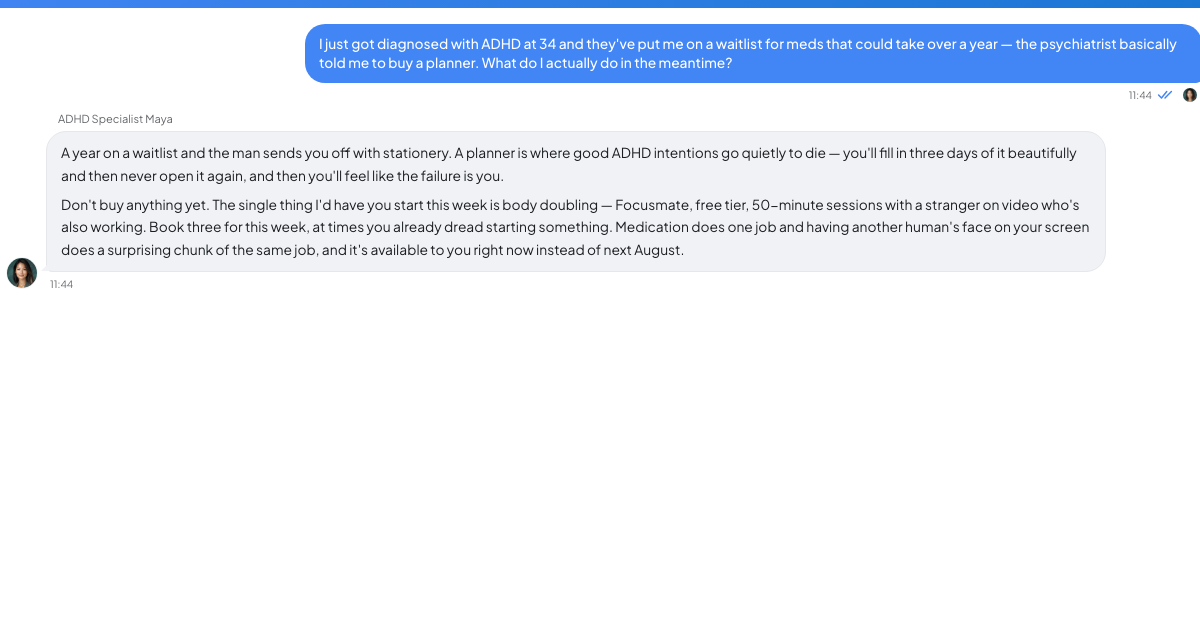
So build in the people. Book the call rather than promising yourself you will draft the practical issue. Tell a colleague you will send it by four. Sit on a video call with a friend, both of you silently doing your own admin, which people call body doubling and which a lot of people find works, even though the reason is not well established.
Appointments work when intentions do not. If something genuinely has to happen, convert it into an appointment with a human in it. That conversion is often the whole job.
That does mean asking for things, and there is a version of this that costs pride, especially at thirty-four when everyone assumes you have had your systems sorted for a decade. That cost is real. It is also cheaper than another nine-day planner.
Design for the day you have nothing
Every system you have ever built was built on a good day. That is the flaw. On a good day the plan is realistic, the steps are sensible, and future you is a reasonable person who will obviously do them.
Then you use it on a Tuesday when you cannot start.
So build for the Tuesday. For anything that matters, define the version you can do while frozen. Open the document and type one line. Reply with a single sentence saying you will come back to this properly on Thursday. Put the letter in the envelope and leave posting it for tomorrow.
That is a mechanical fix rather than a kind one. Frozen-in-front-of-an-email is a state where the task looks like one enormous undifferentiated block, and a small legal move breaks the block without needing the initiation you have not got.
Use the highest-yield hour available to you in the whole wait to automate everything with a penalty attached. Set up direct debits on every bill and renewals set to auto. Fines and letters that escalate are where ADHD gets genuinely expensive; a forgotten charge that later increases is an interface problem, and interfaces can be fixed.
Expect to replace the system, and stop calling that failure
The six planners in the drawer are usually read as six failures. Try reading them as data.
New systems tend to work while they are new. That is how novelty and interest work, and fighting it has a poor track record.
So plan for replacement. Assume the current system has a shelf life of a few weeks. When it dies, do not mourn it and do not buy a bigger one. Ask which single part survived, keep that part, and let the rest go. Over a year you accumulate a small collection of things that kept working, which is a far better outcome than the search for one perfect system that never arrives.
Keep following up on the waitlist. Ask about cancellation slots. Ask whether there is more than one provider you can be referred to, since some health systems have a choice pathway and some do not, and the first date you were given is not always the only date available. Ask, rather than assuming.
There is one thing an AI does at seven in the morning that no planner does, which is answer back. Staring at an email you have read eleven times, you can say I cannot start this and get something other than a blank page, at that hour, without first explaining your whole diagnosis to anybody. That is what TrueTalk's Focus Mentor Maya is for: an AI persona whose catalogue description is an experienced focus educator who shares attention strategies. It is not a prescriber or clinician and offers no help with your position on the list.
The last thing worth saying about the wait is what the diagnosis already changed, even with nothing else in place. Thirty years of evidence that you took as proof of a character defect turns out to have been evidence of something else entirely, and it is the same evidence. The assessment left the events of your history unchanged, but it gave them a different interpretation.
A wait measured in seasons is a long time to be handed a leaflet. Setting up direct debits in one focused hour means each bill no longer needs a separate reminder, decision, and payment task. Do that on Saturday.