It's 3am and You've Googled the Same Symptom for the Fourth Time Tonight
Symptom searching isn't a bad habit, it's reassurance-seeking. What to do in the ten minutes when the urge peaks, and what to say at the appointment.


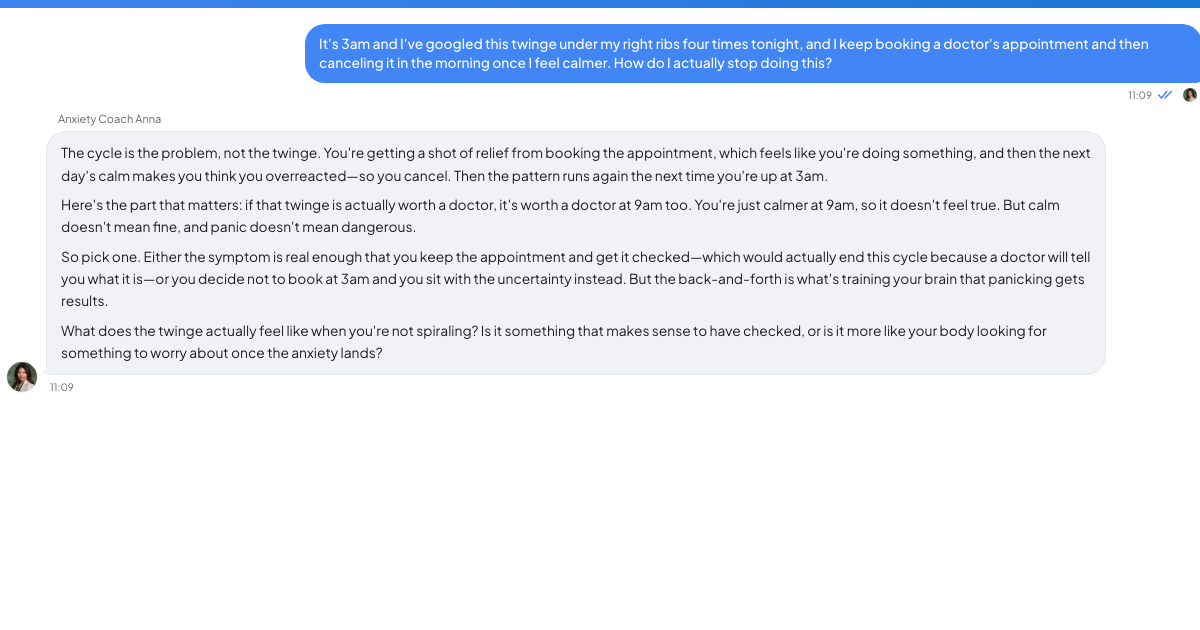
The twinge was at eleven. It's ten past three.
There is something under the ribs on the right—not painful exactly, but present.
By midnight, the standard list of causes had given you about a minute and a half of calm. By half one, a forum thread had supplied a near-identical story that ended with something carrying a five-year survival rate. Now you are changing the wording again, hoping the internet has one decisive answer left to reveal.
You decide to book an appointment. Around nine tomorrow morning, with daylight and coffee, you will be tempted to cancel because the whole episode looks ridiculous. In three weeks, a different body part may restart the same sequence. Stopping at 3am feels like abandoning a question that could kill you. Complete the booking and keep the appointment in your calendar; attend it at nine even if daylight changes how the symptom feels.
Name the loop before you fight it
Symptom searching is reassurance-seeking. It functions like a compulsion: a benign explanation produces a quick reward, the reward fades, and the next search demands more certainty. You can observe the sequence tonight: shoulders drop when you find a reassuring result; then you notice it did not cover your exact combination, or you skimmed the urgent-care warning, and the search resumes.
You need a method for the live urge, not only the instruction to stop. Deep breathing addresses a feeling, while the live problem is an urge with a reward attached. Cognitive behavioural therapy for health anxiety generally targets the checking behaviour instead of debating the feared diagnosis. Treatment focuses on the checking behaviour that sends you looking for an answer at three in the morning.
The NHS recommends recording how often you body-check, ask for reassurance, or search health information, then reducing those behaviours gradually over a week. Its health-anxiety guidance also lists CBT or other talking therapy and anxiety medication as possible help, and says NHS talking therapies can be self-referred in England: NHS health anxiety guidance.
Keep the appointment, then give the clinician the pattern
At nine, cancelling can feel like sanity returning. The 3am search bought certainty for a moment; the 9am cancellation buys distance. Neither lets a qualified person close the question. If you book at 3am, attend at nine. Because your judgment can shift between three in the morning and nine, keep the appointment and let a qualified clinician assess the symptom.
That rule does not mean avoiding care. A symptom that is new, changing, or has stuck around deserves a proper look. Health anxiety does not make you immune to illness, and people with anxiety are diagnosed with real things all the time. Arrange medical assessment for a symptom that is new, changing, or persistent, and record its duration and any changes for the clinician.
A normal result can still buy only a fortnight of relief before the loop starts again. At the appointment, describe the cycle rather than only the twinge: “I keep getting stuck searching my symptoms at night, it’s happened for months, and normal results have not settled me. I think this might be health anxiety and I’d like help with that part.” Ask which talking-therapy routes apply where you live; systems vary, and some allow self-referral without a GP.
There is useful evidence behind treating the pattern. The CHAMP randomized trial report screened 28,991 medical-clinic patients, and 5,769 scored at least 20 on the Health Anxiety Inventory. Adapted CBT averaged six sessions; improvement was maintained over five years, with overall p < 0.0001. The report also cautions that many eligible patients were not randomized and the sample may not be representative: CHAMP trial report.
Make the next ten minutes boring and specific
The urge peaks and passes, but only if you stop feeding it. Use a small action you can check off:
Delay the search. “Never google again” is a rule you may break in an hour. “Not now, not at 3am; I’ll look at six if I still want to” is workable. Set the timer. By six, the urge is often smaller and you may not bother. Count slowly to four before deciding whether to search again; reaching four without opening another tab is the success criterion.
Leave the bed. Searching has become a bed behaviour. Stand up, turn on the lights, and go to another room. The kitchen offers a kettle, a cold floor, and a window instead of a dark room devoted to your body.
Write one line. Put the date and symptom in the same notebook or note: “Right side under the ribs, comes and goes, three days.” Give that to the doctor instead of relying on a bad night’s memory. Do not write pages or rate it hourly; that becomes another checking ritual.
Take your hands off the spot. Pressing to see whether it still hurts is a search with fingers. The pressure can leave the area sore, which may then look like confirmation of the fear.
Say the fear, not the reassurance. “I’m frightened this is cancer and frightened of finding out at a bad time.” Spoken words can be heard and answered; reassurance in your head can keep looping. Put that exact fear sentence in the one-line note so you can show the clinician what the urge sounds like.
You are chasing more than information at three in the morning. You want someone’s face not to change when you say the worst version. Asking your partner can feel impossible because a worried look confirms the danger while “you’re being silly” feels like proof they did not listen, so tell them once and record the recurring pattern instead of reopening the conversation.
An AI belongs in a narrow role here. It cannot tell you what the twinge is and should not try. Calm Guide Anna is a TrueTalk persona built around anxiety management, stress and coping strategies. TrueTalk’s free tier includes ten conversations and one hundred messages per day. At 3am, use it instead of opening a new tab: say the fear in full without reading anyone’s expression, or draft what you will tell the appointment you are not going to cancel.
Health anxiety is recognised and treatable. The NHS lists talking therapy, CBT in particular, and medication among options a doctor may offer. If thoughts of harming yourself appear, do not wait for an appointment: contact emergency services or a crisis line tonight. Bring the one-line record and the recurring-search description to the appointment.