Month Five: When Everyone Has Stopped Asking How You're Doing
Support after a death often fades before grief does. At five months, use a bounded request, plan difficult dates and know which changes warrant professional care.


Six weeks without hearing their name
You noticed somewhere ordinary, perhaps while stacking the dishwasher or halfway through an autumn-budget meeting. Nobody has said their name out loud to you since June.
The funeral took place in March. For the next three weeks, calls came from people you had not spoken to since school, uneaten food arrived, and three separate colleagues told you to take all the time you needed. Afterward, contact thinned. By May, even your closest friend asked as if checking on a cold expected to clear.
The sentence you cannot say is that you feel worse now than you did in April.
The decline is not dramatic; it feels flatter and more permanent. April made noise, while August has exposed the weight of quiet.
Condolence follows the event, not your calendar
Most condolence is organised around events. There's a death, then a funeral, and both of those are things people know how to show up for. Even casseroles come with a natural end date. Cards cease when somebody reaches the bottom of the box.
Other people experienced a fortnight of death-related events. You are living with a permanently rearranged world.
Usually this is neither cruelty nor conscious neglect. From the outside, most people sincerely believe the acute phase has visibly ended. They saw you return to work. Your emails received answers again. Somebody heard you laugh in the kitchen in June and quietly classified you as coping.
At five months you are carrying grief plus the social assumption that grief has expired.
The five stages are not your timetable
Somebody has probably recited denial, anger, bargaining, depression and acceptance.
Elisabeth Kübler-Ross presented that model in her 1969 book On Death and Dying, drawing on work with people who were dying rather than research that scheduled bereaved people. The model supplied neither a schedule nor a validated timetable for bereavement. Culture nevertheless converted it into a timetable against which grieving people measure themselves and feel they fail.
Which is how you end up at month five with a second, worse feeling on top of the first one: that you're behind. That other people did this properly and got to acceptance by now, and you're still sitting in the car outside the house because you don't want to go in.
There is no orderly schedule; grief behaves more like weather than a decaying curve. Better weeks and then a Thursday that takes the legs out from under you for no reason you can identify, except that the reason is usually a smell, or a song, or a form arriving in the post addressed to them.
The American Psychiatric Association says DSM-5-TR, released in March 2022, requires an adult's loss to have occurred at least twelve months earlier before prolonged grief disorder can be diagnosed; for children and adolescents it is six months. Diagnosis also requires at least three specified symptoms nearly every day for the preceding month (American Psychiatric Association). Five months is not a clinical deadline for being "sorted."
Paperwork can postpone the quiet
Early months arrive with administrative jobs. The certificate. The bank. The pension people who need the same document four times. You are also the person who must cancel the phone contract.
Administration is a poor substitute for feeling and an extremely effective distraction from it. When it runs out, there's nothing between you and the size of it.
Feeling worse after the paperwork ends does not by itself mean you are deteriorating; the barrier between you and the loss has disappeared.
Make one bounded request
"Let me know if you need anything" often produces nothing because it leaves every decision with you. It hands you the work of identifying a need, assessing whether it's a fair ask, choosing a person, and phrasing it. Nobody at month five has that in them.
Replace the open offer with one closed request.
Identify the particular hour that feels worst. Suppose it is Sunday from four until six, when the light fades and the house sounds wrong. Text one person — not the group, one person:
Would you ring me Sunday at five for twenty minutes? You don't have to talk about Dad. I just don't want the house quiet then.
The request is small and bounded, with an end time and permission to avoid the hardest subject. That permission carries more weight than it appears to. Some of why people go quiet is that they think the entry price is a conversation about death and they're frightened of getting it wrong. Tell them the price is twenty minutes of talking about anything.
Make the same request again the next week. You may fear you have exhausted an allowance. Frequently the reverse occurred: people stopped offering after assuming you would decline.
A 2020 Oxford-led study tested social disconnection in 676 bereaved people and followed a separate sample of 275 people recruited within six months of loss. Baseline social disconnection was associated with greater distress, and the degree to which disconnection declined predicted improvement (Smith, Wild and Ehlers, Clinical Psychological Science). That does not mean one phone call treats grief, but it gives the bounded Sunday request a concrete purpose.
Give colleagues one of two answers
A colleague forgetfully mentions your mum's garden, then their expression changes. Suddenly they expect you to manage their discomfort.
You decide how much emotional work to do, including none. Two prepared lines handle most cases.
If you want the subject to continue: She died in March. It's alright, you can ask.
If you don't: She died in March. I'd rather not get into it here, but thank you. Then change the subject yourself, because they won't dare.
Both are short on purpose. You don't owe anyone the story, and you certainly don't owe them reassurance that they haven't upset you.
Decide the first birthday in advance
Whatever its date, the first birthday is coming; decide beforehand how you want to meet it.
Decide in advance what happens. Anything counts — the grave, the pub they liked, a day off work doing nothing, cooking the thing they always over-salted. Tell one person the plan so it exists outside your head. Book the day off if you can; a lot of people find the dread of the day heavier than the day itself, and being at your desk pretending doesn't help either half of that.
If you want to spend it alone, spend it alone. If someone insists on being there and you don't want them, you're allowed to say so, on that day of all days.
Signs that need professional care
Some experiences require professional care rather than an article.
Book an appointment with your GP if you're not sleeping over weeks rather than nights, if you've stopped eating properly, if you're drinking more to get through evenings, if you can't hold your work together over a sustained stretch, or if there's no relief at all — no hour anywhere that's even slightly lighter. Bereavement counselling is a real, specific thing and it's not reserved for people in crisis; in the UK, Cruse Bereavement Support is one route in and your GP can point you at others.
And if you're having thoughts of ending your life, that is urgent care, today — your GP, a crisis line, or A&E. Not a website, and not a chat window.
A place to repeat yourself at eleven
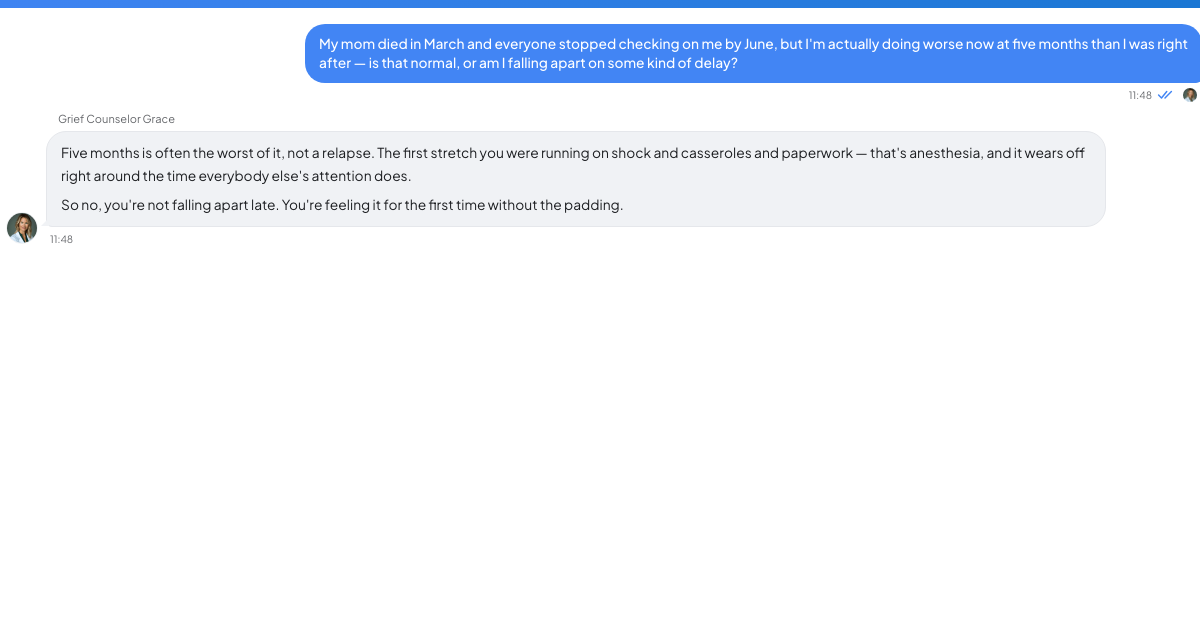
At month five, grief can begin to feel unspeakable around people who love you. You can feel yourself becoming a subject they brace for. So you say you're fine, and then you're alone with it.
TrueTalk has an advisor called Grace Through Grief — an AI persona whose catalogue description is a loss and bereavement educator. Not a human counsellor and not a therapist, which is worth being clear about: it can't assess you, and if anything in the section above applies, the GP comes first. What it can do is be available at eleven at night, not get tired of the subject, and let you say the same thing for the fifth time without you having to manage anyone's face while you say it. The free tier includes ten conversations and one hundred messages per day.
Make the Sunday request
Because grief changes shape without obeying a finish date, choose the difficult hour, text one person, and ask for twenty minutes on Sunday. Early support ending reflects how condolence is organised, not how much the person mattered or how well you are grieving.