You Get Everything Done and Still Feel Nothing
Still hitting deadlines and feeling nothing for months? Functioning is not the threshold for treatment, and “nothing happened” is not a disqualifier.


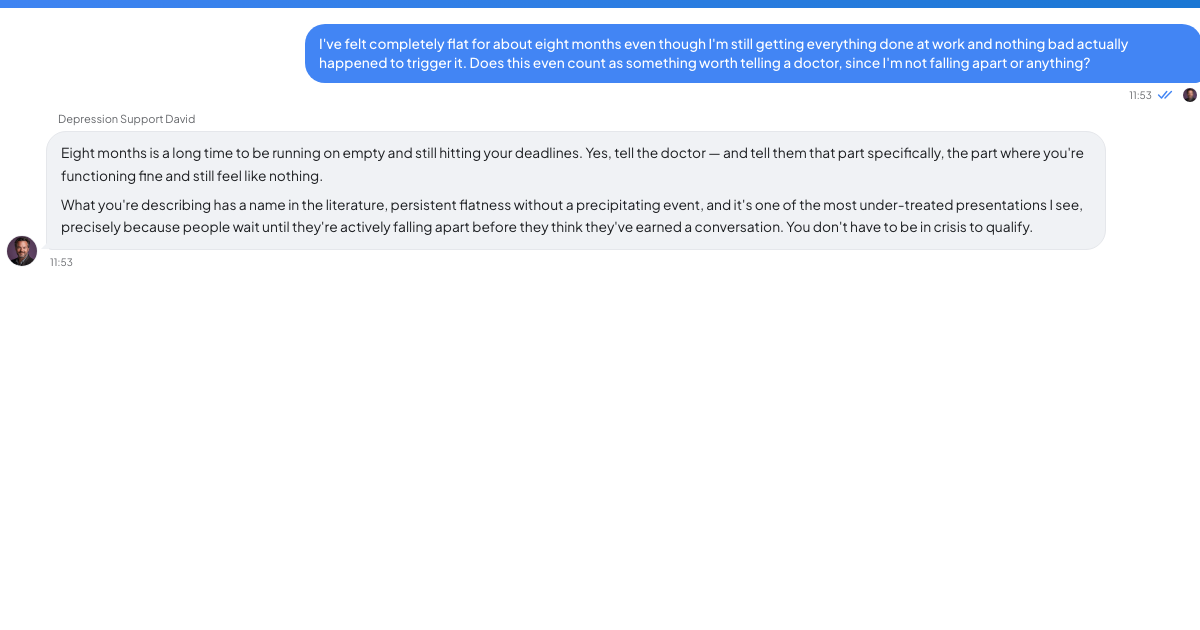
The problem with having nothing to report
Your inbox is empty. You went to the gym on Tuesday and again on Saturday. The thing that was due Thursday went out Wednesday night, and someone replied with three exclamation marks.
And you felt nothing. Not sad about it. Nothing.
It has been about eight months. You know roughly when it started because you can remember the last time something landed properly — a song, a joke, the first cold morning of the year — and it was a while ago now.
You haven't told anybody. Partly because there is nothing to tell. Nobody died. You were not dumped, you were not fired, the tests came back clear. Depression, as far as you understand it, is something that happens to people, for reasons, and it looks like not being able to get out of bed. You get out of bed at 6:40 every day. So whatever this is, it is not that, and raising it would be taking up a chair that somebody with a real problem should be sitting in.
That reasoning is wrong, and it is worth being exact about where.
Before anything else, the part that does not wait
If it has gone further than flatness — thoughts of not wanting to be here, of not waking up, of hurting yourself — that goes ahead of everything else on this page, and it is not something to sit on until an appointment comes through.
In the UK, Samaritans are on 116 123, free, any hour, and they will talk to you when nothing has happened and you do not know what to say. In England, NHS 111 will route you to urgent mental health support. In the US it is 988. If you are in immediate danger, that's A&E or 999 or your local emergency number, and that is a correct use of it, not an overreaction.
Everything below is for the quieter version.
Functioning is not the threshold
Nobody says this part out loud. There is no test you fail. No point at which the system notices and comes to get you. Every route into help — a GP, a therapist, a helpline — starts with you saying a sentence. If you never say it, nothing happens, and you can go on delivering competently for years while the inside stays grey.
That's not a moral failing on your part. It is a design feature of how mental health care works, and it filters out exactly the people who are still coping.
It also is not what the diagnostic criteria say. The core assessment for a depressive episode includes low mood or loss of interest and pleasure in things you once enjoyed, most of the day and nearly every day for at least two weeks. The NHS Talking Therapies clinical manual tells assessors to check the episode's duration and its personal, social, and occupational effects. Separately, it uses a PHQ-9 score of 10 or more as the threshold for likely depression caseness. There is a separate category for low-level mood that has run on for two years or more in adults. There is a criterion about distress or impairment, and it is satisfied by distress alone. Nothing in it says you have to have stopped functioning. Severity and impairment get noted, and yes, someone still working will usually sit at the milder end. Milder is not the same as untreated.
I am not diagnosing you. A doctor does that, with the whole picture. But the belief that you have to be visibly collapsing to qualify — that one you can drop today, because it is not in the criteria and never was.
The word you are looking for is probably anhedonia
You went looking for yourself in descriptions of crying, of heaviness, of the morning being impossible. You were not in any of them, so you decided you didn't belong there.
The version you are describing has a name. Anhedonia — the flattening of pleasure and interest. Things still happen. You still do them. They just do not register. Food is fuel, music is sound, the holiday was fine, and the gap between "this should feel good" and "this feels like nothing" is the whole experience.
Two things carry more weight here than tears: how long it has lasted, and whether anything gets through. Eight months is not a bad week. Eight months is a pattern, and a pattern is the thing worth reporting.
"Nothing happened" is not a disqualifier
You have been holding a rule that says distress requires a cause proportional to it. No cause, no permission.
Depression does not require a precipitating event. Plenty of episodes follow a loss or a shock; plenty do not. Someone whose life looks, from outside and from inside, entirely reasonable can still be depressed. The absence of a story is not evidence against you. It is just an absence of a story, and it makes it harder to explain — which is a communication problem, not a diagnostic one.
Why "try exercise and get outside" lands as an insult
Because you already do it. Twice a week, and the walk to the station, and you would have said yes to going outside more if it were offered.
The lifestyle checklist is not nonsense. There is decent evidence that exercise helps with depression, and no serious clinician would tell you to stop. But it is offered as a first line for someone who is not doing any of it, and when you are already doing all of it, the checklist has nothing left to hand you. So its failure reads as a verdict on you rather than as information.
Read it as information. You have run the low-intensity interventions for eight months. They have not shifted it. That's a result, and results are the reason to escalate rather than a reason to stay quiet.
Saying it out loud, on purpose, in a prepared sentence
The hardest part is not the appointment. It is the first fifteen seconds, where you have to name it before the conversation drifts.
So write the sentence beforehand and use it verbatim. For a GP:
"I have felt flat and switched off for about eight months. I am still working and I am still functioning, but I do not enjoy anything any more. I would like to talk about depression."
It gives them duration, which is what they're listening for. And it says the word out loud, so the appointment cannot quietly become about your sleep.
The gap between deciding to say it and having someone to say it to is usually weeks. The GP is a week on Thursday. Your partner is asleep. If you want to say it once before you say it to a person, TrueTalk's Resilience David is an AI persona whose catalogue description is a mental-wellness educator who helps people find hope and build paths to mental wellness, and it is somewhere to say it first. It is not a therapist, not a doctor, and not treatment — persistent low mood needs a real clinician, and that has to be said plainly.
Practical notes. Ask for a longer appointment if your practice offers one; some do, if you say it is about your mental health. Say the sentence in the first thirty seconds, before you have talked yourself into minimising it, because you will minimise it. Expect a questionnaire — the PHQ-9 is used routinely in UK primary care, and answering it honestly rather than modestly is the whole point of being there. In England, NHS guidance on talking therapies says you can self-refer without speaking to a GP, provided you are registered with a GP and are at least 18, or 16 in some areas. You do not need an existing diagnosis to use the service.
For a partner, a different sentence, because you are not asking them to fix it:
"There is something I haven't told you. I have felt flat since around the start of the year — not sad, just nothing. Nothing's happened and it is not about you. I am going to see the GP, and I wanted you to know before I did."
Say it sitting side by side rather than face on. Driving, washing up, walking. It is easier without eye contact, and there is no rule that says important conversations have to be held across a table.
The permission is not coming
You have been waiting for something to make this legitimate. A bad enough week, a proper reason, a day you cannot get up, some event that would let you point at it and say that, that's why.
It probably is not coming. That's the nature of this particular version — it is stable, it is survivable, and it can run for years without ever producing the crisis that would have made it easy to explain.
Use the eight-month duration in your prepared sentence and make the GP or self-referral contact today.