Every Time I Ask If We're Okay, He Goes Further Away
“Are we okay?” can demand a verdict with no workable answer. Name the loop and use a request with a defined end.


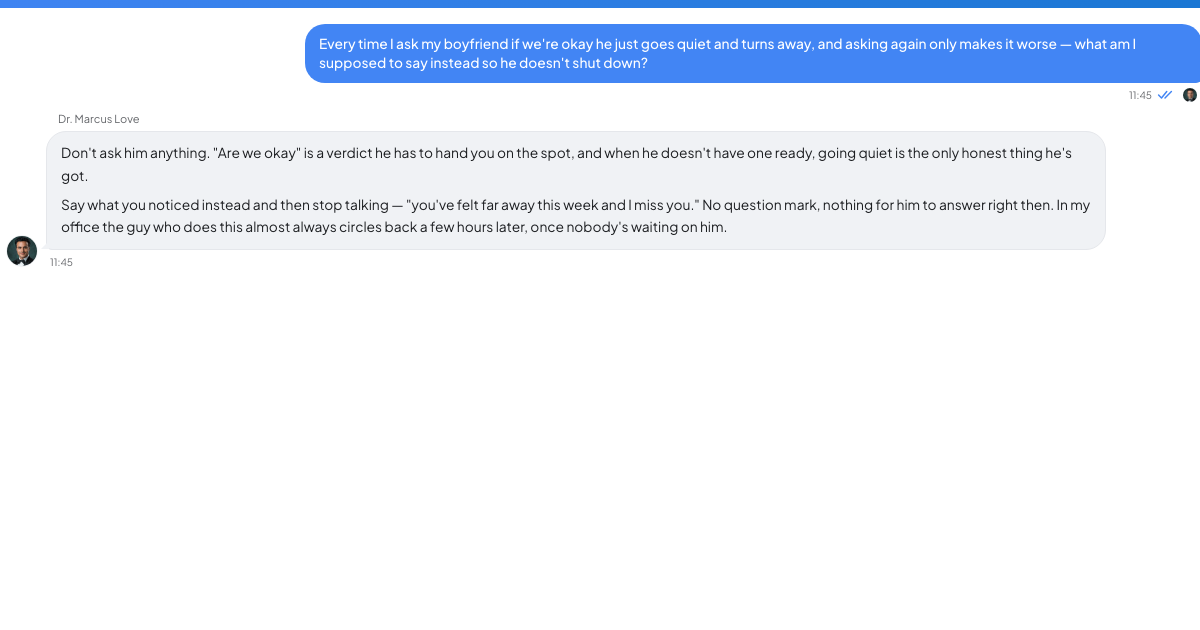
Four words at the end of the night
“Are we okay?” sounds small. It requests a verdict on the whole relationship, immediately and convincingly, from someone who may be at the end of what he has. Say you asked twice. The first yes had no weight, so you asked whether he was sure; the second arrived in the voice that means stop. He may learn that yes does not close the question. In this pattern, he goes still to end the discomfort, not to punish you.
No could detonate the night, while silence reads as the worst answer. On a bad night he may experience no workable answer and go still to end discomfort, although silence is not proof of motive. What looks like indifference is often an intense, pinned internal state: heart racing, words unavailable, an urgent physical need for the conversation to stop. He may hear a test already failed, whose proof has no finish line.
Your reassurance need is real and not a character flaw. The request's form is what you can change.
Labels describe and distribute blame
Anxious and avoidant can hand out blame while pretending only to describe: needy, emotionally unavailable, insults with references. The Experiences in Close Relationships-Revised questionnaire measures attachment-related anxiety and avoidance rather than delivering a clinical verdict; an eight-item version was evaluated in a representative German sample of 2,428 people (Ehrenthal et al., 2021). The familiar four-box attachment taxonomy oversells its precision. The questionnaire's continuous dimensions can vary between relationships and over a life. “Anxious here” may describe something you currently produce together, not a permanent personality. Labels still do not write tonight's sentence.
Researchers call one loop demand-withdraw: one partner presses for connection, change, or resolution while the other limits discussion or closeness. Diary reports from 116 U.S. couples found both wife-demand/husband-withdraw and husband-demand/wife-withdraw at home, especially around relationship topics (Papp, Kouros, and Cummings, 2009). This does not diagnose you.
Each move in the loop is a fairly reasonable response to the move before it. He went quiet, so you asked again, making him quieter, so you asked louder. Or you asked, so he went quiet, so you asked again. Where you start determines who looks unreasonable; the loop has no non-arbitrary starting point. Stop trying to establish who started it. Both cases can persuade without changing eleven o'clock.
Give the ask a door
The gap between the first answer landing badly and the second question leaving your mouth may be four seconds. Put a sentence drafted earlier into it. Ask for a task with a defined end:
- “Can you put your hand on my back for a bit? I do not need to talk.”
- “I have got the thing where my head tells me you are annoyed. I do not actually think you are. Can you say one sentence?”
- “Ten minutes of your attention and then I will let it go tonight.”
- “I want to ask whether we are okay, and I am not going to. Can you stay in here?”
Each names your internal state rather than charging him with distance and offers something completable in ninety seconds or ten minutes. Do not audit the response. If he complies and hears “you do not even mean it,” he may learn that compliance still fails, making next time harder. That is a risk, not proof that you caused every withdrawal.
Agree in daylight on genuine shutdown: “I cannot do this tonight. I am not going anywhere. Can we do it in the morning?” It beats a wall only if morning happens; postponement that never lands poisons the next one.
Marcus Love is TrueTalk's AI relationship advisor. Bring the exact words from last night and ask for three alternatives; drafting at four is easier than improvising at eleven. The free tier includes ten conversations and one hundred messages per day. He helps with wording; rewiring belongs with qualified human support.
Where wording stops
A sentence may improve individual nights but cannot rewire a stress loop. Durable change usually involves couples therapy. Emotionally focused therapy, developed by Sue Johnson and Les Greenberg, is one of several approaches to cycles like this; ask prospective therapists how they work.
If reassurance-seeking spreads beyond the relationship — checking his location, losing a working day to a short reply, or being unable to concentrate until he answers — individual therapy will probably help more than another relationship technique. A clinician can identify what drives it; these examples do not diagnose you.
This is a two-person job. An article can offer sentences to propose, but cannot teach him one or make him use it. If every attempt to agree one is dismissed as making the relationship a project, this is no longer a communication problem. That finding requires a different conversation from attachment styles.