Your Mother-in-Law Wants to Be in the Delivery Room and You Don't Want Her There
You decide who is in the room when you give birth. Settle it with your partner first, then have him tell his mother a short, kind no.


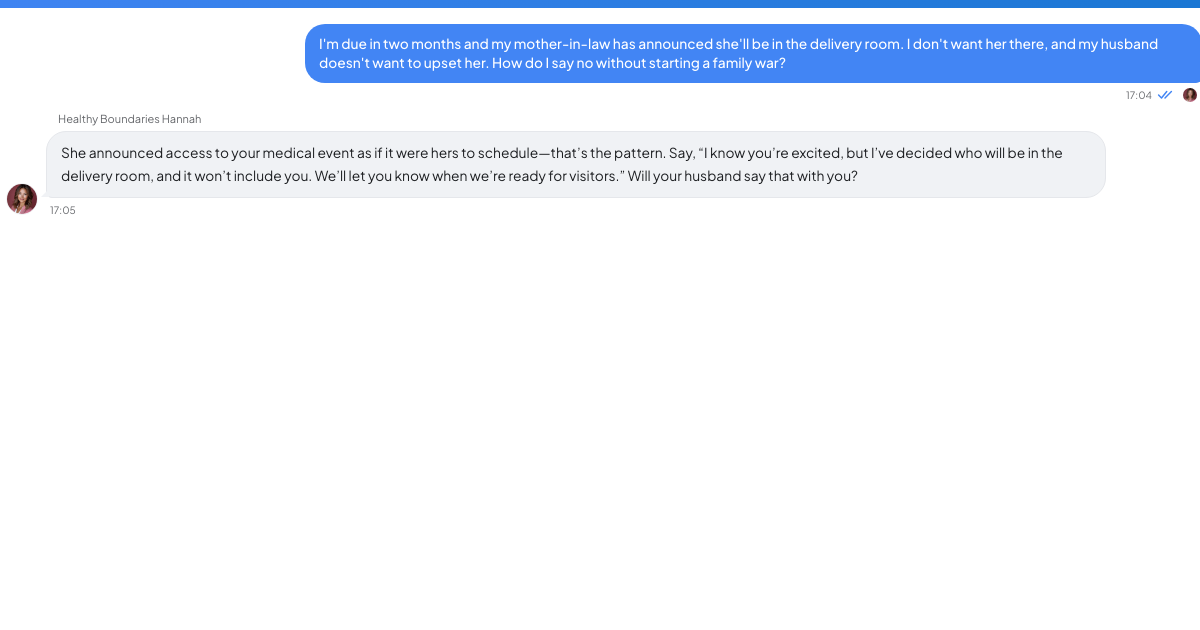
Can my mother-in-law be in the delivery room if I don't want her there?
No. The person giving birth decides who attends, and nobody has a right to be in the room because of their relationship to the baby. The practical route is to agree your list with your partner first, then have him (not you) tell his mother, kindly and early, so she hears a decision rather than a negotiation.
That is the short version. The longer one matters because this conversation is rarely only about the delivery room. It is usually about being seen as the person who is having the baby, and about a partner who is stuck between two women he loves.
Who actually gets to choose who is in the room?
The birthing parent. The UK charity NCT describes a birth partner as a partner or co-parent, a friend, a family member or a professional doula, advises asking what kind of supporter the birthing person wants, and says that no one should feel pressured to take the role. It also points out that not everyone is well suited to it, which is a useful sentence to have in your pocket: wanting to be there and being the right person to be there are different things.
There are practical limits too. NHS Lothian, for example, says you can have up to two birth partners during labour on its labour ward, and only one if you are admitted to the antenatal ward for an induction. Limits vary by hospital and can change, so ask your midwife or the unit what applies to you. If your hospital allows two people and one of them is your partner, you may genuinely have one seat, and that is a fact you can hand to everyone else without it being a judgment of anybody.
Why does she want to be there?
It helps to guess, because the reason changes what you say. The common ones:
- She remembers her own labour and wants to be the person who was there, the way someone was (or wasn't) for her.
- Her son is about to become a father and she wants to witness it.
- She is anxious about the baby and being in the room feels safer than waiting for a text.
- She has been told, by her own family or culture, that this is what a grandmother does.
- She feels the baby is partly hers and is checking where she stands.
None of these makes her a villain, and none of them obliges you. You can be gracious about the motive and still decline the request. If you can name what she is really after (being first to meet the baby, being included, being reassured), you can offer that instead of a seat in the room. A promise like “you will be the first person we call, and you can come to the hospital as soon as we are ready for visitors” answers most of those needs at once.
What if my partner says “just let her come”?
That is the real conversation, and it goes better with a specific question than with a verdict. Try something like:
“I want the room to be just us during labour. I will be more relaxed, and I need that to be true. Can you tell me what worries you about telling your mum?”
Listen to the answer. Often he is not on her side. He is dreading her reaction and has been absorbing it since he was a child. If that is the case, the problem to solve is how to make telling her feel survivable for him, and you can help by drafting the sentence together. If he disagrees with you on the substance, that is worth knowing now, and you can ask him to picture the room at the hardest moment of labour and say honestly who he wants beside you. A couples session or a talk with your midwife about birth preferences can help if you cannot get past it alone.
If this feels familiar, the garage-code post covers the same pattern: the in-law is rarely the one who needs the boundary explained; the partner who relays it is.
What do I say to her?
Keep it short, warm, and about your needs rather than her flaws. It is best coming from your partner, with you agreeing to it in advance. Example wording:
“Mum, we have decided that it will just be the two of us in the room when the baby comes. It is about what helps [name] feel calm, and nothing you did. We want you to be one of the first people to meet the baby, and we will call you as soon as we can.”
A few rules for the script:
- Say it once, clearly. Hedges like “we are still deciding” or “we will see” are heard as yes.
- Do not give her a reason she can fix. “We think it will be crowded” invites “I will stay out of the way.” “We want it to be just us” is complete.
- Offer something real. A specific plan (a visit on day two, a meal dropped off, a role in the first week) turns a refusal into a swap.
- Decide your fallback before she pushes. If she says “but I'm family,” have one line ready: “You are, and that is why we wanted to tell you now.”
What if she shows up anyway or keeps pushing?
Plan for it. Tell the midwife or the labour ward in advance who may be admitted, and ask how the staff will handle a visitor you have not approved. Give your partner a single job on the day: he is the gatekeeper, and he can tell staff, “Only the two of us for now.” Hospital staff deal with this regularly and can usually say no on your behalf.
If she keeps raising it in the weeks before, you do not have to re-argue. A flat, friendly repeat is enough: “We have made our decision and we are not changing it. I am looking forward to you meeting the baby.” Each time the answer stays the same, the topic gets less rewarding to bring up.
If the pushing is part of a wider pattern, such as comments on your parenting, arriving unannounced, or ignoring requests, it helps to treat the delivery room as the first firm line rather than the last. The dishes-argument post is about a different topic, but its advice on stopping a repeated loop applies when you find yourselves discussing the same boundary every week.
What about my own mother, or a doula?
The same principle applies in reverse. If you want your own mother in the room, her presence is not automatically fair play for his. It is still worth saying the reasoning aloud: you want the person who makes you feel safe, and your partner's mother can have her place elsewhere in the plan. Being able to explain it the same way about both mothers makes it easier to hear. A doula is another option if you want a support person who is not family, and NCT lists them among the people who can fill the role.
When to get more help
If your partner will not back you up even after a calm, specific conversation, or if your mother-in-law responds with threats, guilt campaigns that continue for weeks, or going around you to the hospital, it is no longer just a scheduling disagreement. A couples counselor can help you and your partner agree who speaks for the household. Your midwife can also note your preferences in your birth plan, which gives you a document to point to when it matters.
Healthy Boundaries Hannah, one of TrueTalk's AI advisors, can help you draft the exact wording for your partner and the call to his mother, and rehearse the replies you expect. For anything involving your safety or health during labour, rely on your midwife or doctor.
The room can be exactly as full as you need it to be, and everyone else gets to meet the baby soon after.