My Husband Blames Me for His Unhappiness
When a husband treats his unhappiness as your fault, you cannot fix it by trying harder. Here is how to separate his feelings from your responsibility.


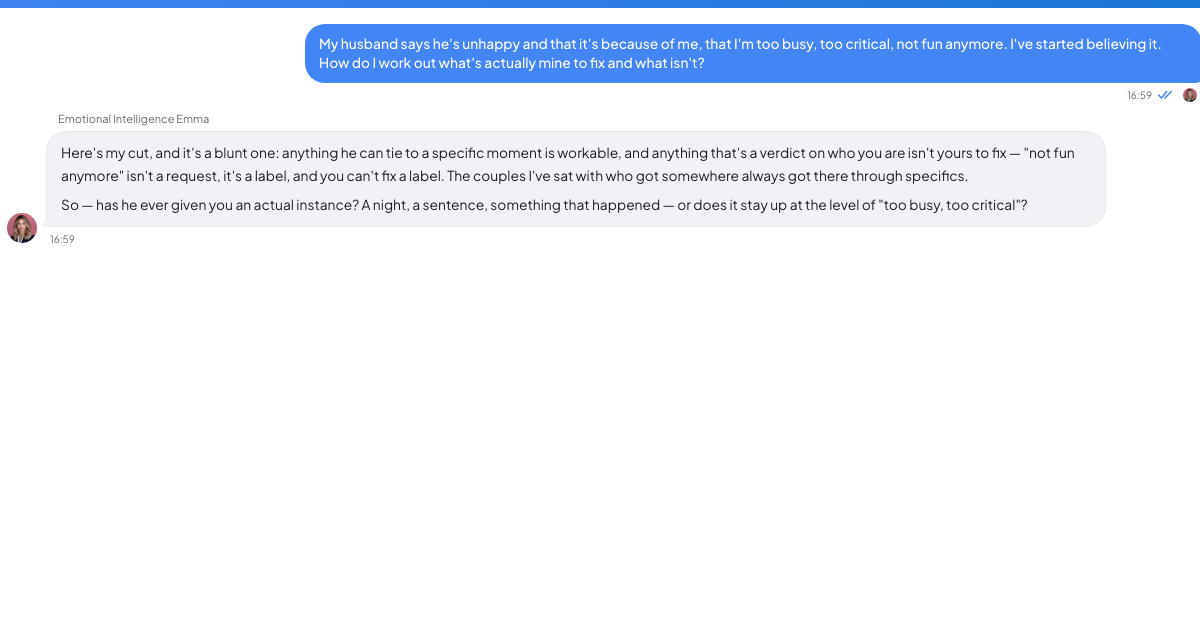
What do I do when my husband blames me for his unhappiness?
Stop trying to be the cause and the cure. His unhappiness is real and worth taking seriously, but you are not the sole source of it and cannot repair it by changing yourself indefinitely. Separate what you can fairly be asked to change from what belongs to him, say so in plain words, and suggest a way for him to work on the rest, such as counseling.
This is hard to do when you are tired and have already tried everything. The steps below are designed to work in the middle of an ordinary bad week.
Is he being unfair, or is there something in it?
Start with the harder question, because the answer decides the rest. Sometimes “you make me unhappy” contains a real complaint that has been said badly. Sometimes it is a way to move his own unhappiness onto the nearest person. Often it is both.
A useful test is to ask whether the complaint is specific. The Gottman Institute draws a distinction between a complaint, which is about one particular thing, and criticism, which attacks the person. Its writing on the four horsemen gives the example of feeling scared when a partner runs late without calling, set against calling that partner selfish. Apply that to what you hear:
- “I'm lonely because we haven't had an evening together in a month” is a complaint. You can act on it.
- “You've ruined my life” or “I'd be happy if it weren't for you” is global. There is nothing in it you can do on Tuesday.
If it is the first kind, there may be a fair request in there and you can take it up. If it is the second kind, you are being handed a job nobody could complete.
Why does he blame me?
There are several possible reasons, and you do not need to work out which one is true to respond well:
- He has no words for what is wrong. Plenty of people can say “I'm unhappy” and cannot say whether it is work, health, money, grief, or the marriage. The nearest person gets the label.
- Depression or burnout. Persistent low mood, irritability, loss of interest and exhaustion often show up as blame. This does not excuse how he treats you, but it changes the next step from arguing to getting him assessed.
- A life he did not choose. A job, a city, a role in the family that he settled into and resents.
- It works. If every time he blames you, you apologize, change plans, and soften, the pattern pays off. People repeat what is rewarded.
- Control. In some marriages blame is a way to keep a partner anxious and compliant. That is a different situation from the others; see the last section.
What can I say in the moment?
When he says it, the aim is to stay kind, stay out of the defense, and stay out of the job. Three lines that work for a lot of couples:
- Acknowledge the feeling, not the verdict. “I can hear that you're really unhappy, and I don't like that for you.”
- Decline the job. “I want to help, but I can't be the reason you're happy or unhappy. I can hear what you need from me, and I can't fix the rest.”
- Ask for something specific. “Is there one thing you need from me this week?”
Then stop talking. The temptation is to explain, defend and list the things you did. The Gottman Institute describes defensiveness as typically a response to criticism, involving excuses or counter-blame, and says it tends to escalate conflict; its suggested alternative is accepting responsibility for your part and acknowledging your partner's perspective. That does not mean accepting blame for everything. It means answering the part that is true and leaving the rest.
If he escalates, it is fine to pause. The same Gottman page recommends taking a break of about 20 minutes to calm down when one of you is overwhelmed, and then coming back. Say that is what you are doing: “I want to keep talking about this. I'm going to take twenty minutes and come back.” Then come back.
How do I raise it when we are both calm?
Pick a time that is not at bedtime or just after an argument. Try:
“I've noticed that when you're unhappy, a lot of it gets pointed at me. I want to hear what's wrong, and I'm willing to change things that are mine. I'm not able to be responsible for all of your mood. What would help is working out together what belongs to us and what belongs to you, with someone neutral if we need to.”
Bring examples from the last few weeks, and name your part. If you have genuinely been distant, say it. Fairness from you is what makes the line you are drawing credible.
What if nothing I do is ever enough?
That sentence is worth stopping on. If you have changed the thing he complained about and a new complaint appears the next day, the issue is probably not the thing. The posts on the dishes argument that repeats for years and on a helpful husband who never just listens both describe a loop where the topic changes and the pattern does not. Naming the pattern out loud, kindly, is often the first useful move.
Suggest couples counseling, and if he refuses, go on your own. A therapist can help you hold your line and tell the difference between fair feedback and endless blame. If you suspect depression, ask him to see his doctor and offer to book the appointment.
When is this something more serious?
Blame becomes dangerous when it comes with other things: monitoring where you go, controlling money, isolating you from friends or family, threats, intimidation, or any physical harm. At that point it is not a communication problem and counseling for the couple is usually not the first step. The post on apologizing constantly when he never hits you explains how coercive control can exist without violence.
If you are afraid of how he will react, or feel you are always walking on eggshells, you can call the US National Domestic Violence Hotline at 1-800-799-7233, text START to 88788, or chat at thehotline.org. It is free, confidential and available around the clock, and the advocates can talk through your situation without any expectation that you will leave. You do not have to be sure it is abuse to call.
Whose job is his happiness?
Yours is to be honest, kind and fair to him. His is to look after his own mood: to say what he needs, to get help when it is more than a bad patch, and to treat you decently while he works on it. A marriage can carry one person's low period, but it cannot be asked to carry it forever as a debt that only one of you pays.
Emotional Intelligence Emma, one of TrueTalk's AI advisors, can help you put your own wording together for these conversations and practice the harder replies in advance. For depression, safety or anything that feels unsafe, speak to a doctor, a therapist or the hotline above.