He's Never Hit Me. So Why Am I Always the One Apologising?
No bruises and no obvious red flags, yet you keep apologising to restore warmth. Count frequency, repair costs and self-editing, then choose support safely.


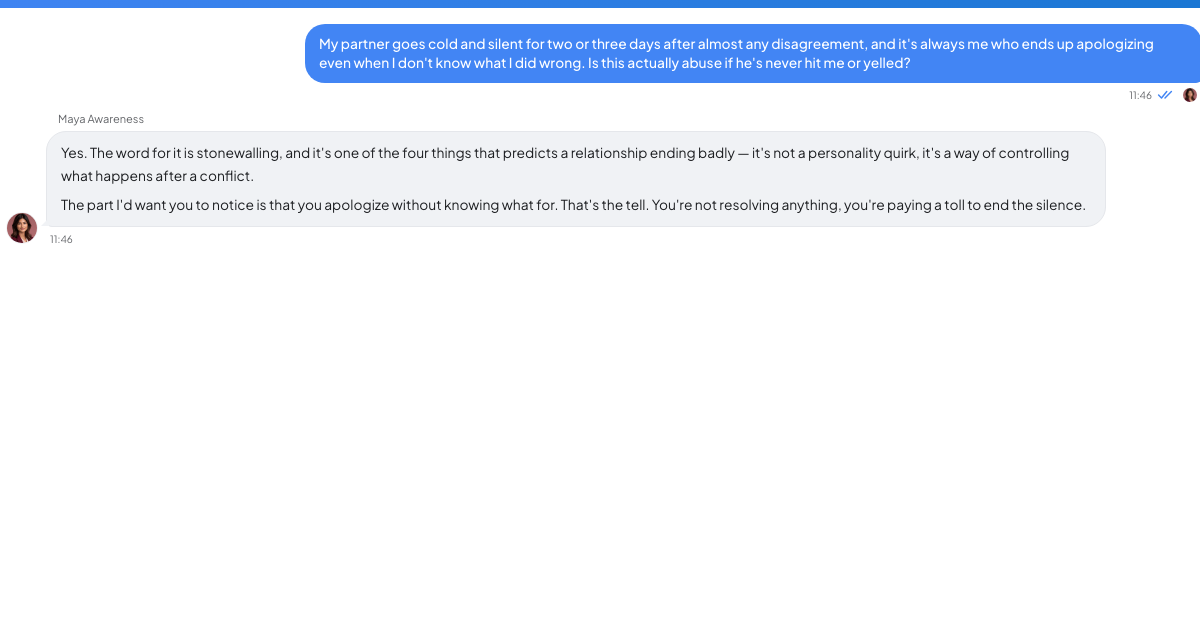
The threshold is not a bruise
Repeated non-violent behaviour that restricts someone's freedom has a name and, in some places, a legal definition. England and Wales made controlling or coercive behaviour in an intimate or family relationship an offence under section 76 of the Serious Crime Act 2015. Scotland went further with the Domestic Abuse (Scotland) Act 2018. The law where you live may be entirely different, and I cannot give you local legal advice.
That context comes first because people recognise the word for about four seconds, then disqualify themselves because nobody has hit them. Some legal systems put the threshold elsewhere. The current text of section 76 requires repeated or continuous controlling or coercive behaviour, a personal connection, a serious effect, and knowledge or constructive knowledge of that effect. It defines serious effect as fear of violence on at least two occasions, or serious alarm or distress that substantially affects usual day-to-day activities (UK legislation, section 76).
Those elements do not decide your case or supply a plan. They give you permission to examine the pattern before excluding yourself.
Why a clean quiz proves so little
You have probably completed red-flag lists at one in the morning, more than once. Yours came back clean; the relief lasted roughly two days.
The lists favour the most legible cases: monitoring, threats, confiscated money, and friends peeled away one by one. Those items are easy to score because nobody can dispute what they describe. A list can show whether your relationship resembles the clearest extreme cases while missing whether your relationship is harming you. A clean answer to the first question is easily mistaken for an answer to the second, and that mistake can keep somebody in place for another two years.
Instead of ranking severity, count observable effects. You do not have to prove what he meant.
Count frequency, repair and self-editing
Begin with frequency, but do not use the quiz's yes-or-no question, 'has he given me the silent treatment?' Record how many times it happened in the last six months and how long each episode lasted. Put a rough count on paper and include dates where you can. Two or three days each month may sound survivable until the page shows thirty-odd managed days across a year.
At that volume, separate incidents form the emotional climate. Your nervous system can reorganise around it just as you eventually stop noticing the motorway beside your home.
Next, examine repair and its price. Every couple ruptures; pay attention to who always begins the repair and what they must concede. If warmth returns only after you accept an account you do not believe, you are exchanging your version of events for reconnection.
After forty repetitions, you start pre-editing. Before speaking, you ask whether the sentence is worth three cold days, then produce a shorter, flatter, safer version. You omit that your sister rang and report only that dinner was fine. Treat that editing as the clearest finding. His silence invites endless arguments about intention; your editing is directly observable because you are doing it.
One question often remains unanswered: what happens when you do not apologise? If nobody has allowed the silence to run, you may not know whether it lasts four days or three weeks without your intervention. That missing information matters, though fear makes deliberately testing it unsafe for some people.
Tell one safe listener
Many people in this position have never spoken the sentence. A friend brings opinions, shared history and perhaps a sister who will hear about it; saying it to him may feel impossible. Left inside your head, the thought is easy to dismiss at four in the morning.
Maya Awareness is an AI advisor on TrueTalk. You can use it to describe your actual last three arguments aloud to something with no stake in the answer and no chance of meeting him at a wedding. The free tier includes ten conversations and one hundred messages per day. It is neither a helpline nor a therapist; if fear is present, use the services below instead of an app.
Intention remains unknowable from inside
None of these observations establishes his intention. Some people learned that conflict means being shouted at and have no response beyond leaving the room. They may be underwater and unaware that you experience their withdrawal as punishment. Others discovered that three cold days produce the outcome they want and repeated the method because it worked.
Inside the house, those explanations look identical. Another year spent studying him may not separate them, but it will still consume a year. You do have direct access to the effect on you, and you may name it without proving motive first.
Change is a separate question that you cannot settle alone in the kitchen. It generally requires him, a third person in the room, and willingness from him that you have not yet seen.
If you are calculating danger
Fear changes the priority, so the counting exercise becomes secondary. Contact a domestic-abuse advocate or licensed therapist sooner rather than eventually if you fear his reaction to being named, calculate consequences before speaking, or the pattern has touched physical safety, money or the children.
In the US, the National Domestic Violence Hotline is 1-800-799-7233 or thehotline.org, 24 hours a day. In the UK, Refuge runs the National Domestic Abuse Helpline at 0808 2000 247, also 24 hours. Find your country's national line before you need it. These services ask what you want and help you plan around it instead of opening with an order to leave; the help is free.
Leaving is an outcome with a long plan attached, not a single step. The US Hotline defines a safety plan as personalised and practical, designed for safety while abuse is happening, while preparing to leave, and after leaving. It also warns that internet use can be monitored and cannot be erased completely (National Domestic Violence Hotline). Use a safer device if browsing could be watched.
If you genuinely are not in danger, begin with the paper count and tell one person once.
A Wednesday test
Perhaps Sunday involved his mother, the holiday dates, or nothing you can identify. On Monday he was polite; Tuesday brought single words and bed at nine.
By Wednesday the flat has its familiar temperature, and you have drafted an apology since four o'clock without knowing what offence to name. Experience says you will find one, and it will work because it has never failed before.
Before sending it, record the date, the length of the cold period, what you are about to concede and whether you believe it. Then choose a safe listener and say the pattern aloud.