How to Break Up With Someone You Live With
Decide the logistics first, tell them calmly and in private, then agree a move-out date and house rules. Here is the order that keeps it from becoming a siege.


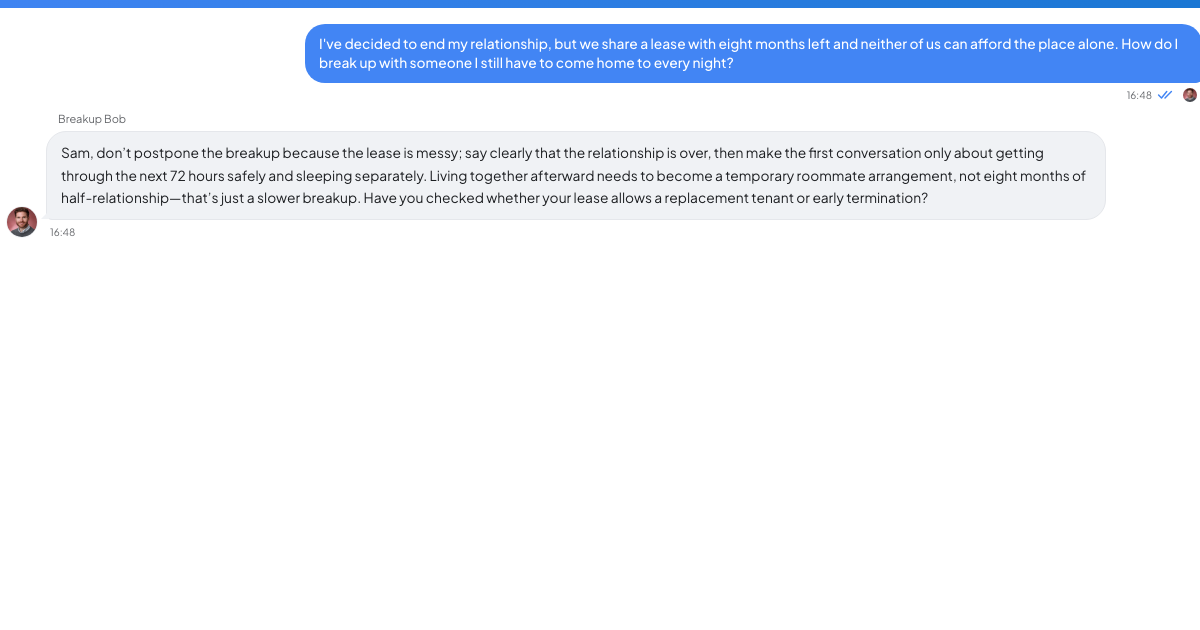
How do you break up with someone you live with?
Sort the practical side before you say anything: who has the lease, where each of you could go, and what a fair timeline looks like. Then tell them calmly, in private, once, with a clear decision rather than a question. Agree a move-out date and a few house rules for the time in between, and keep your replies short.
A breakup while sharing a home is a different problem from an ordinary one. There is no distance afterwards, no door to close, and every decision about money and objects arrives within hours. Planning the order of events is what separates a hard few weeks from a months-long standoff.
What should I sort out before I tell them?
Quietly, over a few days:
- Read the lease or mortgage. Whose name is on it? Is there a break clause, a notice period, a deposit? In many places you cannot simply change the locks or remove someone who lives there, even if the property is yours, so check the rules locally with a tenants' advice service or a solicitor before you act.
- Work out where each of you can go. Friends, family, a short-term rental. If you are the one leaving, line something up first. If it is them, think about what is realistic for their situation.
- List what is shared. Rent and deposit, bills, subscriptions, a car, a pet, furniture, a joint account. Decide in advance what you consider fair.
- Choose your own safe place. Know where you will sleep for the first few nights, even if you have to stay put.
- Pick a date and an hour. Not a birthday, a work deadline or a family event. Early in the day, with time afterwards for both of you to breathe.
If you feel unsafe about telling them, because of threats, intimidation, controlling behaviour or any past violence, change the plan: do not tell them on your own, and speak to an advocate first. In the US, the National Domestic Violence Hotline is free and confidential at 1-800-799-7233 (text START to 88788, or chat at thehotline.org), and it can help you plan before anything is said.
What do I say?
Say it once, early in the conversation, in plain words. A long build-up leaves the other person waiting for bad news and listening to nothing else.
“I need to tell you something hard. I've thought about this for a while and I've decided I want to end our relationship. I'm not asking you to agree. I wanted you to hear it from me directly, and I want us to be fair to each other while we sort out the living situation.”
Then stop. Expect shock, tears, anger, bargaining or silence. Your job is not to fix their reaction. Useful phrases for later in the conversation:
- “I know this hurts, and I'm sorry. It's still my decision.”
- “I'm not going to argue about whether I'm right. I'd like to talk about what happens next.”
- “I can see we're both upset. Let's take a break and come back at six.”
Avoid explaining all the reasons. A reason you offer becomes something to negotiate, and a list of faults becomes something to fight about for weeks. One honest sentence is enough: “We want different things” or “I don't feel the way I need to feel.”
Who moves out, and when?
There is no universal answer, so use these rules of thumb:
- Whoever is named on the lease and can afford it often stays, but that is a practical outcome and not a moral one. Whoever is leaving needs a realistic runway.
- If you both are on the lease, you each have equal rights to the home and equal liability for rent. Talk to the landlord about options such as releasing one person or ending the lease.
- Set a date in writing, even a text: “You'll move out by the 30th, and I'll cover the rent until then.” A specific date is what stops this dragging on indefinitely.
- Keep the timeline short. Two to six weeks is often as long as people can tolerate under one roof. Longer gets harder, not easier, for both of you.
If the move-out cannot happen soon, because of money or a lease, consider whether one of you can stay with a friend or relative for part of the week.
How do we live together until then?
Agree a handful of rules the same day, while the conversation is still practical:
- Separate sleeping spaces. The sofa, the spare room, a friend's place. Do not keep sharing a bed to be kind, because it prolongs the confusion.
- Split the schedule. Take turns for the kitchen and living room if needed.
- Bills stay paid. Keep paying your agreed shares on time. A late rent payment ruins both credit records.
- No relitigating. If the conversation turns into the same argument, say “I'm not discussing this tonight” and leave the room.
- No new relationships in the home. It sounds obvious. It is also the thing that turns a sad situation into a bitter one.
- Pets and belongings. Agree who has the pet, or alternates, and what each of you takes, before anyone starts packing.
If these rules are broken by the other person repeatedly, or if they escalate to intimidation or damage, stop trying to manage it yourself. Staying with a friend and talking to a solicitor or tenants' service is reasonable.
How do I cope while we are still under one roof?
Breakups hurt more when you cannot get any space. Some things that help:
- Build a routine away from home. Gym, work, friends, a walk after dinner.
- Tell two or three people what is going on, so you are not carrying it alone.
- Be careful with journaling. Writing about your feelings helps many people, but a study led by David Sbarra at the University of Arizona, covered by ScienceDaily, followed 90 recently divorced or separated people and found that expressive writing may hinder recovery for some, particularly high ruminators who brood while seeking answers. If you notice that writing about it only gets you more tangled, switch to writing about daily activities or put the pen down.
- Limit the talking in the house. One conversation a day about logistics is plenty.
- Sleep and eat. It is basic and it works.
It will feel strange when the first weeks pass. That is a normal part of recovery, not evidence that you were wrong.
What if they don't take it well, or refuse to leave?
Stay calm and repeat the same short message. If they will not go and the property is in your sole name, get legal advice about the proper process in your area. Do not change locks, remove their belongings or cut off utilities without checking first, because in many places that can be illegal and will hurt your position.
If you are both on the lease, a mediator or a landlord can help work out who leaves. If there are threats or violence, call emergency services and the hotline above.
What if I'm the one being broken up with?
You can ask for the time you need: a date, a short timeline, and rules about sleeping spaces. You cannot make someone stay in a relationship, and trying to turn the shared home into leverage usually makes recovery longer. Ask for what you need in writing, look after your own money (especially anything in joint names), and tell someone close to you. If it was your decision to stay under one roof for weeks, check in with yourself about whether that is really helping.
What comes after depends on where you are. If you were not sure whether to end it at all, the post on cold feet and real warnings can help you tell doubt from decision. If you are splitting a long-term household, the piece on a partner who stops paying a joint card covers what to do when the money side goes wrong after one person leaves.
Breakup Bob, one of TrueTalk's AI advisors, can help you write the first sentence and plan your house rules. A therapist is a good idea if the aftermath is heavy.