Five Weeks to the Wedding and I Keep Imagining Calling It Off
Five weeks out, sort dread about the wedding event from a specific relationship doubt, then raise the concrete issue without detonating the conversation.


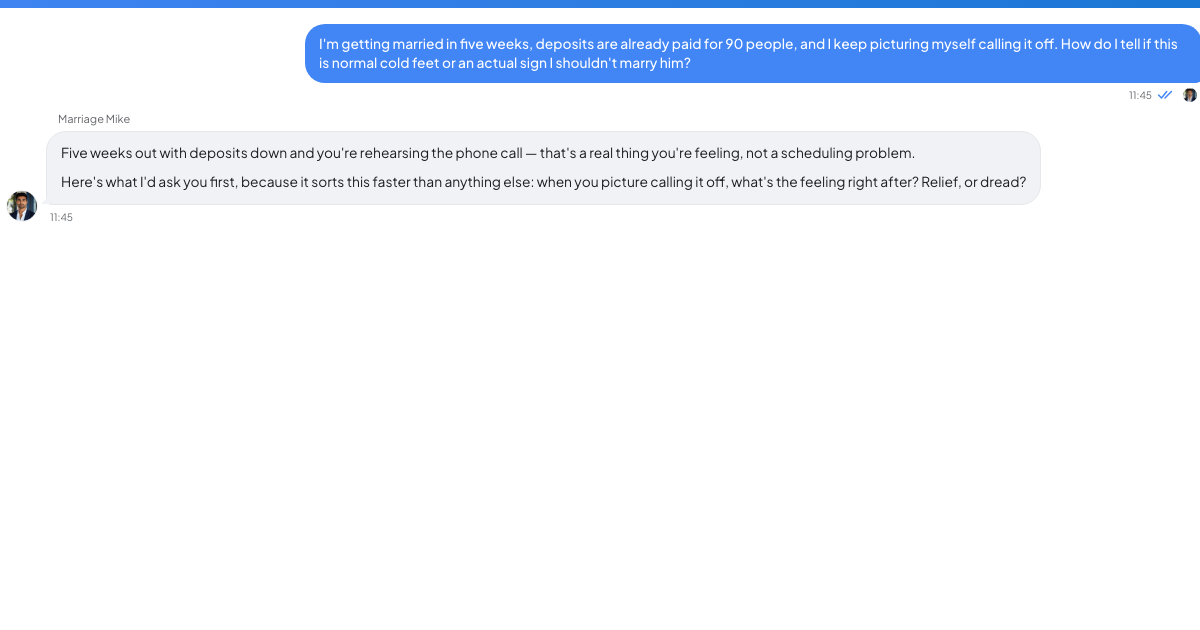
You keep rehearsing the cancellation
You now know where you would stand, which of you would cry, and who would ring the caterer. You never chose to write this scene. It arrives in the shower, in the ten minutes before the alarm, and once during a meeting about next quarter's numbers. You feel sick, then answer your mother about the table plan as if nothing happened.
There are five weeks, ninety people, and deposits that are gone whatever happens. Finding a neutral listener is unusually hard. If you tell her, you cannot take it back; even if you marry her and are happy for forty years, she will always know what you said five weeks out. Your best man is a lovely bloke who has never kept anything. Both sets of parents are stakeholders. Everybody available has money or feelings invested in your answer.
Online advice splits into two piles: cold feet are normal and mean nothing, or cancelling saved someone's life. The first can miss the one doubt that matters. The second has selection built in because people write the version that became a story. The man who had four terrible weeks, married anyway, and is fine eight years later has no essay to write.
The useful question is narrower: are you reacting to an enormous irreversible event, or avoiding a specific doubt about this specific person? A forum cannot settle that. A therapist cannot directly settle it for you in five weeks either, but you can sort the question more carefully than you can at 1am.
Give the dread a subject. Write one sentence beginning the thing is, then finish it with something about her. Keep the wedding, marriage as a concept, your parents' divorce, and the mortgage out of it. Name something she does or does not do, or something she said in March that you have replayed since.
If twenty minutes pass and you cannot produce anything concrete, that is information. Anxiety can attach itself to the speech, the money, or the aunt who is not speaking to your sister because it needs a nearby target. If the sentence comes out immediately and you realise you have avoided finishing it for about a year, you have different information. You already knew the subject and stored it behind the seating plan. This is a sorting exercise, not a diagnosis or a verdict on whether to marry.
Remove the event in your head. Let a flood or fire cancel the venue, with no fault attached, no calls to make, and nobody blaming you. Notice whether relief or grief arrives first. Relief tells you almost nothing about the relationship; plenty of people would welcome having a large, expensive public performance removed from their calendar.
Ask the question underneath it. With the wedding simply gone, do you still want to be with her next year, living in the same house and planning the next thing? If the answer is yes and it arrives quickly, you have an event problem. If you hesitate, or if part of you hoped the fire would take the relationship with it, you have a different problem, and deposit maths cannot convert it into the first one.
Watch the dread for a week as another check. If it spikes when final numbers go to the venue and drops the next day, it is moving with the event. If it is worst on a quiet Sunday when nothing wedding-related is happening, the event is a less convincing explanation. Anxiety about a hundred decisions and non-refundable deposits often rises and falls with those decisions.
Someone will tell you a cancelled wedding is cheaper than a divorce. The statement is true in the abstract and useless for deciding whether your particular fear is about the ceremony or the person. It skips the question you actually need to answer and converts two unknown futures into a slogan.
Do the sunk-cost arithmetic accurately. Say the deposits total eleven thousand and none comes back. In the future where you cancel, the eleven thousand is gone. In the future where you marry, the same eleven thousand is gone; marrying her does not refund it. You are not choosing between losing eleven thousand and keeping it, so the money already spent cannot tell you which future to choose.
The social cost is real. Calling off a wedding five weeks out can mean a hundred phone calls, most made by people who are not you. Some relatives may remain unkind for years, and her mother may never speak to you again. Anyone saying none of that matters has probably never done it. The honest comparison is a few appalling months against making a life decision because cancelling would be embarrassing.
What you say to her matters. Do not open with I've been imagining calling off the wedding. It is true and it is a grenade, not a useful sentence; it gives her the worst version of your inner life with five weeks to go and no way for either of you to put it down. If the exercise named a subject, raise that subject without the meta.
Money, whether you are having children and when, her mother, how arguments end in your house, or a job in another city are conversations. I want to sort the money thing before the wedding rather than after gives a fiancee something she can work with. I've been picturing cancelling is a sentence she will not forget.
There is one absolute exception. If the honest answer to the vanished-wedding question is that you do not want the marriage, tell her before the day. Five weeks is not an exemption. Marrying while knowing that would be worse for her than the worst few months after a cancellation.
Use the five weeks for two or three sessions of premarital counselling with a licensed therapist when the doubt has a subject. That is enough time to put a referee in the room and have the money or children conversation properly rather than in midnight fragments. Evidence is modest rather than magical: a meta-analysis of 117 studies found effects on relationship quality and communication skills while noting limits in the samples and outcomes studied (Hawkins et al., 2008). A study of 662 couples tested PREP relationship education and examined whether it could mitigate risks associated with premarital cohabitation (Rhoades et al., 2015).
Before you can get an appointment, you can say the sentence somewhere with no stake in the answer. TrueTalk's Marriage Mike is an AI persona built around marriage and premarital preparation, not a therapist and not a human being, and it should not be sold as either. No invitation, deposit, or side is involved. At 1am, without booking anything, you can say what you cannot say to anyone in your actual life and watch nothing detonate.
The thought arriving by itself decides nothing. Plenty of people imagined this scene in the shower, in detail, then married and were glad. Others could name a subject and ignored it because invitations were printed. You can learn which situation resembles yours, mostly, and five weeks gives you time to do it. Start this week while there is still time to examine the question carefully.