He Fixes My Car, Pays My Bills, and Has Never Once Just Listened
You value everything he does and still feel unseen. Learn how to turn the guilt and a vague wish for listening into one clear, practical request.


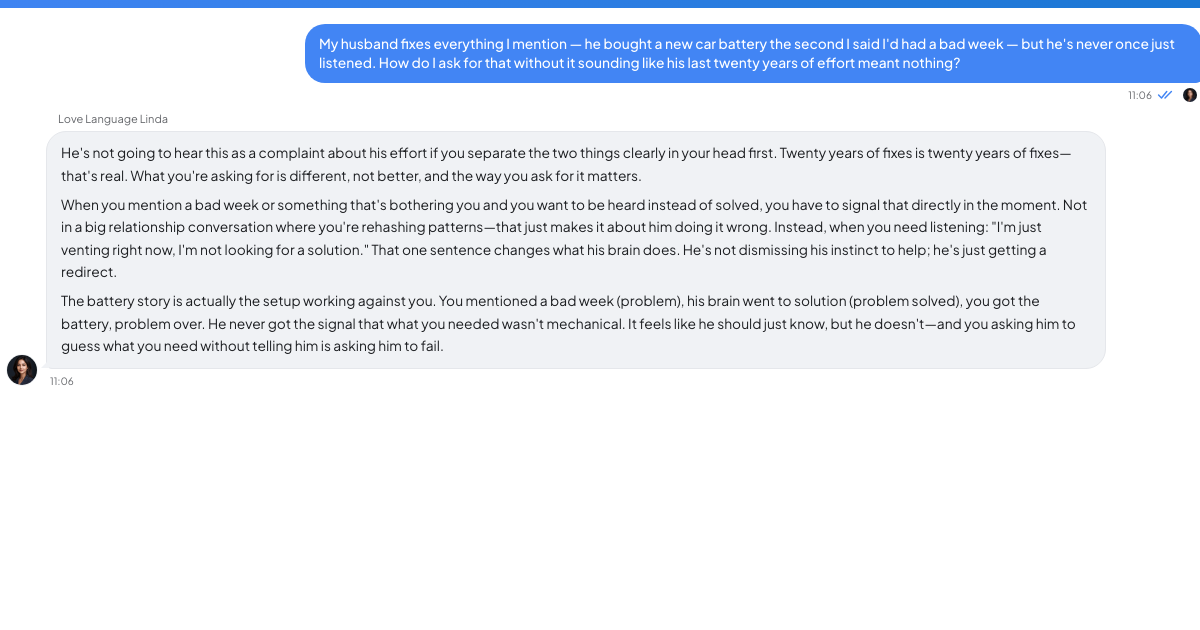
Tuesday's bad week became Thursday's new battery
You told him your sister had been strange with you, work was grinding you down, and you had started waking at four. He listened for perhaps forty seconds. Then he remembered the car had been slow to start on Monday. By Thursday, it had a new battery and the tyres were done.
He was pleased because he had done something useful for you. You thanked him in the drive and felt a loneliness that seemed to come with a receipt.
Everyone calls him a good man, and they are right. He fixed your mother's fence, handles the insurance renewals, and has spent two decades making sure you never felt unsafe, unwanted, or short of anything. Admitting that you feel unseen in the same house sounds almost indecent. You can already hear someone asking whether you know how lucky you are.
That guilt has kept you quiet longer than the mismatch itself. His generosity remains real. Your need to be heard remains real too. You do not cancel his effort by wanting another form of care, and gratitude does not require you to pretend every need has been met.
You are not comparing him with a better man. You are a person who needs listening, married to a person who reaches first for usefulness. Neither preference is a defect. Believe that before you raise the subject. If you still think your request is unreasonable, you will bury it under apologies, and he may hear the apology instead of the request.
Use the love-language label as a starting vocabulary
You may already have taken the quiz: he chose acts of service, you chose words of affirmation, both of you nodded, and Thursday still happened.
Gary Chapman, a Baptist pastor, introduced the five love languages in a 1992 book based on his marriage-counselling experience. The labels can give a couple names for gifts, quality time, words of affirmation, acts of service, and physical touch. They do not diagnose either of you, and the research does not justify treating one primary language as a fixed key to a relationship.
The evidence is useful precisely because it is more qualified. A 2022 study of 100 heterosexual couples found that greater alignment between preferred and expressed affection was associated with relationship and sexual satisfaction. A 2025 study of 696 adults, whose average age was 43.8, did not find that satisfaction with a partner's primary love-language behavior predicted relationship satisfaction better than satisfaction with lower-ranked behaviors. In that sample, words of affirmation and quality time were stronger predictors of perceived love and relationship satisfaction.
So keep the vocabulary and drop the verdict. Saying that he speaks acts of service can describe a habit. It cannot close the conversation with that's just how he loves, as though a description were permission never to learn another response.
The label also cannot translate your request for you. “He speaks acts of service” does not show you how to ask for twenty minutes of undivided attention without sounding as if you have declared twenty years of his effort the wrong currency. That translation is the work in front of you.
Give him an instruction he can complete
You have probably said, “I need you to listen more.” He went quiet, looked hurt, and later repointed the garden wall.
From his side, “listen more” may sound like a poor performance review of his whole marriage. His established response to the idea that he has not done enough is to do more: identify a job, finish it, and show you the result. Every completed job then widens the gap while leaving him honestly confused, because he believes he responded immediately and thoroughly.
The sentence is also too vague to act on. It has no start time, length, subject, or definition of success. Give the request four parts instead: when, how long, what will happen, and what will not happen.
Try: “Thursday, after the kitchen's done, can we sit for twenty minutes with your phone in the other room? I want to tell you about the thing with my sister. There is nothing for you to fix. I want you to hear me.”
That request has an end, so he is not agreeing to an unlimited emotional obligation. It identifies one subject rather than asking him to become a different man in general. It also says explicitly that fixing is off the table. He will not reliably infer that last part, because fixing is the tool that has served him well for years.
Expect the first attempt to be clumsy. He may listen for a few minutes and say, “Have you thought about just not going to Christmas?” Let that premature solution go on the first try. When the time ends, thank him and mean it; tell him the attempt counted. If every imperfect first try is recorded as total failure, he has little reason to make a fourth.
You are not required to praise dismissiveness or accept repeated refusal. You are making room for someone learning a new behavior, not abandoning the need that prompted the conversation.
Expect the first three attempts to land as criticism
Assume the first three attempts will feel like criticism to him, and plan for that instead of being ambushed. Several responses are common enough that you can decide what to say before Thursday.
- “So none of the stuff I do counts?” Answer the actual fear first. Tell him that it counts, you do not want him to stop, and you are asking for one additional thing that does not replace any of it. Keep that order; reassurance comes before explanation.
- He listens and immediately finds a job. If he spends twenty minutes with you and then cleans the gutters at nine at night, the job may be how he discharges feelings for which he has no conversational channel. Let him clean the gutters.
- “What am I supposed to say?” It can sound sarcastic when it is a sincere request for a script. Tell him that “that sounds really hard” is enough. He does not have to produce a solution.
- He agrees, then forgets. If Thursday passes untouched, keep the reminder small: We missed the Thursday thing. Can we do it tonight? You do not need another speech.
Over the next few months, aim for a couple of reliable twenty-minute pockets that both of you protect. You are not demanding a transformed personality by next week. Repetition gives a structured exercise the chance to become an ordinary part of the relationship.
Know when communication technique is no longer the issue
This approach assumes he wants you to feel loved and is repeatedly missing the target. Pay close attention to what happens after he understands the request.
A partner who calls you too much or too needy, stores your disclosure for later ammunition, deliberately goes cold for three days, or plainly refuses a modest request is doing something different. Contempt and stonewalling do not yield to a more elegant four-part sentence. Couples therapy, or individual therapy for you, is the appropriate next step.
If you are editing every word because you fear setting him off, treat that as a safety issue rather than a love-language problem. Contact a domestic abuse service instead of relying on a communication technique.
Draft the ask somewhere neutral
Rehearsing with friends can create another bind. Tell a friend that your husband never listens and you may recruit an ally against him; tell someone else and you may be ordered to count your blessings. Neither response helps you draft Thursday's request.
TrueTalk's Love Language Linda focuses on love languages, relationship dynamics, and the ways people communicate. She is an AI persona, not a human counsellor, and is available whenever you need to turn the request over in your mind. The free tier includes ten conversations and one hundred messages per day. You can use that space to make the twenty-minute ask clear without turning it into an indictment.
Once your own request is on the table, ask what reaches him. A partner who communicates through work may also be lonely if he rarely receives care in that form. Perhaps the last time anyone said he had done a job well was around the birth of your second child. His answer may be as modest and specific as yours, and you will finally be discussing two needs rather than defending two competing accounts of the marriage.