Four Months In, and My Eight-Year-Old Wants to Know Who I'm Texting
Your eight-year-old needs an age-sized truth, not a secret or a vote. Coordinate with her father, then introduce a partner gradually and without ceremony.


She noticed before you chose a date
You are four months in: nine evenings out, including two that were only coffee. Nobody at school knows, your sister does not know, and your best friend knows because she watched your daughter. Then your eight-year-old looks up from a colouring book in the back seat and asks why you are smiling at your phone. You say "work." She accepts it because she is eight. She may not next time.
You can already see two bad futures. In one, she meets him, likes him, he goes, and she has lost a second person before ten. In the other, you keep the relationship sealed for a year and it dies from never being a priority. Those fears collapse three separate decisions into one: what your daughter knows, what her father knows, and whether she meets your partner. Each runs on a different clock.
Give an eight-year-old a small, age-sized truth
She has noticed the phone, your mood, two evenings out in a week, and the attention you now give Thursday clothes. Children may be appalling at maths but excellent at atmosphere. She has started making a theory, so your choice is whether a calm fact helps shape it.
Tell her while you are doing something ordinary: "I've got a friend called Tom. We go for dinner sometimes when you're at Dad's." You do not need a formal announcement, a photograph, or a request for permission. Asking an eight-year-old to approve your love life gives her responsibility for an adult decision and may leave her feeling responsible for whatever happens next.
The American Academy of Pediatrics advises parents to tell children about new adult friends and let them express feelings and opinions; it also warns that a middle-years child can form an attachment before that is appropriate (HealthyChildren.org). At eight, she might be curious, dismissive, excited, suddenly clingy, worried that he will replace Dad, or loyal to Dad and angry that liking this man could betray him. She may seem unbothered and ask the important question three days later while you brush her hair. Receive the reaction without asking her to manage yours.
Keep privacy, secrecy, and loyalty separate. You are allowed an adult private life and do not owe her romantic detail. Secrecy asks her to deny or conceal something and signals that the subject is unsafe. Loyalty conflict appears when she thinks affection for one adult subtracts from another. You can say, "You don't have to feel any particular way about him, and nobody replaces Dad. You can always ask me questions." Do not ask her to keep Tom from her father. The AAP says children should not be made keepers of secrets (HealthyChildren.org).
A name is much smaller for her to hold than a person doing bedtime. Knowledge is cheap; attachment is expensive. This is why a universal six-month rule fails. Articles offer six months, a year, or two years and only if you are engaged because duration is the only simple answer they can hand a stranger. They cannot see your child's age, whether the relationship is stable rather than merely exciting, whether her father files information or weaponises it, or whether she has lived through one upheaval or four. No clean number resolves those differences.
Coordinate with her father before contact
Read your custody order rather than remembering it. If it addresses new partners, overnight guests, introductions, or notification, follow it and take questions to a family lawyer in your jurisdiction. A forum, this article, and a midnight text exchange cannot give you legal advice, and every message may later become an exhibit.
If the order says nothing, you generally do not owe an ex a running account of your private life. Regular contact with your daughter changes the practical calculation. He will find out, and learning it from her puts her in the middle. Usually, give your daughter the small truth first and notify him shortly before a real introduction. Coordinate logistics without seeking permission unless the order requires it.
Write: "I've been seeing someone for a few months. He'll be meeting her at some point soon. I'll let you know when." Leave out his job, how you met, and how well it is going. Use the channel you would accept being read aloud—a co-parenting app if you use one, otherwise email. If her father needs a practical fact for the child's safety or handoff, provide it; this is not a licence to provoke him by withholding necessary information. If he threatens custody, screenshot it, do not reply that night, and take it to your lawyer.
You can also align on the child-facing message without pretending both homes must feel the same: "She knows I have a friend called Tom. I have told her he does not replace either parent and she does not need to keep secrets. Please send any adult questions to me rather than asking her." That protects her from becoming the messenger or investigator.
Introduce him by degrees
Months alone do not tell you whether the relationship is ready. Ask whether you have watched it survive an argument, a bad week, a cancelled plan, and his response when your child suddenly comes first. Four smooth months reveal less than a proper disagreement handled well.
The first introduction should be forty minutes in a public, active place with a distraction, where your daughter can wander off and return. A park works, and another adult or two can lower the intensity. Do not sit them across a table, announce someone special, or let him bring a present. He is your friend who came along and talks to her a normal amount—which is less than he will want to. The AAP describes the first encounter as a chance simply to say hello, without rushing closeness (HealthyChildren.org).
Leave without conducting a review in the car. Later, make room with something neutral: "You met Tom today. If you ever want to tell me what that was like, you can." Her silence is not approval or distress; it is simply silence. Watch behaviour over the following days and let questions arrive in their own setting.
Increase contact gradually if the first meeting remains ordinary: another short group activity, then a slightly longer shared outing. Do not move from a park hello to every weekend because she appeared delighted. Excitement can produce attachment as quickly as anxiety produces resistance. If she becomes persistently distressed, slow down and seek qualified support rather than forcing a timetable; a paediatrician or child therapist familiar with separation can help you interpret a sustained change.
Cafcass says children cope best with predictable, regular routines and notes that a new parental relationship may feel like a crisis to the other parent, particularly if the partner moves in (Cafcass). Preserve her normal handoffs, school rhythm, and time with each parent while the introduction grows. A ceremony creates stakes; gradual, ordinary contact gives her less to defend and more time to adjust.
Account for the Tuesday problem
All of this assumes you can leave on a Tuesday. A sitter every week costs money. Your mother helps, but you feel the ledger. Nights at her dad's are also when you catch up on what the week consumed, and using one for yourself may bring guilt at ten past nine, halfway through the main course.
No reframing turns a childcare gap into a mindset problem. Work out honestly what an evening costs and what it is worth to you. Use nights you already have instead of manufacturing new ones, and tell your partner early that alternate weekends are your actual availability. A man who cannot work with that will fail the test eventually.
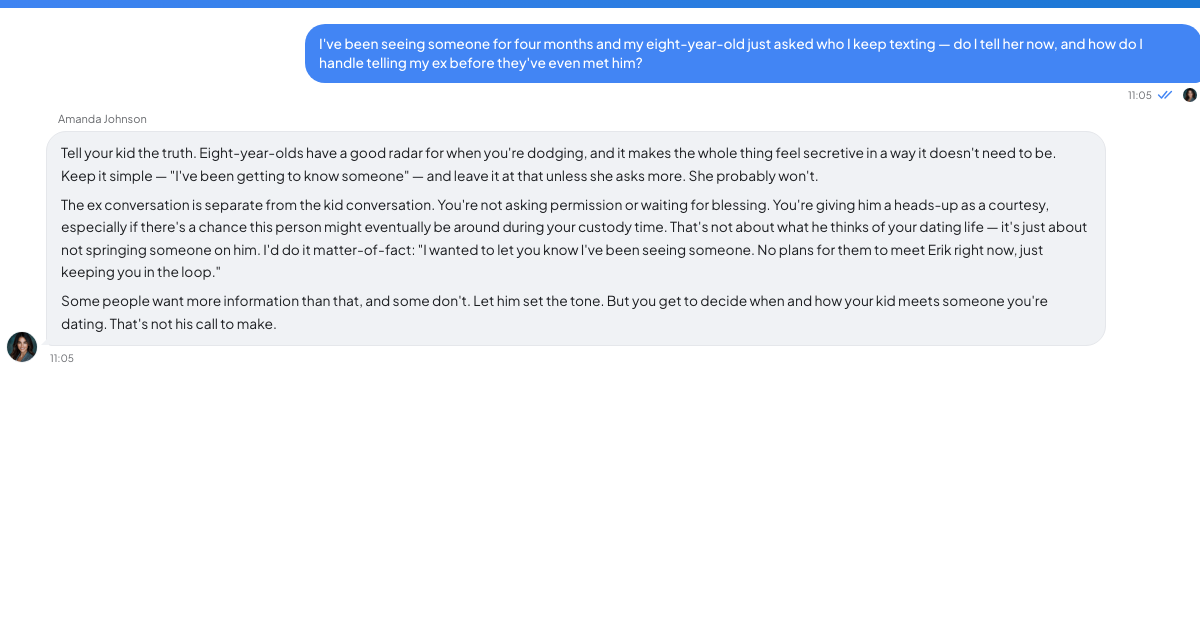
Amanda Johnson is an AI persona on TrueTalk—a bakery owner and single mother, not a person or family lawyer—if you want to think through the wording with someone outside your family who will not repeat it. The free tier includes ten conversations and one hundred messages per day. Anything involving the custody order still belongs with your lawyer, and sustained changes in your daughter's wellbeing belong with an appropriate child-health professional.