He Hits the Baby, Sits in Time-Out, Then Does It Again
When time-out gives a three-year-old concentrated attention after he hits the baby, study the pattern, protect the baby, and move connection to safer moments.


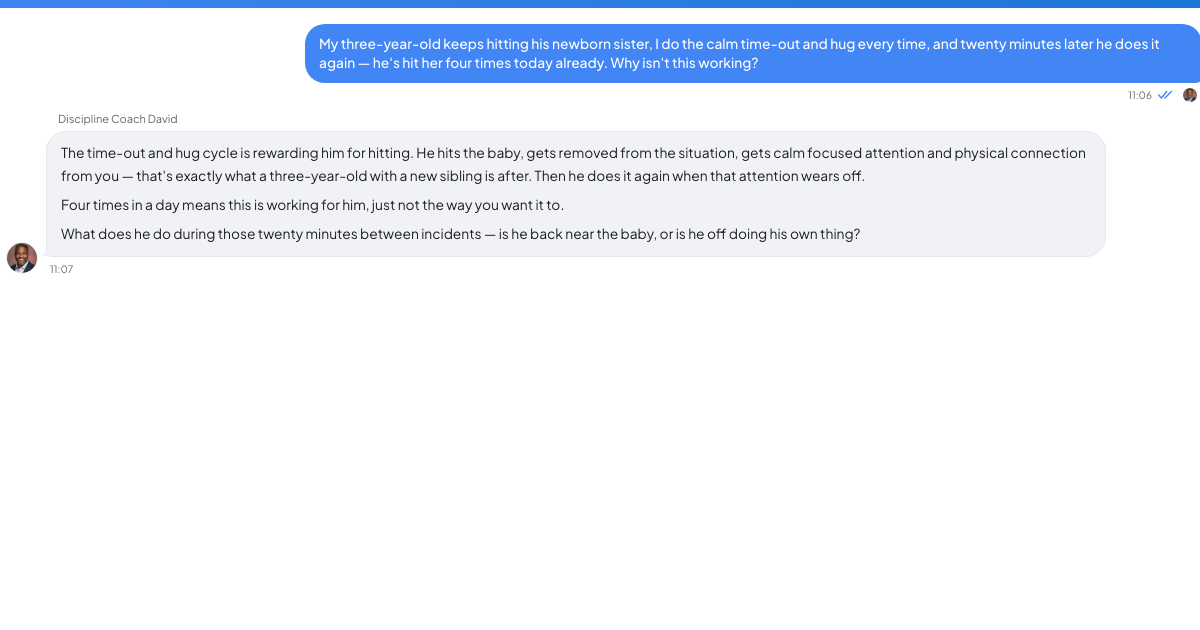
At 10:40am, he watches you instead of his sister
You are feeding her on the sofa when he crosses the rug without hurrying and smacks her leg. His eyes stay on your face. He barely looks at the baby.
You keep your voice calm. You say, “We don't hit,” put him on the step for the allotted minutes, get down to his level afterward, hug him, and talk about gentle hands. He nods, with all the sincerity a three-year-old can bring to the moment.
Twenty minutes later, he hits her again.
It is the fourth time today, before lunch. A newborn is attached to you, you cannot physically enforce much of anything, and an unwelcome thought has arrived: the time-out is not working, and perhaps he enjoys this.
The sequence may indeed be working for him, but that does not mean he enjoys hurting his sister. Look closely at what his behavior reliably produces.
Test what happens in the ten seconds before
Spend one day collecting evidence before you settle on an explanation. In a phone note, record the time of every incident and what was happening during the preceding ten seconds: where you were, where the baby was, what you were doing, and when he last had you to himself.
The hits may cluster during feeds, nappy changes, phone calls, or the last hour before dinner when everyone is depleted. A pattern that begins whenever your attention transfers to the baby supports an attention-payoff explanation. A random pattern, or one concentrated around dressing and transitions, points elsewhere; he may be overwhelmed rather than displaced.
One day cannot diagnose your child, but it can stop you applying the wrong intervention on autopilot. Your own notes are more useful than ten generic articles when they show the conditions under which the behavior occurs.
This matters because time-out is short for time out from positive reinforcement. The child briefly loses access to an enjoyable, attention-rich environment. In your house, however, the place he leaves may be one where you have held someone else and made no eye contact with him for forty minutes. On the step, an adult escorts him, watches him, speaks to him, and eventually kneels for a two-minute cuddle and feelings talk with no baby between them. The supposed removal can contain more concentrated attention than the room he left.
The CDC explains that time-out works by removing parental attention and other enjoyable things; its guidance describes the space as boring and without interaction. The CDC also says harmful behavior such as hurting another child is one of four situations in which time-out may be appropriate. The issue is therefore not that time-out is inherently wrong for hitting. It is whether the version you can deliver actually removes reinforcement and keeps both children safe.
Move your attention away from the hit and toward gentleness
For a small child, eye contact, speech, touch, and a parent's face can all function as attention. The CDC's behavior guidance makes the mechanism unusually concrete: attention given immediately after a behavior, whether positive or negative, increases the likelihood of that behavior recurring. That does not make your son calculating or cruel. It means he has learned a dependable route back to you: one smack buys instant eye contact, words, physical guidance, supervision, and a private cuddle.
Change when attention arrives. “More one-on-one time” is too vague if all the concentrated connection still follows an incident. Attention has to arrive unpredictably and unearned, before and between incidents, when he has done nothing and has not had to buy it.
- Front-load a feed. Before you sit down, give him two minutes of your face and full attention. Then assign a specific role: he can fetch the burp cloth or choose the song. “Go and play” can feel like dismissal; a job gives him a legitimate place in the routine.
- Notice the exact opposite behavior. When he has spent five minutes near her with soft hands, say, “You are touching her hand so gently. She likes that.” The calm minutes are easy to ignore because nothing is going wrong. The CDC recommends specific, positive praise because it tells a young child which behavior you want repeated.
- Teach a safe bid for you. Small children hit partly because they lack a better tool. When everyone is calm, rehearse putting his hand on your knee. Your answer can be, “I see you; two minutes.” Honor that promise near enough to the time requested, or the safer tool will stop competing with the one that always works.
- Keep the incident response brief. Shield the baby with your body or forearm, say “no hitting” once in a flat voice, separate them, and attend first to her. Do not ignore dangerous behavior: stop it immediately. What you remove is the extended performance, not protection. Reconnect with him twenty minutes later, unexpectedly and without making the cuddle a final stage of the hitting sequence.
The delay breaks the learned link between hitting and cuddling while leaving affection available to a three-year-old who still needs it.
Design the room for one-handed safety
You cannot safely carry a three-year-old to a step while wearing or feeding a newborn. Build the setup around that fact.
Feed with your back against a wall and keep him in front of you so you can see him approach. When you are not holding the baby, use a raised, secure surface that keeps her out of his hand-height reach. During the hours your notes identify as difficult, a sling can free an arm and keep her against you rather than within reach. Follow the sling manufacturer's positioning and age guidance.
Blocking counts. Calmly placing your forearm between them dozens of times is not failed discipline; it is immediate prevention. Your first responsibility in the moment is to stop contact, not to produce a perfect consequence.
Do not leave them alone together, even for a shower or while you answer the door. This rule does not label him a monster. He is three, his impulse control is developing, and a newborn cannot protect herself.
If you continue using time-out, make it consistent and feasible: a known safe place away from toys and people, one neutral sentence, immediate follow-through, and no conversation, eye contact, or touch during the interval. Practice the routine at a calm time. If you cannot administer those conditions while keeping the baby safe, use separation and environmental control rather than pretending the step is operating as intended.
Treat your resentment as a signal to get support
You may look at him and feel cold before you feel loving, then spend the rest of the day ashamed. You are exhausted, healing, feeding around the clock, and managing one child striking toward another child in your arms. Resentment in those conditions tells you about load; it does not deliver a verdict on your character as a parent.
Tell somebody plainly. Secrecy leaves you alone with an increasingly charged situation.
TrueTalk has an AI persona called Discipline Coach David, written as a child behavior specialist and discipline coach focused on positive discipline and behavior change. He is not a clinician or a substitute for your paediatrician or health visitor, but he is available at 2am when you are reviewing the notes. The free tier includes ten conversations and one hundred messages per day. You can use it to organize the day's observations and prepare questions for a professional.
There are firm limits to a home behavior plan. If the aggression escalates instead of settling over a few weeks, he aims at the baby's head, the hitting also occurs at nursery, or he hurts animals, contact his paediatrician soon.
Your mental health needs its own route; his doctor does not treat you. If your mood has gone somewhere dark since the birth, or you fear what you might do when you reach your limit, call your GP or health visitor today. Use those direct words rather than a tidied version. If you are thinking about harming yourself or the baby, do not wait for an appointment: call your GP, an urgent care line, or emergency services now.
Clinicians see both childhood aggression and postpartum mental-health distress often, and earlier help is easier than waiting for either to intensify. Meanwhile, keep the baby out of reach, observe the pattern, and make calm contact available before your son has to demand it.