He Used to Tell Me Everything. Now I Get 'Fine.'
A formal talk can make a quiet fifteen-year-old retreat further. Try ordinary shoulder-to-shoulder time, protect disclosure, and know when to call the GP.


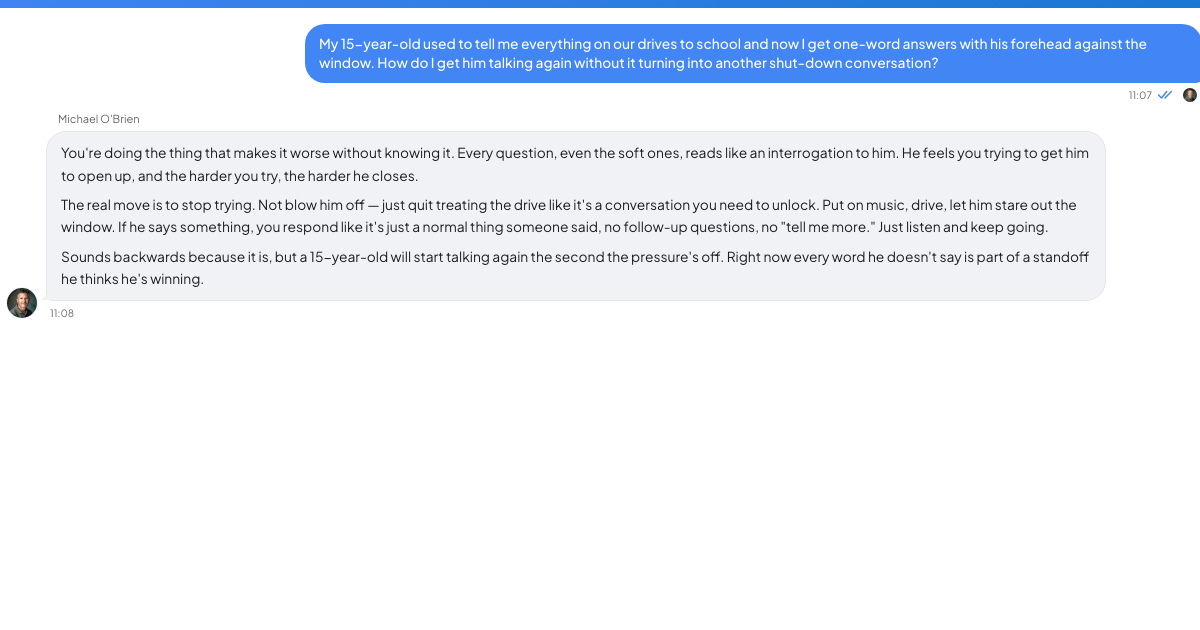
Nine words this morning; four were "yeah"
The school run takes fourteen minutes each way. For three years — perhaps four — you never planned a topic for the truck because conversation simply happened. That was where you learned he'd fallen out with Jack, wanted to try out for the team, and had concluded that his history teacher knew nothing.
These days he puts one earbud in, rests his forehead against the window and stays there for all fourteen minutes.
You treated the silence like any other problem and addressed it. On Sunday afternoon you sat him down, said you needed to talk about how things had been lately, and watched his posture collapse in the chair. Three lots of "I dunno" led to "can I go" and then a closing door.
The result bothered you: things get worse after these meetings, with each sit-down buying four days colder than the four before. That is enough evidence to retire the sit-down for now.
Why directness misfires here
Being direct has worked with subcontractors, your father and a mortgage adviser. In each case, the person opposite also wanted the identified problem gone.
Your fifteen-year-old sees no problem to solve. Adolescence involves building a self that is not merely a smaller copy of you, and privacy is part of the raw material. You experience a wall while he experiences a door he has only just become able to close. A sit-down asks him to surrender that privacy, so resistance is unsurprising.
A study of 276 ninth- and twelfth-graders and 249 parents found that adolescents felt less obliged to disclose personal matters than moral, conventional or safety-related matters; parents expected more disclosure than adolescents did. Greater trust and parental acceptance were associated with more disclosure and less secrecy. That does not turn one study into a recipe, but it supports treating privacy and safety as different categories rather than demanding the whole story at once (Smetana et al., Child Development, 2006).
Withdrawal is not automatically harmless; the warning signs below still matter. But "he has stopped talking, so our relationship is broken" is only one interpretation, and acting as though it is certain can turn an ordinary developmental shift into a genuine rift.
Use words that sound like you. If you have never said "it sounds like you're feeling frustrated" in forty-eight years, introducing it to a fifteen-year-old in the kitchen will sound dubbed. Advice such as create space, validate his experience and reflect what you hear is often written in a register many fathers cannot naturally produce. Some men can say it sincerely, and they should.
If you cannot, he will identify the internet technique in about a second and a half. Feeling handled gives him another reason to close the door, at the cost of a week's goodwill. The useful method has to survive in your own voice.
Put a job between you
Recall where the good conversations happened: in the truck, on a bank at six in the morning, under the bonnet or on the way back from the tip. They rarely happened across a table.
Sitting beside him removes compulsory eye contact. A task makes silence legitimate, and he can neither storm away nor reasonably feel trapped because the job explains why you are together. Face-to-face announces a meeting about him; shoulder-to-shoulder leaves talking optional.
Create more of those ordinary chances. A grand fishing trip is a sit-down carrying a rod, and he will smell it from the car park. Keep it small, frequent and unceremonious: he comes to the parts store, holds the other end, or rides twenty minutes for the better pizza instead of collecting the nearby one. Frequency matters more than engineering one perfect conversation.
The opening ninety seconds
Begin with something genuinely boring: the van needs tyres, your knee has hurt since Tuesday, or somebody at work mishandled a delivery. Give him thirty seconds about your day without attaching a lesson. Then ask for a fact: "Ten or twelve, which do you reckon?" "Window down?" "Is that the song from the advert?"
For the first ten minutes, avoid:
- how are you doing
- everything alright at school
- you know you can talk to me
- your mother says you've been
Each is the sit-down in miniature, and he can hear it approaching. After the factual question, leave room. Six seconds in a car can feel like a minute and a half to a man who fixes things, but another question reads as pursuit. Let the radio occupy the gap.
When he finally says something
Sooner or later, success means hearing something unwelcome: there was drink at the party, he will not bother revising, or someone posted something about him online. Your response in the next four seconds determines what disclosure costs him. Volume, a lecture and an immediate consequence teach him to pay that price only once.
Say "right", keep your hands on the job and ask one flat follow-up question. If the issue needs action, deal with it later, outside the truck, when both of you are calmer. Separating disclosure from consequence does not let him off; it keeps the route open for next time.
When pulling away needs professional help
The advice so far assumes ordinary separation. Call your GP or a mental health professional instead of arranging another fishing trip if:
- he's pulled away from his friends too, not just from you — the phone's gone quiet in both directions
- he's dropped the things he loved without picking up new ones
- sleep or appetite has changed markedly and stayed changed for weeks
- grades falling off a cliff rather than drifting
- marks on his arms, or long sleeves in July
- talk about being a burden, about people being better off, about not being around
- alcohol or drugs turning up regularly rather than once
- giving away things that matter to him
The National Institute of Mental Health's warning-sign list specifically includes talking about being a burden, withdrawing from friends, giving away important items, extreme mood swings, and eating or sleeping more or less (NIMH). Any talk of suicide or self-harm warrants a same-week appointment; if danger feels immediate, contact emergency services or a crisis line — 988 in the US, while most countries have their own. You do not need certainty first. A mistaken appointment costs an hour.
Ask directly about suicide. You are posing one plain safety question, not demanding that he open up generally. NIMH says research shows that asking about suicidal thoughts or behaviour does not create or increase them and may be the best way to identify risk.
For rehearsing the four seconds after an ordinary disclosure, Michael O'Brien is an AI persona on TrueTalk. He is a construction project manager whose areas include parenting teens, renovation, budgeting and fishing, not a person or therapist. The free tier includes ten conversations and one hundred messages per day. If anything in the warning list is present, contact the GP first; the persona is for an ordinary week.
Tomorrow's fourteen-minute drive does not need a breakthrough. Take him along, mention the tyres, ask one factual question and allow the quiet to remain.