I Gave Them the iPad and My Daughter Stopped Calling
There are two arguments in that text message and only one of them is about screens. How to tell the rule you disagree with from the standing you've lost, and which one to actually fight.


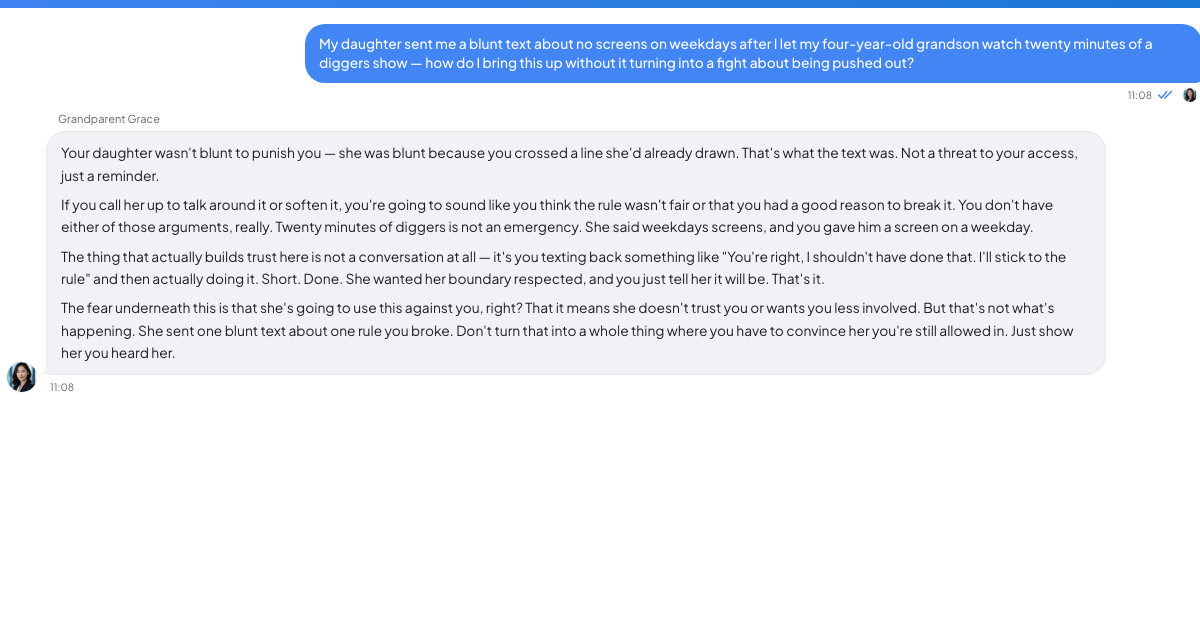
The text arrived at nine at night and you read it three times
Take a day that went like this. He's four. You had him from ten in the morning until six. Four hours in he was on the floor about the puzzle, you'd been up since half six, and you handed him the tablet. Twenty minutes of a programme about diggers. He went quiet, you got the kitchen done, and the afternoon was pleasant again.
He told her, because he's four and he tells her everything.
The message was not angry. Angry would have been easier. It said: we do not do screens on weekdays, can you stick to that please. And then nothing else. No how was your day, no thanks for having him.
You raised three children. Two of them are doing well and one of them wrote that text.
Before you answer it, one thing has to be sorted out, because getting it wrong is what turns a bad evening into eighteen months of coldness. There are two arguments inside that message and only one of them is about screens.
One is the rule. Twenty minutes of diggers on a Tuesday, whether it is harmful, whether you'd have done it. The World Health Organization's 2019 guidance recommends no sedentary screen time for infants or one-year-olds and no more than one hour a day at ages two through four; for three- and four-year-olds it also recommends at least 180 minutes of physical activity, including at least 60 minutes at moderate-to-vigorous intensity (WHO). Other national bodies have landed elsewhere, which shows why twenty minutes of diggers cannot settle the standing argument by itself.
The other is your standing. Whether you are a grandparent with judgement or an unpaid member of staff working to a policy you were not consulted on. Whether a decision you made in your own kitchen, about a child you love, gets reviewed at nine at night.
Twenty minutes of diggers probably does not explain all of your reaction.
A quick way to tell which one you are in
Run it back with one thing changed. Imagine she'd said it to your face, warmly, on the doorstep. "I know this is a fussy one, but we're really trying to hold the weekday screen thing at the moment — would you mind?"
If that version leaves you calm, the delivery and your standing caused the hurt more than the iPad did.
If that version still makes your jaw tighten, then you genuinely disagree with the rule, and that is a different conversation with a worse chance of success. Keep reading anyway.
What you are actually afraid of
Most of what's written about grandparents and parenting rules is addressed to the parents. Set clear expectations with the grandparents. Do not be afraid to enforce consequences. Have a conversation about who's in charge. The genre exists to help them manage you, and hardly a line of it is written from the chair you are sitting in.
Which is why the thing underneath never gets named, so I will name it. You are not afraid of losing the argument. You are afraid that the relationship with your own daughter is now conditional, and that saying so out loud is what proves it.
I will not talk you out of that with a reassuring line. Grandparents generally have very limited rights to contact where a parent decides otherwise, and what exists differs enormously between countries and states. If you are seriously worried about being cut off, that is a solicitor in your own jurisdiction, not an article and not a forum.
Most of the time, being cut off is not what is happening. It may just be a tired parent who read something frightening about screens, sent a blunt text at the end of a long day, and has no idea it landed like a written warning.
Opening it without it sounding like a grievance
Choose the time and order carefully.
Not by text — whatever you write gets read in the worst available tone, and a phone call at nine at night is the same trap with a voice on it. Not at handover either, in the hall with a child listening and a car running; that conversation has a two-minute limit built into it, which is how it ends badly. A quiet hour, arranged on purpose, when nothing has just happened.
Lead with wanting the information rather than with the injury. Something like: I want to get this right and I would rather ask than guess — what are the things that really matter to you two at the moment?
Then ask for the list to be short. This is the most useful sentence available to you. If it is ten rules I will get some of them wrong; give me the two or three you'd actually be upset about and I will be strict on those. Parents often have a hierarchy they have never been asked to state. Asking for it lets you act as an ally instead of defending every choice.
Then say the standing thing. Once. No case attached, no history, no when-I-raised-you. "The bit I found hard was reading it in a text at nine o'clock. If I've got something wrong, tell me and I will change it."
Do not attach the line about how you raised three children and they are all still alive. I know it is true. It reads as a defence of your era against hers, she'll defend hers back, and now you are two people arguing about the nineteen-eighties instead of about Tuesday.
The part you will not enjoy
Some of these rules are not up for discussion, and treating them as preferences is how a grandparent loses the whole account. Anything to do with allergies, medication, car seats, water, or a food a child is not allowed. There is no version of "he was fine" that survives one of those going wrong. Follow them exactly, every time, and say so.
Then the strategic bit, which sounds like surrender.
Pick the rule they care about most—the one generating the texts—and follow it conspicuously and consistently for a couple of months. The American Academy of Pediatrics advises families to create media rules around their own routines and values, including screen-free zones and turning off autoplay and notifications, so ask for the parents' actual plan rather than assuming the WHO ceiling is their household rule (HealthyChildren.org). Mention it unprompted. He did not have any screen time, we did the sticker book instead. No sugar after four, as agreed.
For the next couple of months, visible compliance with their highest-priority rule gives them evidence to use when deciding about unsupervised Sundays and smaller exceptions.
Then trade, once you have banked some credit. Ask for one thing that is yours: the Saturday afternoon where the rules are slightly your own, or the one food, or bedtime being loose when he stays over. Keep the exception named, small, and agreed in advance. That is an ordinary negotiation between adults, and it is much easier to have when you are not asking from a deficit.
Somewhere to say the unsayable part
The demoted feeling has nowhere to go. Not your daughter — that is the whole problem. Your friends will tell you she's being ridiculous, which is satisfying for an evening and makes you worse at the actual conversation.
Grandparent Grace is an AI persona on TrueTalk, not a person; grandparenting and intergenerational relationships are her whole subject,. The free tier includes ten conversations and one hundred messages per day. Worth half an hour before the real conversation, mostly for working out which of the two arguments you are in and drafting the sentence you'll be saying to someone who can text back.
She may well have written that message at the end of a fourteen-hour day and hit send without rereading it. That is the version worth assuming until you know otherwise — and it is exactly why you should not answer it tonight.