I Chose to Stay. Seven Months Later I'm Still Checking His Phone at 2am.
Months into reconciliation, still awake at 2am with his phone in your hand. Why a month-seven spike isn't the repair collapsing, which kind of checking does damage, and the friends you can't call.


Both of them said leave
Say you told two people in the first fortnight, back when you were still telling anyone. A sister, a friend. Both of them said the same thing, kindly, and fast.
You stayed.
So now a bad night has nowhere to go. A bad night is evidence for their case. You'd spend the first ten minutes of the call defending the decision and never get to the thing you rang about, so you say you are fine, and you keep saying it, and after a few months of that his secret has quietly become yours. Nobody warns you about that part. It might be the loneliest thing in the whole business.
One move is worth trying before you write a friend off. Put the terms at the top: I need an hour where you do not tell me to leave, and I will ask for that view when I want it. Ask one person directly and notice whether they can respect that boundary; do not withdraw from everyone before you have tried it.
The schedule you are apparently behind on
Almost everything written about reconciliation reads like a staircase with a handrail. Disclosure, remorse, transparency, trust rebuilt, a timeline pinned to each step. By that model, at seven months, you are late.
Which puts a second layer on top of the grief. Shame about the grief. And that layer is manufactured entirely by content.
I cannot give you an average and I would distrust anyone who hands you one to the month. What I can tell you is that the spikes have triggers and the triggers are stupid — a song, a hotel logo on a billboard, somebody's hand soap. A spike in month seven does not mean the repair is collapsing. The American Psychological Association describes betrayal after infidelity as capable of producing trauma-like responses, including waves of distress and checking a partner's phone; psychologist Galena Rhoades says short-term checking can sometimes help build trust even though nobody wants it as the long-term arrangement (APA).
The physical punch can impersonate evidence, but it supplies no new fact. It just arrives with the same physical punch as the day you found out, which is exactly why it impersonates evidence.
Two kinds of checking
Before checking, identify which of these two actions you are taking.
Information-seeking. You have a specific question. Has he still got her number saved. Did he actually go to the thing on Thursday. You look, you find out, you stop. It is bounded, it terminates, and afterwards you are steadier whichever way the answer went.
The other kind. There is no question, or the question is one a phone cannot answer — am I safe, was any of it real, did he ever mean it. You scroll until you find something. Finding nothing makes it worse rather than better, because now the search continues tomorrow. You are pressing a bruise to see whether it still hurts, rather than investigating a bounded question.
The test takes ten seconds. Before you pick up the phone, write the question down. One sentence, on paper or in a note. If you cannot write a question, you aren't looking for an answer, and going in will cost you the night.
Checking at seven months is not automatically pathological. The agreement exists for a reason and using it is not a relapse. Watch the direction of travel across months rather than nights. Unevenly downward is fine. If the monthly pattern has stayed flat since March, bring that observation to counselling.
2:14
Say it goes like this. He's asleep. The phone is face down on his side of the bed and you know the passcode, because he gave it to you in month one as part of the transparency you both agreed. So it is not even snooping. It is permitted, and somehow that makes it worse.
Thirty-five minutes later you have found nothing, which is what you find every time. You put the phone back at the exact angle it was lying at. Then you are on your back with an image you did not request and cannot delete.
Two things to do instead. Neither is clinical advice, and both are smaller than they sound.
Get out of the bed. The bed is turning into the place where this happens and that association can set if you let it. Different room, a lamp rather than the overhead light, and then the most boring podcast you own. Your immediate task is smaller than feeling better: You are trying to reach 3:30 without opening the phone, which is a much smaller target than peace.
Write the image down, longhand if you can stand it, and keep the page. Not to process anything — to get it into the past tense, and to have something to hand your counsellor on Thursday. That is the difference between a private collapse at 2am and material.
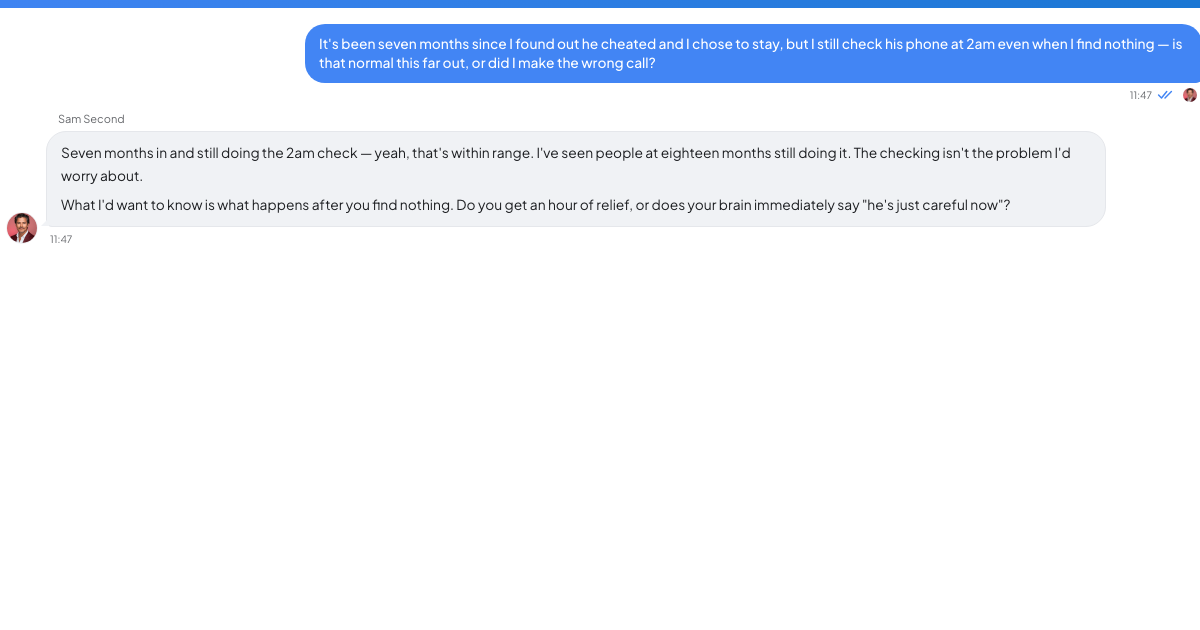
Sam Second is the TrueTalk advisor for this one. It is an AI, not a counsellor and certainly not yours; the narrow use is the hour. It is there at 2am and there is nothing to book. The free tier includes ten conversations and one hundred messages per day. It is not therapy and it is not a crisis line.
Asking a tired partner for reassurance
The part you cannot say to anyone: he's started to sigh.
Not cruelly. He answers. But there is a half-second before the answer now, and you have clocked it, so you have begun rationing the asking. Rationing means it comes out late, compressed, at the worst hour, in the worst shape — usually as an accusation at eleven at night, which is the version he's least able to meet.
Some asks cannot be answered. 'Do you still think about her' has no version that helps you; both answers hurt and one of them is a lie. 'Was any of it real' is a question about his interior life that he'll hear as a charge and start defending against.
Asks that can be answered look like tasks:
- 'I'm having a bad one. Can you sit with me for ten minutes and not fix it.'
- 'Tell me again what you decided. I want to hear you say it, not because I doubt it.'
- 'This is going to come out sounding like an accusation and it is not one. Thirty seconds.'
Each of those has a shape and an end. He can do it, know he's done it, and go back to sleep. An open request for proof has no floor, and a person being asked for proof will eventually stop supplying it — not out of guilt, out of exhaustion.
Agree the 2am protocol in daylight, on a Saturday, when neither of you is bleeding. Something like: if I wake you and say it is a bad one, you do not have to say anything clever, you just do not sigh. That is keepable. 'Be endlessly patient' is not.
One more thing, and it is uncomfortable. He's grieving something too, and he is not allowed to say so, because he's the one who did it. That is not an excuse and it moves none of the responsibility. It is a reason his reserves are low. If neither of you can say it out loud, the tiredness turns into resentment, and resentment is corrosive to a reconciliation.
When it is bigger than a bad night
If sleep has mostly gone, if you are not eating, if the images are turning up in the middle of the working day, if you are drinking to get to sleep, or if you have had any thought of harming yourself — that is a clinical picture and it wants a therapist trained in trauma. Not an article, not an app. If you are in crisis in the US, call or text 988. The 988 Suicide & Crisis Lifeline says its support is free, confidential, and available 24 hours a day, seven days a week across the United States and its territories (988 Lifeline).
Worth saying too: individual therapy is a different thing from the couples counselling you are already doing. Couples work has to hold both of you. You also need a room that is only yours.
Was staying the wrong call
You cannot assess that from inside a bad night. The 2am version of you has one input and it is the intrusive image.
Ask it in daylight, out loud, to someone. And you are allowed to change your mind later — seven months is not a contract, and it is not a sunk cost that obliges you to keep going.
Pain intensity does not answer whether staying was wrong. Assess his conduct, your boundaries, the direction of the checking, and what both of you can discuss in counselling.