It's February, You Want to Put Them Back in School, and You Feel Like You've Failed Them
A February homeschool collapse can signal the wrong curriculum, a depleted parent, or a poor fit for one child. Test the cause before deciding what happens through June.


The registration form has been open since Sunday
Your district's new-student page wants a birth certificate and two proofs of address. You close the tab whenever a child walks in, then reopen it at eleven at night.
You have homeschooled for eighteen months, perhaps three years. The math program you researched for six weeks sits at lesson 41 of 160. One child cries before you finish naming the subject, and the crying now takes most of the morning. Four people occupy the house all day, and the rooms show it. You start counting this week's hours of actual instruction, then stop because the total frightens you.
The people you would usually ask are invested in continuation. Co-ops, curriculum publishers, conference speakers, blogs, and a four-hundred-person group chat offer another way to keep going: deschool for two weeks, lighten the work, try unit studies, or read the book about how school breaks children. Some suggestions may help, but all answer a different question. You need somewhere safe to ask whether you should stop.
Stopping can be the correct decision. It is not proof that you were incapable, and families can homeschool, enroll, and homeschool again. Most February collapses are another problem wearing the same face. Before you submit the form, identify which of three problems has made February unbearable; they feel alike during a bad week, require different responses, and only one means enrolling.
Locate the resistance before you interpret it
A curriculum mismatch usually attaches to one subject. Your child still completes other work, including difficult work, while you postpone this subject until last and run out of time four days a week for a month. Treat a switch like returning shoes that do not fit, not a moral judgment on six weeks of research. A used curriculum can often be resold through homeschool groups, and a replacement may cost less than the original. This is the change you can often make over a weekend.
Your depletion spreads across the day. Monday is passable; after a bad night, you are gone by Thursday. You teach three grade levels, manage the house, and may also work. The arithmetic never balanced, so you supplied the difference until your body could not. Watch what happens with another teacher. If a co-op instructor, online tutor, grandparent, or aunt gets reasonable work from the same child, the child is fine and homeschooling is fine; your capacity is the constraint. That physical limit is larger than a bath. Generic self-care is being prescribed at the wrong scale.
Homeschooling does not fit this child right now. Some children respond differently to an authority figure who does not also make lunch. Some require a daily peer group that two afternoons each week cannot reproduce; loneliness may appear in schoolwork before the child names it. A suspected learning difference, reading difficulty, or speech issue requires professional evaluation, not another curriculum.
In the US, federal IDEA Child Find guidance explicitly includes children who are homeschooled. It says the local education agency where the parents reside is generally responsible for initial evaluations and reevaluations, and a parent may request an initial evaluation at any time. When an evaluation is required, federal rules generally set a 60-day period after parental consent unless the state has its own timeline. In many places, the district is the route to having an evaluation paid for while your child remains homeschooled. Ask your district what applies where you live, and ask this week because evaluation queues take time. Outside the US, contact the relevant education or health authority locally.
One child can need enrollment while a sibling continues at home. Splitting arrangements is administratively awkward and may feel uncomfortable at co-op, but it can match the actual children better than one household-wide verdict. Check your state's requirements before planning around one sibling enrolling while the other remains home.
These causes also overlap. You may be depleted, using the wrong curriculum, and teaching a child who needs peers. Thinking harder will not untangle them. Make the cheapest plausible change first and observe the household for three weeks.
Use the remaining fourteen weeks as a controlled test
In mid-February, you have roughly fourteen weeks until June. If you test a reduced term, shorten the list rather than making every subject thinner and sadder.
Do math and reading daily, forty minutes total across both. Keep one activity the child chose and would pursue without you standing over them. Move one entire subject off your plate through an online class, paid tutor, or co-op session for which you write a check. On Tuesday morning, that subject must no longer be your job. Remove everything else. Do not offer lighter science; pause science.
Check the law first. The US Department of Education's state-by-state directory separates accreditation, registration, licensing, and other K–12 homeschool requirements because they are not uniform. Your state may control what you teach, record, assess, or file. Elsewhere, use the official education authority for your jurisdiction. Asking a co-op where to find the procedural rule is safe because nobody has to read a decision into it.
Homeschool households already report varied reasons for their choices. In the National Center for Education Statistics' 2019 survey, parents could name more than one reason; 80% cited concern about school environment, 75% moral instruction, 75% family life, and 73% dissatisfaction with other schools' academic instruction. Your reasons can be multiple, and changing arrangements does not erase the reasons that brought you home.
After three weeks, examine the evidence. Did crying concentrate in the discarded subject? Did the outsourced class release enough capacity to make Thursday workable? Did your child still need peers or an evaluator? You are testing a hypothesis, not proving your worth.
If you enroll, expect administration rather than judgment
Call the school office and ask for the exact sequence. You may need records, a withdrawal notice in some states and none in others, and a placement assessment. The office has handled mid-year entrants before. Your child may be ahead in some areas and behind in others, just as a child transferring from another district can be.
The first term may be socially difficult for reasons unrelated to your teaching. Weigh that genuine cost, but do not let it rule out enrollment by itself. Ask how the school introduces a mid-year student, which class or counselor will receive them, and what work samples or records would help placement.
If you suspect a disability, do not assume enrollment is the price of asking for help. In the US, Child Find duties reach homeschooled children, although eligibility, services, and whether a homeschool is treated like a private school depend on federal and state rules. Ask the district to explain evaluation and service rights separately from enrollment.
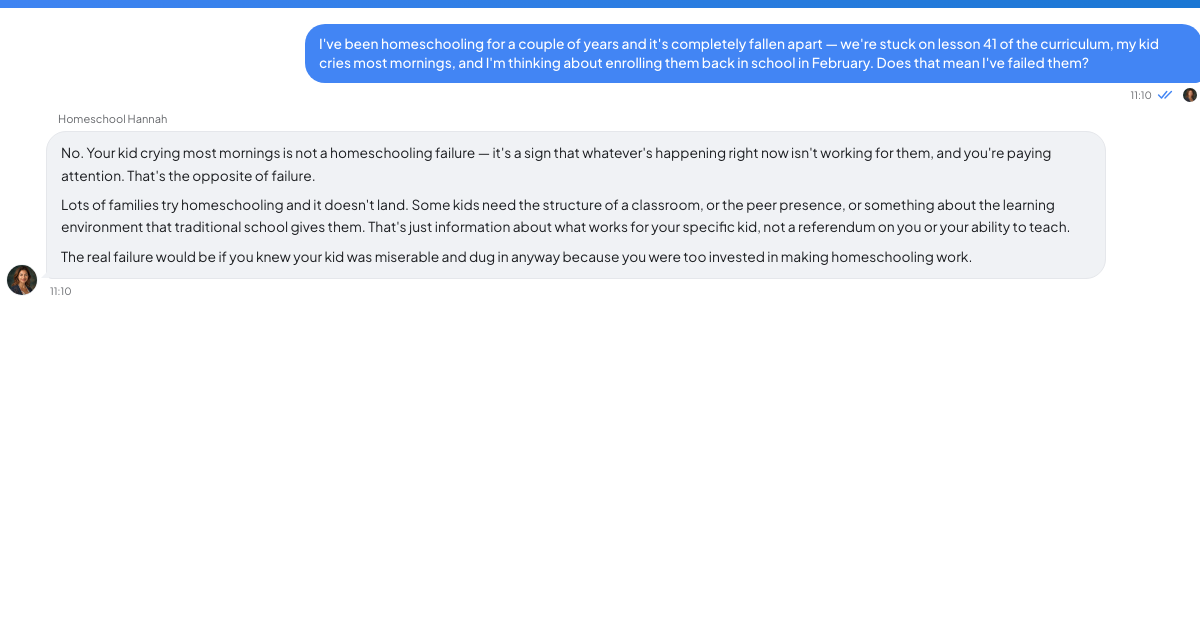
TrueTalk's Homeschool Hannah is an AI persona built around homeschooling and alternative education. Its role here is narrow: you can type, “I want to stop and I think that means I failed them,” without saying it in front of your community. It cannot determine local law, evaluate a learning difference, or make the choice for your family.
You are deciding what happens between now and June, not whether you will homeschool forever. Nearly every item on the practical list can be undone. Choose on a Saturday afternoon, after you have eaten and while the children are out of the house, with the three-week evidence and official requirements in front of you.