Meeting His Family in Lagos and Terrified of Getting It Wrong
Your partner cannot easily narrate the rules he learned as reflexes. Ask for remembered scenes, consult an in-law, and prepare for four high-attention moments.


Ask your partner for memories, not rules
His blind spots are not a failure. The rules of a childhood home become bodily habits rather than information you can easily list. He has never once had to decide who to greet first, in the way you'd have to decide, because for him it isn't a decision — it's what the body does when the door opens. Ask him what the rules are and he'll say there aren't really any, we're pretty relaxed, and then two hours into the visit he'll wince at something you did that he could not have predicted he'd wince at.
That is how you reached eleven open tabs with three weeks remaining, none answering the family-specific question. Two discuss business handshakes and eye contact. Three more repeat that you should respect local customs. The 2014 forum thread ends in an argument. Your fear is not that you will offend an entire country. You fear spending a weekend in a Lagos living room while eight people who matter enormously to your partner decide what they think of you.
You have asked more than once. His kind answer — just be yourself — gives you almost nothing to act on.
He also wants you relaxed, which encourages him to minimise. Because he is managing your nerves instead of briefing you, each answer returns slightly softened.
If he emigrated as a teenager or has lived abroad for years, his map may also be frozen at departure. Meanwhile, households continue changing. His description of his mother may come from the household he knew at seventeen, not the household you will enter now.
Stop asking him to summarise "the customs." Prompt him with incidents and sequences instead.
Six questions that retrieve real scenes
These questions work by retrieving incidents rather than requiring him to describe an invisible system.
- Who in your family is it most important I get right? What happens if I get them wrong?
- What did your cousin's wife do when she first came that your mum still brings up?
- What were you told off for as a kid that you'd never think to tell me?
- If I do nothing at all — just sit there politely — what will they assume about me?
- Walk me through the first ten minutes. Who opens the door. What am I doing with my hands. Who do I greet, in what order.
- What would embarrass you, specifically?
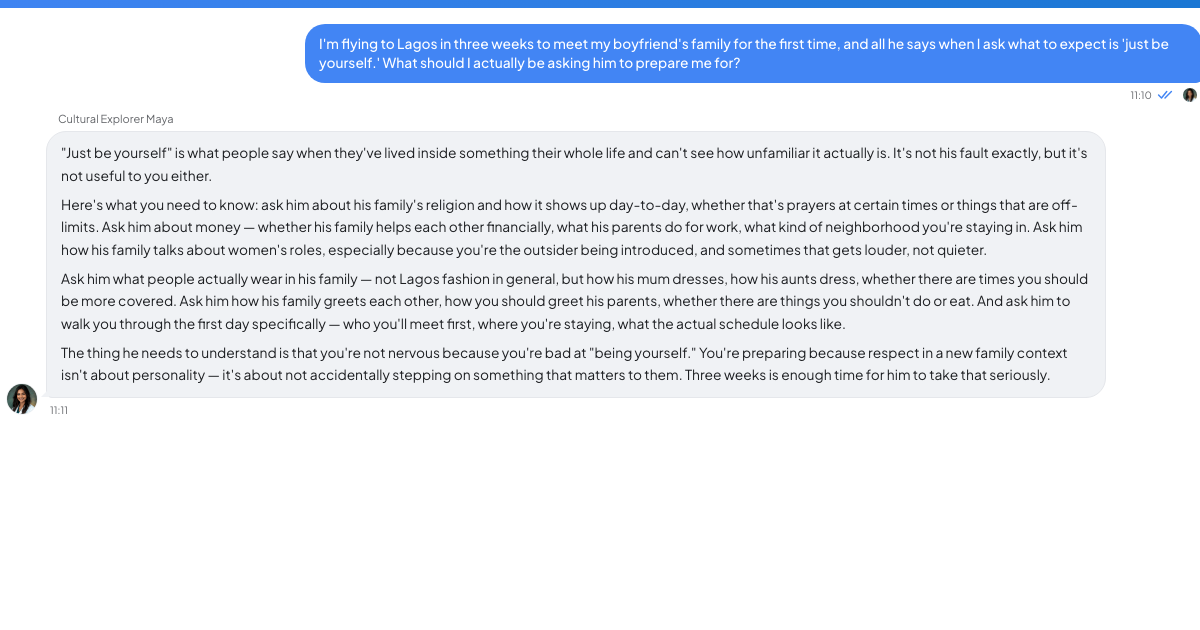
The final question may reveal more than all the others. He can't retrieve the rules, but he can absolutely retrieve his own embarrassment, and the rules are sitting underneath it. If you want to rehearse those six questions before you put them to him, Cultural Explorer Maya, an AI advisor on TrueTalk, is available through the free tier, which includes ten conversations and one hundred messages per day.
Afterward, find a second informant. His sister, a cousin near his age, or best of all somebody who married into the family from outside. The in-law who had to learn it consciously is the only person in that house who can describe the rules as rules, because they were once a set of instructions rather than reflexes. Ask him for an introduction, then put the same questions to that person. Pay closest attention where the two accounts disagree.
Prepare for four high-attention moments
A weekend lasts a long time, but family attention clusters around a few moments.
The arrival. Many Nigerian households expect elders to be greeted first and individually. In Yoruba culture, published scholarship describes kneeling and prostration accompanying verbal greetings as signs of respect toward older people (Journal of Language and Literature study). Lagos is largely, but far from exclusively, Yoruba; a younger woman's traditional form is kneeling and a younger man's is full prostration. Practice varies enormously by family and generation, so this evidence cannot brief you on his particular home.
Ask his sister whether this household still observes it, and follow her answer. Do not attempt the greeting cold on his assurance; he may say it is unimportant and still flinch when you omit it. Once you know the household's version, have him demonstrate it aloud in a kitchen several times before you reach the doorway with a suitcase.
Across the possible versions, greet people individually rather than waving at the room, beginning with the oldest person present.
The gift. Avoid cleverness that depends on context you do not have. Clever needs context you don't have. Bring something that is plainly from where you came from, bring enough of it that it can be shared out rather than owned by one person, and hand it to the head of the household rather than distributing it yourself. Ask in advance about alcohol — Lagos families are Christian, Muslim, both within the same building, and neither, and a bottle of something can be a warm gesture or a small insult depending on a fact you can check in one text message.
The first meal. Eat visibly, name what you liked, and accept a second helping at least once even when you are full. Refusing food in a house where feeding you is how affection is expressed reads as a verdict on the house. The honest exception: if you have an allergy or a genuine religious restriction, that gets said in advance, by your partner, to his mother, days before you land — not discovered at the table with everyone watching.
The offer to help. Generic advice fails particularly badly in the kitchen. In many households the offer to help in the kitchen is the whole point, and being waved away is not a refusal — it's the first move in a short exchange where you're expected to offer again. In others, a guest in the kitchen is genuinely in the way. Ask him which one this is, and ask specifically: what happens when I stand up and offer? Do they mean it when they say no?
On dress, choose more coverage than you might at home and ask specifically about an unannounced church or mosque visit. Current UK travel advice says visitors should dress modestly, particularly in northern Nigeria and at religious sites, and notes that Ramadan conduct varies by predominantly Muslim area (UK FCDO Nigeria advice). That national safety guidance does not tell you what his Lagos family expects, which is why you still ask.
For language, learn four phrases rather than forty. A greeting, a thank you, an answer to how are you, and whatever the respectful greeting for an elder is in that house. Say them badly. Badly is fine — better than fine. You are not trying to pass. You're trying to demonstrate that you took the trouble, and a clumsy attempt communicates that far more clearly than fluency would.
Know which problems etiquette cannot solve
Some relatives may have decided before you arrive. If the objection is religion, or nationality, or that you are not from the same part of the country, no gift and no correct greeting will move it, and the honest goal for day one isn't winning them over — it's not handing anyone ammunition. That's a slower project measured in years and mostly conducted by your partner, not you.
The trip can also reveal a relationship problem rather than an etiquette problem. If he won't prepare you, deflects every question, or hasn't told them something significant about you, then the problem isn't etiquette. It's that you're being sent into a room without a briefing, and that's worth a conversation before the flights, not after.
Trying too hard creates its own difficulty. A guest performing a culture they've studied for three weeks reads as performance, and performance reads as anxiety, which makes everyone in the room anxious too. Aim for respectful and attentive. Not native.
You will probably make a mistake, as he will during his first visit to your family. A family can see the difference between an error made after sincere preparation and one that suggests you never bothered to ask. Before the flight, have him demonstrate the doorway greeting twice, confirm the gift and alcohol question with his sister, and ask who will be at the first meal.