My Last First Date Was in 2012
A drink is booked for Thursday and you haven't done this since 2012. What genuinely changed, how much to say about the marriage, and what to do with the nerves.


The part nobody warns you about is the car park
Twenty past seven on a Thursday. You are sitting in the car outside a bar you picked because the parking is easy, and you have been there four minutes now, doing arithmetic. Arrive first and you are the man alone at a table watching the door. Arrive second and you have to walk the length of a room while someone already sitting down watches you do it.
Neither is good. You have to pick one.
And underneath that is the bit you'd rather not say out loud, which is that you are forty-three and this nervous about a drink. People half your age do this on a Tuesday for something to do.
You have got about twenty-six hours, not a year, and most of what's written for divorced people assumes you have got the year.
What actually changed since the last time you did this
The conversation starts before the date. If you met on an app there is a written record of the last week sitting in your phone. Jokes, and a night that got moved twice. On Thursday you are not meeting a stranger, you are meeting someone who already has a version of you assembled out of a short profile and a handful of photographs. Read the thread once before you go. Not to script anything. Just so you do not ask her a question she answered on Sunday.
The apps have video calling built into them now. You may ask for one before meeting, although that ship has sailed for Thursday. Pew found that one in ten partnered US adults met their current partner through a dating site or app, while users were divided on their overall experience: 53% called it positive and 46% negative (Pew Research Center). Those figures describe the format, not how this particular drink will go.
Assume she's taken precautions, and do not make it mean anything. She has probably told a friend where she is and roughly when she will be home, and she may have looked you up. If she suggested the venue, accept it; if she arranged her own way home, do not treat that as a verdict on you. RAINN's safer-dating guidance recommends a public, populated meeting place and staying in control of your own transportation, while stressing that precautions reduce risk but cannot guarantee safety (RAINN).
The evening is smaller than it used to be. Plan for an hour. One drink, two at most. If it is going well you can extend it, and extending feels far better for both of you than a booked three-course dinner where you have both worked it out by the starter and still have ninety minutes to serve.
On money: offer, once, with no performance attached. If she wants to split it, let her, and do not turn it into an anecdote about how you were raised.
What did not change
People can still tell when you are performing.
Being asked a real question and then genuinely listened to is still rare and still works. No app has touched it. Three seconds of silence is still not an emergency, and someone deciding they do not fancy you is still allowed.
Say something about the marriage, then stop talking
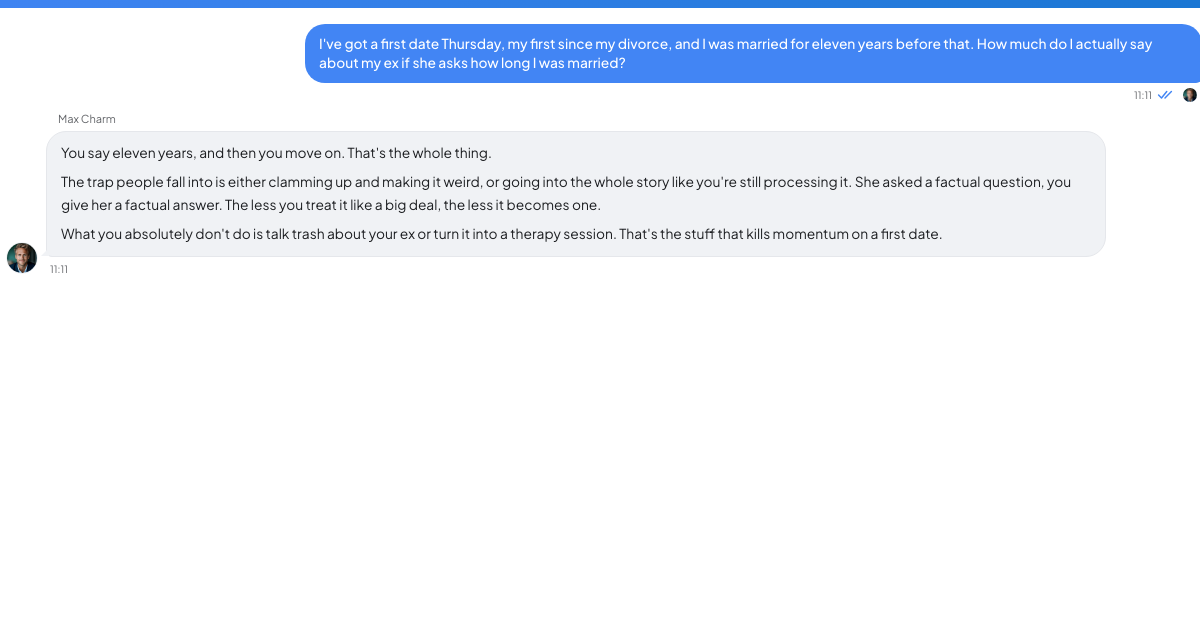
Every article says do not mention your ex. For a twenty-six-year-old that is decent advice. For you it is nonsense, because an eleven-year marriage is not a skeleton you are hiding, it is most of your adult life, and refusing to say anything at all about it reads as evasion or as a wound that is still open.
So say something. Say very little.
Imagine it lands forty minutes in, somewhere between the second drink and the food she may or may not want. So how long were you married? The instinct is to give her the true shape of it. The eleven years. The bad stretch. The counselling in year nine that did not take. The fact that you did not want it to end and it ended anyway. All true. All yours. All far too much for a Thursday.
Give her the sentence instead. Eleven years, we split two years ago, it was grim for a while and it is fine now. Then ask her something and actually listen to the answer.
No villain and no timeline, and no second sentence unless she asks for one. Everything you leave out is what you tell someone in month four, if there is a month four.
The first ninety seconds are admin
Nothing charming happens in the first ninety seconds, so stop trying to make it. There is a greeting, then a decision about where to sit, then a coat that has to go somewhere, then a drink to order. Do the admin cleanly and calmly, and the evening has somewhere to start from.
Hands need a job. Both hands wrapped around a glass is the tell. One hand on the glass, the other loose on the table or in your lap.
The phone does not go on the table. It also does not go face down on the table, which is the same thing with a hat on. Jacket pocket, silent, and it stays there for the hour. Nobody needs you tonight.
Decide before you leave the house what time you are happy for it to end. Just knowing, so you are not making that decision at the same moment as everything else.
Nerves are the correct response at forty-three
The advice you'll find is to project confidence. Fake it, walk in like you own the room. At twenty-nine that might have worked on somebody. At forty-three, across from a woman who has probably also had a decade she'd rather not summarise, it reads as a man doing a bit.
Visible nerves at this age say you care how it goes. Compare the alternative sitting three tables over: the bloke who has done this every week for four years and could do it in his sleep.
Nerves denied are the thing that reads badly. The story told slightly too loud, then the little glance to check whether it landed.
You are allowed to name it once. Sorry, first one of these since 2012, I might be rusty. Once. Lightly, near the start, and then never again. Say it twice and it stops being honest and becomes a request for reassurance, which is a heavy thing to hand someone in the first hour.
About the fear under all of it. That whatever made you appealing at twenty-nine has gone. Some of it has, and that is arithmetic. You do not have his face, or his free Saturdays, or his ability to be interested in absolutely anyone, or his appetite for starting from nothing. What you do have is that you know what you are like to live with, and you can usually tell inside twenty minutes whether someone is being straight with you.
Whether the specific person opposite you on Thursday finds that attractive, nobody can promise. It does read as adult, and the twenty-nine-year-old couldn't do adult at all.
One honest caveat. If the separation is very recent, or if you spent last week mentally rehearsing arguments with your ex, Thursday may just be too early, and there is no shame in a drink that turns out to be a drink. Some dates are simply bad, in ways that are nobody's fault and reveal nothing about you. One is not a sample.
You'll drive home at some point either way, and the evening will be over, and you'll still be forty-three. The only real difference between the man in the car park at 7:20 and the man driving home at half ten is that one of them has done it recently.
Max Charm is an AI advisor on TrueTalk, built around first impressions, confidence building and social skills. Not a person, not a counsellor. If you want to hear the ex sentence out loud four times on a Wednesday night rather than spending a friend's patience on a rehearsal, that is the sort of job it is for. The free tier includes ten conversations and one hundred messages per day.