She Calls Me By My First Name Like It's a Weapon
Your stepchild's coldness and your partner's silence require different responses. Reduce pressure on her, then ask him for one immediate, observable action.


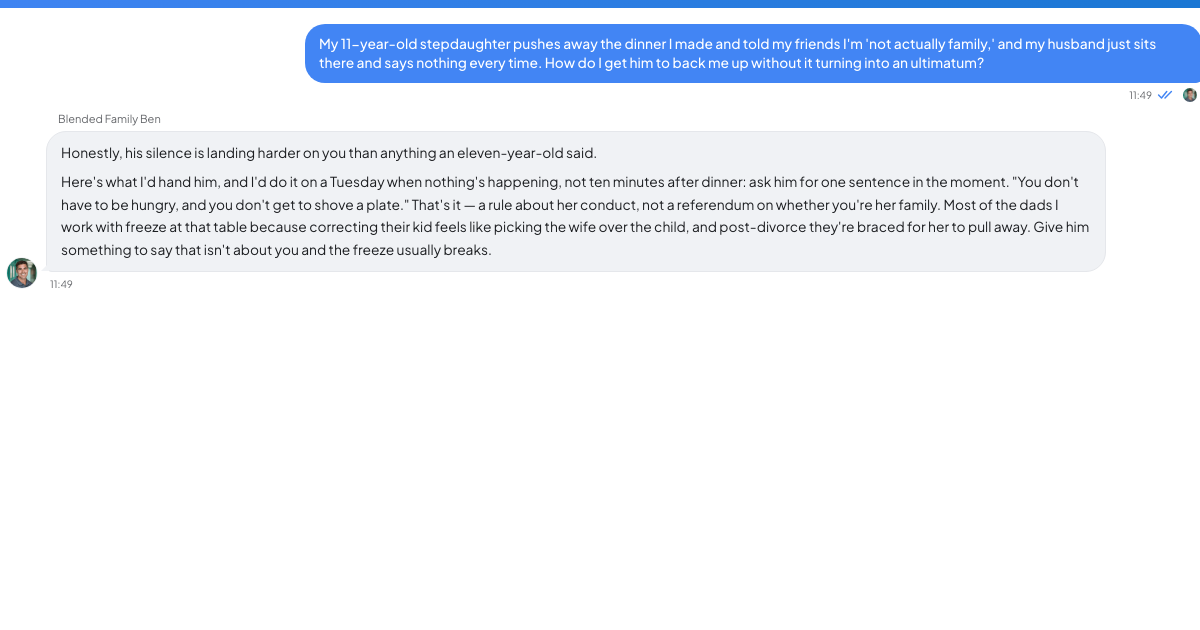
Tuesday at six, with the pasta untouched
You cooked the pasta. For three years, most Tuesdays have included your pasta, just as family life has included packed lunches, PE kit, dentist appointments and a birthday gift for the friend whose name took two attempts.
She slides the plate two inches away, announcing that she will wait until her dad cooks.
Her father watches from the same table. He stays silent because no single act looks serious. Her voice never rose. No swear word was used. Mentioning it later risks casting you as the adult who created drama over pasta.
Last month she also told your friends that you were not actually family. She delivered the comment lightly. Your friends produced small laughs while looking down at their glasses.
The pattern consists of deniable incidents like these. Because no incident reaches crisis level, the pattern continues until you dread entering a room in your own home.
Separate the two jobs
Most advice offers two familiar lines. Do not force closeness; allow the child to control its pace. The second line says rejection concerns what you represent rather than your individual worth.
Each can be true. In practice, both instructions can assign all the household homework to you.
Look separately at the two problems producing the pain. They currently register as one large hurt despite requiring different timelines and remedies.
The first problem is an eleven-year-old's coldness toward you. Her coldness develops slowly, is fairly common, belongs largely outside your control and is usually not urgent.
The second is your partner watching and advising you to "just be patient." That one is fast, fixable, and it is where nearly all of your despair is actually coming from.
Continuing to solve only her coldness could cost another two years of increasingly strenuous caretaking.
Reduce pressure on the child
An eleven-year-old may experience affection for you as disloyalty toward her mother. Neither a cruel child nor misconduct by her mother is required for that loyalty conflict. Within one evening, she may enjoy you and then penalise that feeling.
Working harder for approval can tighten her loyalty bind. Each additional act of caretaking can raise her perceived cost of accepting you. When you make yourself impossible to reject fairly, you make yourself something she has to reject unfairly.
Step out of the audition. Not out of spite — just take the pressure off the transaction.
When the plate returns, say:
"No problem. There's bread and cheese in the kitchen if you want to sort yourself out."
Continue your own meal. Don't look at your partner. Don't say it in a wounded voice. Don't follow her into the kitchen to check she's eaten. The whole point is that the snub doesn't purchase a reaction, and that you're not gone either — still here, still pleasant, still eating your dinner.
When she answers you through her dad, you don't compete for the channel. You say the thing once, to her, and then you let the silence be hers to hold. It's amazing how often kids answer on the third occasion when nobody made a fuss about the first two.
In the early years it usually works better if the biological parent handles discipline while the stepparent builds the relationship. A meta-analysis covering 56 studies found stepparent-child relationship quality positively associated with children's psychological and academic wellbeing and negatively associated with psychological and behavioural problems (Jensen, 2022); association does not prove that extra effort can force warmth. That's not you being denied authority. That's you being spared a fight you cannot win from where you're standing.
And the thing you're allowed to hold, without any authority at all, is conduct in front of you: not being spoken to with contempt in your own kitchen. But the person who enforces that is her father.
That leaves your partner's responsibility.
Ask him for one action
His silence is not neutral. He thinks he is. In a house where one person is being treated badly and another person is watching, saying nothing is a position — it just doesn't feel like one from the inside, because it doesn't require him to do anything.
What he is doing may come from fear that setting a limit will make her withdraw from him too. Research with 234 stepcouples found stepparent affinity-seeking associated with less stepchild conflict, stronger couple relationships and greater family cohesion (Ganong et al., 2019); that supports protecting both the couple and child relationship, not making you audition harder. He's already lost one household. So he outsources the whole problem to you, in the form of advice, and "be patient" costs him nothing at all.
Do not begin this conversation at 11pm after an incident. It'll come out as a list of grievances with dates, he'll hear an attack on his daughter, and you'll spend Sunday apologising.
Choose a calm Saturday morning instead.
Don't lead with feelings, lead with the ask, and make the ask smaller than feels satisfying:
"I need to talk about something, and it's not about her. I don't need you to make her like me — I know you can't do that and I'm not asking. What I need is that when she says something like the family comment, you say something in the room, at the time. Not a punishment. One sentence, from you, so she knows where you stand and so I'm not the only adult in the house who noticed."
After the request, allow him to answer.
If he says he doesn't want to make it worse, that's the real objection and it's worth taking seriously out loud: "I think saying nothing is what's making it worse, because she's learning it's allowed. But tell me what you're worried about."
If he says you're too sensitive, don't argue about sensitivity. Move it to the specific: "Would you have let her say that to your mother?"
What you're aiming for is one concrete behaviour he agrees to do, and a date a few weeks out where you check whether it happened. Not an ultimatum. An ultimatum tells him the marriage is on the line, and compliance that comes out of fear tends not to last.
When one conversation is insufficient
Sometimes a clear, kind request wins agreement but no change. Six weeks later you're still alone at the table.
At that point the question quietly changes. It stops being "how do I win over my stepdaughter" and becomes "what do I do about a marriage where I carry the household and stand outside it." That's a different problem and it deserves to be named as one rather than absorbed as more patience.
That's also the point where a family therapist or a couples therapist earns their fee, particularly one who works with stepfamilies, because the pattern you're in has been mapped and someone who knows the map can move faster than you can. If there's anything frightening in the house — not coldness, but genuine cruelty, or a child being used as a message-carrier between two hostile adults — that's professional territory now, not advice-column territory.
Some relationships take years to warm. Whether it warms up later is genuinely not knowable from where you're standing — not by me, not by a therapist, not by anyone who tells you confidently that she'll come round at twenty-two. That's an unsatisfying thing to be handed. It's still better than the alternative, which is a household where you keep trying to earn a place you already have.
If you want to run either conversation before you have it, TrueTalk has an AI advisor called Blended Family Ben, written as a blended-family counsellor and stepparent coach. He's an AI persona rather than a person, which is exactly what some of this needs at 11pm — nobody who knows your partner, nobody who'll take a side at Christmas, and nobody you'll have to face afterwards. The free tier includes ten conversations and one hundred messages per day. Say the sentence out loud, hear how it lands, change it.
Return to next Tuesday's pasta.
Cook it again next Tuesday. Do it without proof or expectation, simply maintaining the household's Tuesday routine. The steadiness is the whole offer. Whether she takes it is genuinely not up to you.
But the part where you eat that meal with an adult who backs you up? That part is up to somebody, and it isn't her.