You Sit Down to Meditate and the Panic Gets Worse
If breath focus intensifies panic, use an external anchor, shorten the session, and stop escalation. Why the loop happens and when to ask for treatment.


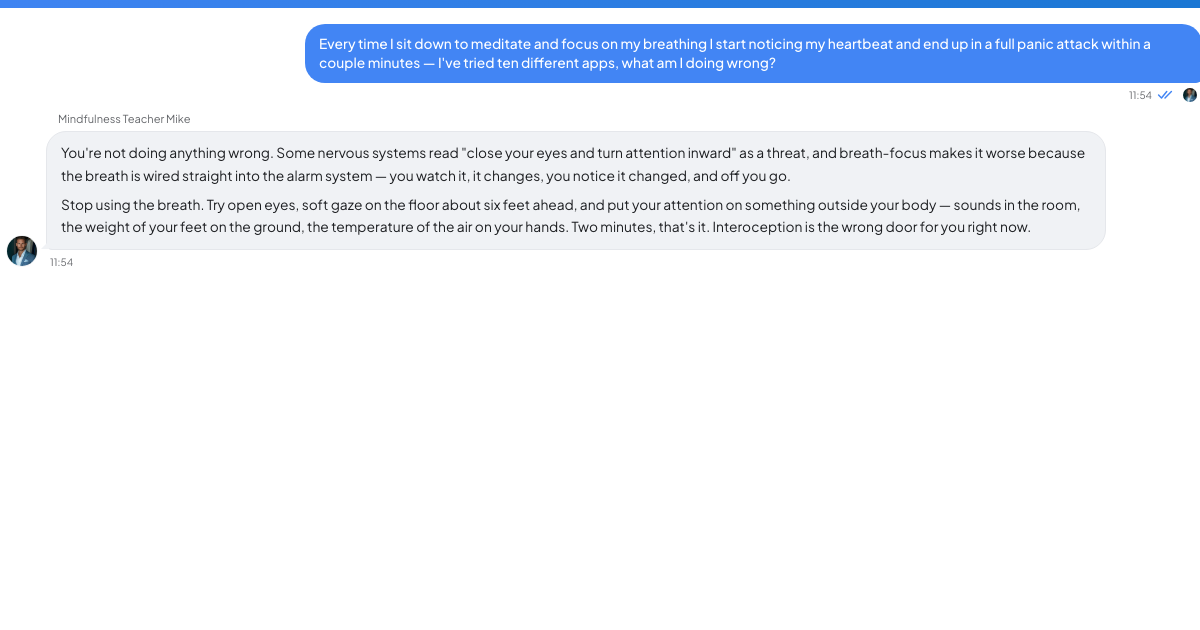
Ninety seconds in, on the bedroom floor
You close your eyes and put your attention on the breath, following the voice in the app.
And then you notice your heartbeat. Not dramatically — just there, at the base of your throat, more obvious than it was a minute ago. So you notice it. Then you notice that you've noticed it, and it seems faster now, and you check whether it's faster, and checking makes it faster, and by two and a half minutes your hands are going and you're opening your eyes and standing up because you have to do something with your body.
You have tried ten apps and made four proper attempts, abandoning each one somewhere around week two.
The conclusion feels obvious: you're uniquely bad at the one free thing every single person recommends.
Those ten apps gave you ten versions of one practice, not ten different things.
Why the standard instruction goes wrong for you in particular
A common clinical account of panic runs roughly like this. You feel a normal bodily sensation — a skipped beat, a tight chest, slight breathlessness — and read it as evidence that something is badly wrong. That interpretation produces alarm, which creates more sensation; the louder sensation appears to confirm the interpretation, and the loop tightens fast into a panic attack. The sensation alone is not the trigger; the attention and the conclusion attached to it drive the loop.
Read the standard beginner's meditation instruction again. Close your eyes, remove external input, sit still, and place sustained attention on the movement of your chest and the passage of air.
Those instructions aim a spotlight straight at the fuel.
For many people, the breath is simply boring, which is the point. When you're panic-prone, it can be the opposite of boring. Every one of those ordinary sensations gets amplified by the act of watching, and stillness strips away the background noise that usually drowns them out.
Clinicians have a name for anxiety that rises during relaxation practice: relaxation-induced anxiety. Heide and Borkovec wrote about it in the early 1980s, so you're a long way from being the first. The National Center for Complementary and Integrative Health says a 2020 review of 83 studies found negative effects in about 8 percent of participants, with anxiety and depression reported most often; meditation is not automatically benign for every person.
That makes the near-universal follow-up — sit with it, push through, this is just resistance, try a longer session — actively bad for this particular problem. Meditation discomfort can be ordinary restlessness that settles. What you're describing is a mechanism doing exactly what the mechanism does, and repeating it mostly teaches you that sitting down to meditate is a thing that comes shortly before panic.
Before the alternatives: this is treatable, and there are people who treat it
If you're having panic attacks with any regularity, or you've started arranging your life around avoiding them — checking exits, not going certain places, not being alone, not exercising because a raised heart rate frightens you — take that to a doctor, and sooner rather than later.
Effective treatments for panic disorder are available. Cognitive behavioural therapy for panic is well established, and part of what it does is precisely the thing this article keeps circling: it works on the interpretation of body sensations, deliberately and in a structured way, with someone who knows how to pace it. The National Institute of Mental Health identifies CBT as a well-researched treatment and describes interoceptive exposure as safely recreating bodily sensations associated with panic so you can respond differently. Medication helps some people. Both are ordinary, unglamorous routes, and neither requires you to have got worse first to qualify.
Tell your GP, using the words "panic attacks" and saying roughly how often they happen.
Nothing below replaces that care; the rest addresses the smaller, specific meditation question.
Other doors
Every option here remains mindfulness on an honest definition: you pay attention, on purpose, to what is happening now without immediately trying to fix it. None of it requires closed eyes, stillness, or the breath. Choose one of them rather than trying all four.
Anchor outside your skin. Eyes open, gaze soft and low, resting on something with no meaning — a patch of carpet, a plant, the grain in a table. When attention wanders, come back to the object. Because a table is not a symptom, an external anchor does not feed the loop.
Hands and feet, not chest. For a body anchor, move your attention to the periphery. The pressure of your heels on the floor. The temperature of your palms. The bit of one finger touching another. Ankles and fingertips don't carry the threat meaning that the chest and throat do.
Sound. Sit anywhere and listen, with your eyes open or closed. Not to a soundtrack — to the room. Traffic. Boiler. Someone upstairs. Your task is to notice each sound arrive and end. Sound works unusually well here because it's continuous, external and impossible to control, which quietly undermines the idea that you're supposed to be controlling anything.
Walk. Walk outdoors for ten minutes at an ordinary pace, without headphones. Attention on the soles of your feet, or on naming five things you can see. Walking gives the arousal somewhere to go, and there's no sitting-still requirement to fail at.
Do one job with your whole attention. Washing up is the classic example: attend to the water temperature, the plate's weight, and the sound. Fifteen minutes of that is a real practice.
Make it short enough to finish. I would start by shortening the practice to ninety seconds. Set a timer, do ninety seconds of one of the above, stop when it goes off even if it's going fine — especially if it's going fine. At present, you are rehearsing a sequence that ends in panic. You want a stack of repetitions that finish with nothing much happening. Duration can grow later, or never. There's no prize for twenty minutes.
And a rule that overrides all of it: if it starts to escalate, stop. Open your eyes, stand up, walk to the kitchen, run your hands under the tap. Stopping keeps the practice from becoming something you dread.
The quiet mind thing is a marketing invention
Meditation has been marketed as a calm, empty, still state. So people sit down, produce a mind full of tomorrow's meeting and an old argument and something they said in 2019, and reasonably conclude they're doing it wrong.
Every mind wanders, including those of teachers, retreat participants, and the person whose voice is in your app.
The practice consists of noticing and returning. When attention leaves, you notice and bring it back. If it happens forty times in ninety seconds, you completed forty repetitions. That's a heavy session. A session where attention never wandered wouldn't be practice at all, because there'd be nothing there to practise.
Same with calm. Calm is a side effect some people get sometimes, and chasing it is its own kind of monitoring — monitoring your own calm is structurally identical to monitoring your own heartbeat.
Where a recording can't tell you've stopped
An app cannot tell that you have stood up. It carries on in the same soothing register while you're standing there with your hands buzzing, which somehow makes it worse — now you're failing at something in front of a voice that hasn't noticed.
TrueTalk's Mindfulness Teacher Mike is an AI persona, not a clinician and not a human teacher. Unlike the app, it's there at the hour this actually happens, which is usually about eleven at night. The free tier includes ten conversations and one hundred messages per day. Use it as a thinking-out-loud tool; the GP guidance above outranks it.
And if you never take up meditation at all, that's a legitimate outcome. Meditation is one tool, and plenty of people manage anxiety well without ever sitting on a cushion.
If you want to try, choose one option from the list and set a timer for ninety seconds. Stop when it sounds, including when the practice is going fine.