Your Foot Went at Week 11 and the Race Is Already Paid For
A five-week marathon decision starts with a real heel examination, then a plan for cross-training, a guarded finish or timely deferral.


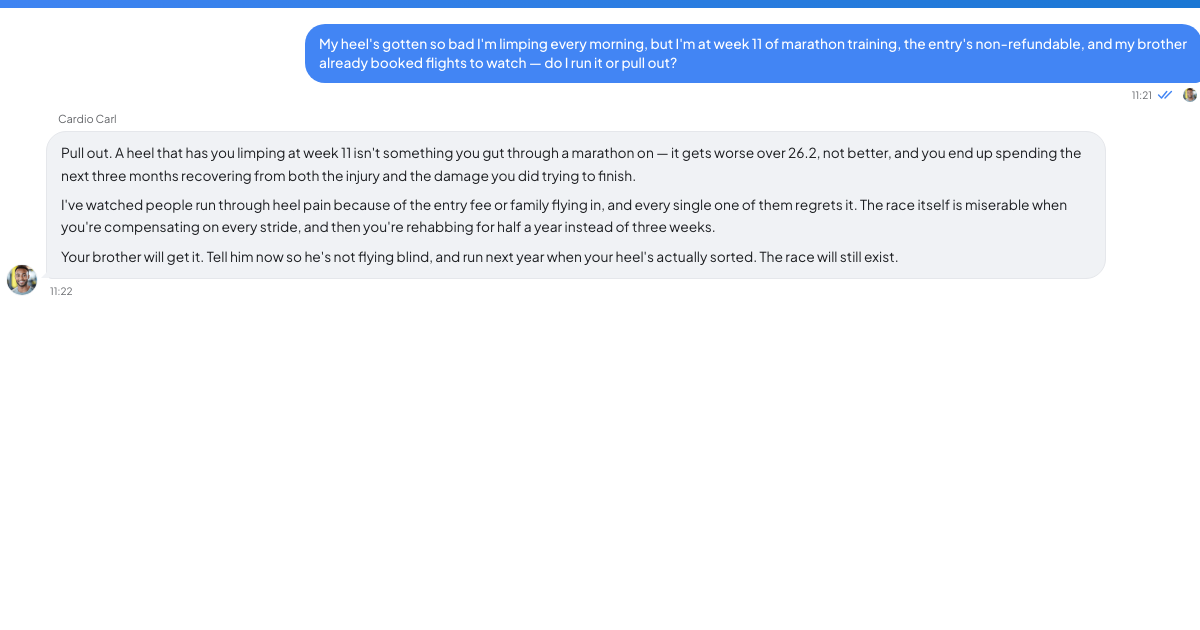
At 11:20pm, the arithmetic feels personal
You are in week eleven of a sixteen-week plan. The heel problem you could manage in June now makes you limp for the first twenty minutes after getting out of bed, though it took until Tuesday to call it a limp.
The entry fee has gone. The hotel becomes non-refundable after the 30th. Your brother has flights and keeps asking where he should stand along the course. About forty forum replies have left you between two declarations: rest for six weeks, or run because somebody else did and was fine. Neither reply can identify what is injured in your foot.
The survivors who post race reports may have had injuries that tolerated the load. People eight months into rehabilitation are less likely to be writing triumphant recaps, so the sample quietly loses bad outcomes. Meanwhile, the six-week-rest answer optimises tissue recovery alone. You are balancing the race, the season, booked flights and the amount of risk you will accept.
Get the heel examined this week
Morning pain that improves after a few minutes of walking matches a common plantar-fasciitis pattern; the American Academy of Orthopaedic Surgeons lists pain on the first steps after bed or prolonged rest among its typical symptoms. A familiar pattern still does not diagnose you. Heel pain can come from the plantar fascia, fat pad, a nerve, a tendon or a bone stress injury.
That last possibility changes every recommendation here. Soft tissue can often be managed around. Bone cannot be negotiated with: continuing to run on a stress reaction can lead to a fracture and a boot, eliminating any viable version of this race.
Book a physiotherapist or sports doctor this week. Say "marathon" and "five weeks" during the appointment so the clinician understands the timetable. Pain focal enough to cover with one fingertip on the bone, pain at night, or pain that is worsening rather than level warrants urgent attention. The AAOS also notes that MRI or ultrasound is not routinely needed for plantar fasciitis but may be ordered when a clinician suspects another cause, which is why an examination comes before a training workaround.
Every training option below depends on a qualified clinician having examined you and identified a soft-tissue problem.
Three weeks without running does not erase eleven weeks
Your aerobic work is more durable than it feels in the dark. Mitochondrial density and oxidative enzymes do not vanish in a fortnight, especially when you keep training your cardiovascular system another way.
Blood and plasma volume change sooner. A 2024 review of detraining research reports that Coyle and colleagues found about a 7% VO2 max decline after 12 days and says the initial decline was partially caused by decreased stroke volume (official review on PubMed Central). The primary study's abstract records seven trained subjects measured at days 12, 21, 56 and 84; it summarises a 7% VO2 max decline during the first 21 days and muscle capillarisation remaining 50% above sedentary controls after 84 days (canonical PubMed record). Their 1986 follow-up studied eight endurance-trained men after 2–4 weeks of inactivity and measured a 9% reduction in blood volume, a 12% reduction in plasma volume, a 12% reduction in stroke volume and a 6% decline in VO2 max (canonical PubMed record). Blood volume recovery can be as quick as the loss. Those are small studies, not a personalised forecast; your training age, genetics and substitute training prevent anyone from honestly assigning you an exact percentage.
Running-specific tolerance is the more dangerous mismatch. Your tendons, calves and other connective tissue lose familiarity with landing forces while your aerobic engine still feels capable. That is how a runner returns, trusts their lungs, and acquires a second injury in week two back.
Use the three weeks to train without loading the foot. Deep-water aqua jogging with a belt is the least fun option and the most effective: it most closely resembles running without landings, provided you hold a real effort rather than bobbing. Cycling works. An elliptical works if it is genuinely pain-free. Rowing preserves effort but loads the calf more than many people expect. Across all four, stop if the session hurts or the next morning is worse. Morning pain is the only reliable gauge for this kind of injury because tissue reports after cooling, rather than while you are warm and full of adrenaline. The American Orthopaedic Society for Sports Medicine describes first-step morning pain as characteristic, so compare the same first twenty steps each morning.
Keep the plan's weekly shape: replace the long run with ninety minutes of conversational cycling and replace intervals with pool intervals. Three weeks off running followed by two guarded return weeks costs a chunk of finishing time. It does not cost the race if the examination supports returning and you rebuild impact carefully rather than coming back stupidly.
Replace 3:45 with a finish-or-defer decision
If 3:45 sits at the top of your plan, it is not happening. Three weeks of cross-training and rehabilitation plus two careful weeks can leave your aerobic base broadly intact, but your legs underprepared for the back half of 26 miles. Starting at goal pace ends with you walking from mile 18 and a foot that is now a six-month problem instead of a five-week one.
A slower finish is available. Jeff Galloway built a coaching career around run-walk racing, and many runners complete marathons that way. Choose a pace slow enough to feel like surrender, then keep it through ten miles beyond the point where restraint feels embarrassing. Before race day, choose the mile where you will stop if the pain changes character. Tell your brother the number; he will be standing at mile 18, and he is the only person in a position to hold you to the decision you made while calm.
If the time was the reason for the year, check the deferral policy today. Deferral and transfer windows close, and choosing on the 15th rather than the 29th can determine whether you preserve the entry fee.
Also answer one question aloud: if starting costs your next six months of running, is the race worth it? A yes can be rational for a charity place with money raised, a fiftieth birthday, or an ill parent who specifically wants to see this year's race. You would be weighing one real value against another. For most people, hearing the question produces a clear no.
Rehearse the conversation before Friday
Your brother is both the person you need and the person whose flights make the conversation awkward. Tell him now that the plan changed.
TrueTalk's Cardio Carl is an AI advisor specialising in marathon training, cardiovascular fitness and running technique. He is an AI persona, not a physiotherapist, and cannot diagnose your heel; the appointment remains necessary. At 11:20pm, however, you can use him to map a run-walk race or rehearse telling your family that you may not start. The free tier includes ten conversations and one hundred messages per day.
Make the decision this week after the examination. Five weeks of half-sessions is the worst outcome: it can keep the injury simmering while fitness slides, leaving you trained for neither a conservative finish nor a proper recovery. Choose the guarded finish or the deferral, and give your brother time to adjust before Friday.