Your Kid Cries in the Car Before Every Game
She's brilliant in training and freezes on Saturday. Move the hard conversation to Tuesday, shrink the game-day demand, and audit what she sees on your sideline.


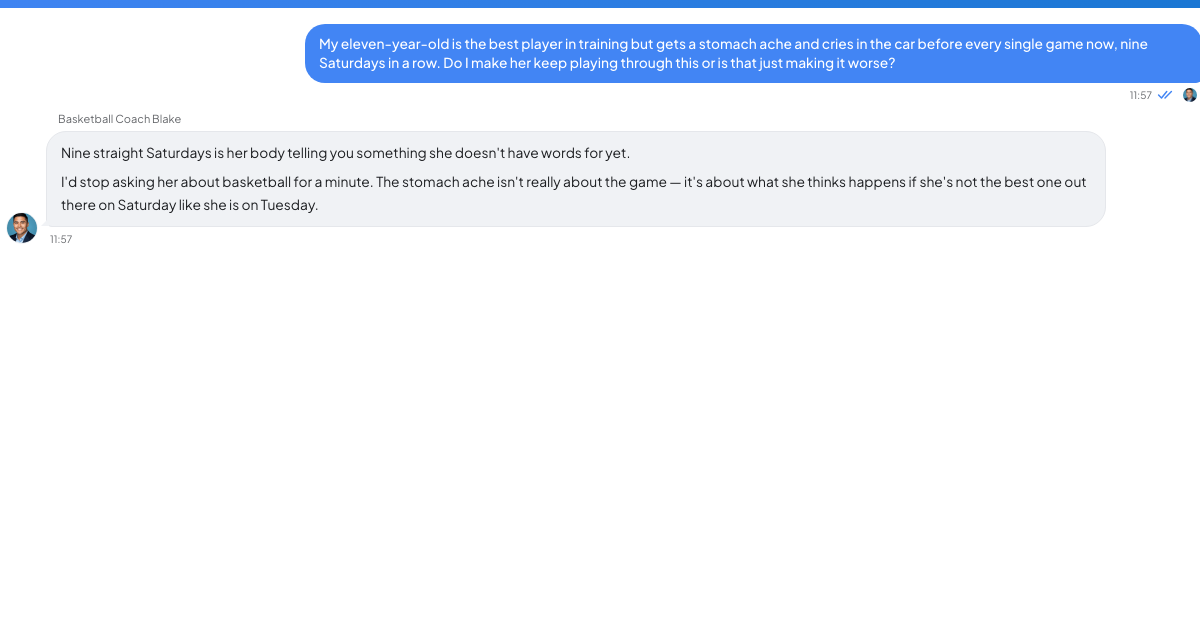
Move the conversation away from Saturday morning
She's eleven and brilliant at basketball training. On Wednesday she was the best player in the gym, and everyone there knows it, including her; on Saturday, for the ninth game running, the stomach ache starts around half eight and the tears arrive near the roundabout. By the time you park she has composed herself but will not look at you. She passes as soon as the ball reaches her and will not shoot.
On the drive home she apologises for letting everyone down. You wonder whether some of the pressure is coming from the sideline, where she can see you.
Do not try to solve this in the twenty minutes before leaving the house. She is already distressed and you are watching the clock. Talk on Tuesday, when neither of you has to produce a game-day decision.
A 2025 clinical review by Katherine Beenen, Jennifer Vosters and Dilip Patel describes youth sports performance anxiety as emotional distress before, during or after performing in front of others; in children it can include bodily symptoms and avoidance. That is a useful description of the stomach ache and the wish not to go, without pretending it is a diagnosis (PubMed; record retrieved through NCBI E-utilities).
Keep contact, reduce the demand
The choice is not simply force her through every game or let her quit that morning. Compulsion can make Saturday feel like something done to her. Immediate withdrawal rewards avoidance because the stomach ache disappears as soon as the decision is made.
Have her go, but agree on a smaller job. She could warm up and decide at the whistle whether to play. She could ask the coach for fewer minutes for a few weeks. She might spend two Saturdays in kit on the bench with her teammates. The aim is continued contact at a level her body can tolerate. Put those options to her on Tuesday and let her disagree; she needs ownership of the plan.
Training and competition ask different things of attention. A poor pass on Wednesday is practice. On Saturday it comes with a scoreline, the coach's face, an audience and a parent visible from the court. Once she monitors her performance in real time, she has less attention left for reading the play. Getting rid of the ball immediately becomes the safest move.
Telling her to relax and have fun gives her another state to fail at. Explain the mechanism in her own words. Eleven-year-olds are relieved by explanations that turn "something is wrong with me" into "my brain is doing a thing that brains do." The clinical review above says assessment should distinguish ordinary pre-competition nerves from longstanding symptoms causing significant distress or impairment; it also identifies cognitive behavioural therapy as the main psychological intervention studied in young athletes.
Give her two countable jobs
Replace the outcome target with actions she controls. Scores, wins and how well she played depend on other people; a process goal can be completed whether her team wins by twenty or loses by thirty.
Choose from concrete options:
- Call for the ball five times, loudly enough to be heard.
- Take the first open shot, regardless of whether it goes in.
- Sprint back after every turnover, including her own.
- Say one thing to a teammate after a mistake.
Four is plenty and two is better. She chooses them, because a process goal assigned by you becomes another evaluation. In a prospective study of 160 high-school athletes, mastery-and-improvement goals predicted more self-confidence and less cognitive and bodily anxiety, while avoidance goals predicted more anxiety (PubMed; record retrieved through NCBI E-utilities). She is younger than that sample, so use the finding as support for the direction, not as a promise about her result.
For one month, those two actions are the only basketball details either of you raises after a game.
Change the car ride and the sideline
Before the game, keep the car boring: water, whether Nana is coming, then music or silence. If she brings up the game, say, "You don't have to play well today. Just do your two things." Skip the pep talk; reassurance about how important today is still tells her that today is important.
Afterwards, do not analyse. The post-game car teaches her what the game was for; if immediate analysis is the first thing she hears, performance becomes the point. Say, "I loved watching you play," and ask whether she wants chips. If she wants to talk about the game, she will do it on her own schedule, usually about twenty minutes later and about something you never noticed. Technical feedback belongs with the coach; if the coach is not giving it, speak to the coach separately.
Then audit your own behaviour without turning the audit into a confession scene. Guilt makes a parent defensive or dramatic, and she needs neither. Count how often she looks at you after a mistake. Notice hands on head, turning away or looking at another parent; she can read those reactions from thirty metres. Those moments teach her what parental attention feels like while she attempts something difficult. Count how many non-playing days this week included basketball talk. If it is most days, basketball has become the main channel between you, and a channel that large carries pressure. Record your first post-game question: if it concerns the score or her performance, it reveals what you value, whatever you say aloud.
Ask the uncomfortable question too: are you attached to the level she might reach, the Saturday parents, or the version of her you have pictured since she was seven? You do not need to be free of that investment. You need to know where it leaks into what she sees. Change the behaviour quietly and expect the change to take weeks.
Rule out more than basketball
Two months of recurring stomach aches warrants a GP appointment, both to check physical causes and to discuss anxiety-linked symptoms. Track the pattern before you go: Saturday only, or also Sunday nights, school mornings, tests, birthday parties and places she used to enjoy.
If the dread has spread beyond basketball, ask the GP about a child psychologist. Anxiety at this age is treatable and treated routinely, and seeking help early is not overreacting. If it remains specific to games, take the smaller-participation plan to her coach and agree exactly what Saturday will involve.
TrueTalk's Basketball Coach Blake is an AI, not a clinician and not her coach. You can use it at 11pm to say the thought you have not said to your partner or the coach: that you may be part of the problem. The free tier includes ten conversations and one hundred messages per day. Use that conversation to choose one observable behaviour to change at the next game.