Your Lifts Are Down, Your Sleep Is Wrecked, and Your Coach Says Push
You cannot diagnose fatigue from how motivated you feel. Book the blood tests, collect four measures for seven days, and run a down week you can retest.


Ring the GP this week
Your resting heart rate has been eight beats higher since spring. You woke at 4:10 this morning, just as you did on Tuesday and the Tuesday before. The back squat that moved in March has gone backwards twice. After nine months of training six days a week, you are in the car park at 5:12am wondering whether you are exhausted or simply not trying hard enough.
Keep medical causes in the investigation. Thyroid disease, low iron, sleep apnoea, a lingering virus, a couple of drinks most evenings and ordinary medications can all disturb heart rate, sleep or performance. Book blood tests and tell the GP the two specifics that determine what gets tested: heart rate up since spring and awake before five. Every month spent testing training theories is a month not spent investigating a medical cause. Run the training check below alongside the appointment.
The European College of Sport Science and American College of Sports Medicine consensus statement says overtraining syndrome is an exclusion diagnosis. It specifically names infection, iron deficiency, negative energy balance and insufficient carbohydrate or protein among the alternatives clinicians should examine (PubMed; record retrieved through NCBI E-utilities). That is why the blood tests remain necessary alongside the training review.
Collect seven days instead of judging your character
Do not decide what to do with training today. First collect seven days of evidence. Fatigue and low motivation can feel identical from inside your head. Effort is unmeasurable and output is measurable; that difference is why arguments about effort do not end. Use output and repeatable observations instead. Record four things; together they take under ten minutes a day.
Resting heart rate: measure before sitting up, coffee or your phone. Record exactly one number a day. Keep the conditions the same and compare the seven-day line with March. A single poor reading can come from one bad night and mean nothing.
Bar speed: this is the most useful of the four measures and the one people skip. Choose about 70 per cent of your best this year, film three singles from the side on the same weekday and compare clips. You do not need a velocity tracker to see whether the bar leaves your back cleanly or needs to be ground up.
Sleep: record two numbers: roughly how long sleep took and whether you woke before five. Deep fatigue often presents as wired at 11pm and awake at four even though people expect exhaustion to mean easy sleep.
The drive in: before entering the gym, mark the session neutral, wanted or dreaded. One Monday proves little; five days out of seven deserves attention. You can also note appetite and whether small cuts or scrapes linger.
If heart rate is elevated, the fixed-load bar is slower, four o'clock waking persists and the drive feels like a tax, four independent signals point toward accumulated fatigue. If they split, investigate nutrition, life stress, a programme with no wave, or the cut you have quietly run since June.
The same consensus statement distinguishes functional overreaching, which improves after recovery, from non-functional overreaching and overtraining syndrome largely by the eventual clinical outcome and recovery time. It also says no current hormonal, performance, psychological or biochemical marker meets every criterion for general acceptance. You find out partly by reducing load and observing what returns; one reading cannot label you.
Run an actual down week
One rest day after nine months is a rounding error. Keep the six-day frequency if your life is built around it, but change the work inside each hour.
Cut working volume to roughly half: three sets where you usually do five, or the first third of a long chipper. Keep every working load at about 70 per cent or below. Do no singles, touch-and-go max efforts, failure sets or score-driven AMRAPs.
Put conditioning inside a fixed eight-to-twelve-minute window and stay at nose breathing or beneath a heart-rate ceiling chosen before you start. Use the spare capacity for positions, single-leg work and the shoulder issue you have ignored since February. The light work may feel like a wasted hour. That feeling is withdrawal; write it down and keep the plan.
Complete the seven-day evidence record first. Only after reviewing those data should you decide whether to begin one lighter week. Retest the same bar at the same load after that lighter week. If it is faster and you slept through twice, you were overreached and the fix lives in the programme. If nothing changes, continue through a full fortnight of lighter training and retest after the second week; if nothing has moved then, stop treating this as a training-only problem and pursue the medical appointment.
A separate International Olympic Committee consensus statement concludes that inappropriate load management raises the risk of acute illness and overtraining syndrome, and recommends monitoring training, competition and psychological load alongside well-being and illness (PubMed; record retrieved through NCBI E-utilities). Your seven-day sheet covers several of those lanes instead of reducing the question to willpower.
Take the social pressure out of the decision
You already knew what a deload was. The obstacle is the 6am class: fourteen familiar people in a room where intensity acts like currency. Light work can feel like a public announcement, so you continue training hard but badly.
You owe nobody one. Scale the load and keep the movement. If asked, say, "Light week, I'm on a wave." Most people are occupied with their own board; the one or two classmates who comment are supplying information about the gym, not about your effort.
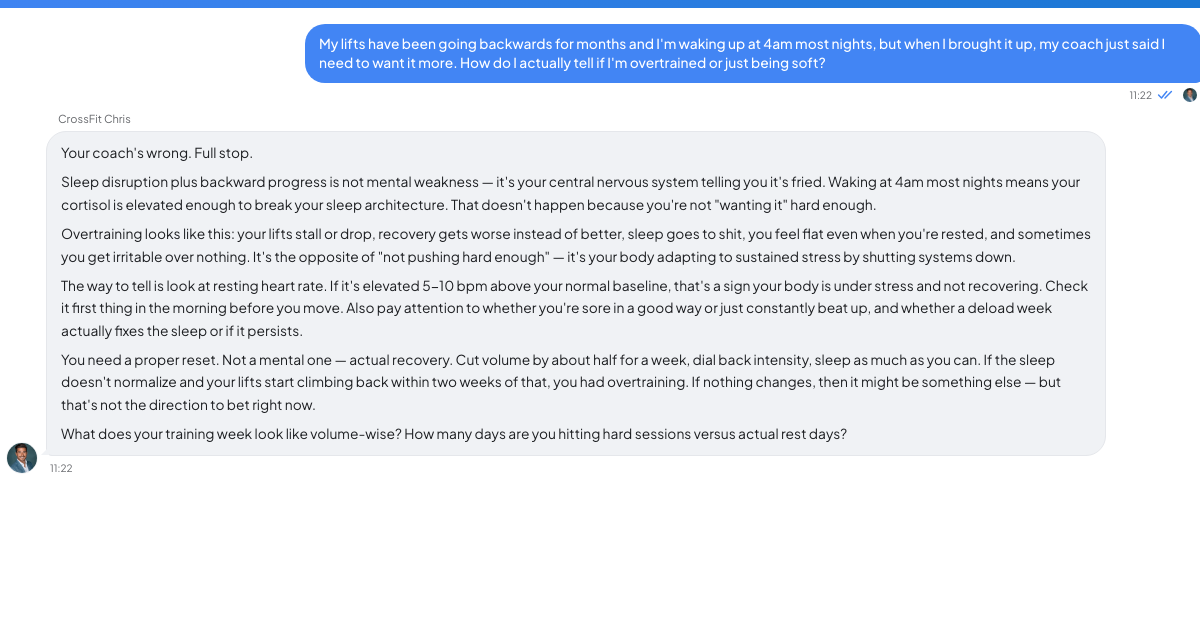
A coach responding to months of declining output with "want it more" has replaced programming with a slogan. Most serious programmes are built in waves, and a wave includes a light week. Falling numbers deserve investigation, not a universal instruction to push harder.
TrueTalk's CrossFit Chris is an AI second opinion. It cannot examine you and it is not your coach, but it is available at five when your coach is not and it will not stand beside you in the 6am class. The free tier includes ten conversations and one hundred messages per day.
Book the bloods now and start the four-column record tomorrow. Measure the fixed-load bar next Tuesday as the evidence week's bar check, then review all seven days. If those data point toward accumulated fatigue, begin the lighter week and retest the same bar again after that week is complete.