Your Neck Hurts Every Afternoon and Physio Can See You in March
A five-month physiotherapy wait needs a workday plan: move before the afternoon flare, build capacity gradually, track the pattern and recognise symptoms that need earlier assessment.

Work with the five-month wait, not around it
The physiotherapy letter arrived last week: first appointment in March, five months away. Meanwhile, your job still requires eight hours a day at the desk that brings on the pain.
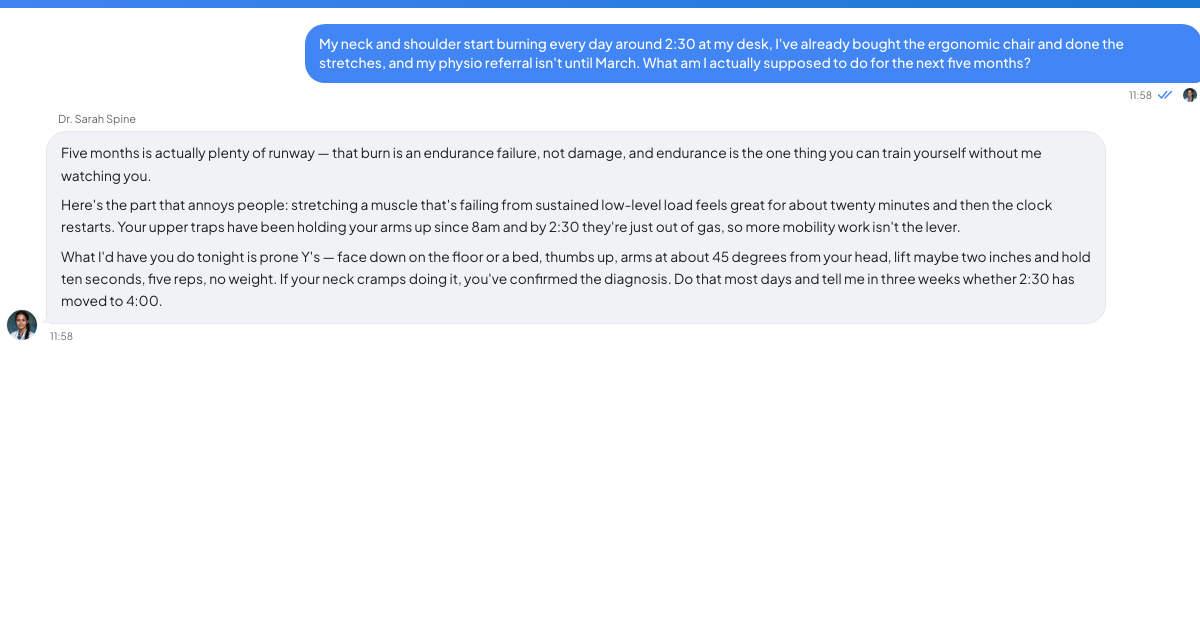
At about 2:30pm, a hot line starts at the base of your skull and runs into the right shoulder blade. By four, you are jamming that shoulder into the chair back for thirty seconds of a different sensation. You have already spent roughly four hundred pounds on the recommended chair, raised the monitor to eye height on books, moved the keyboard forward and followed the NHS stretch page twice daily for about two weeks.
Keep the March appointment. Also check whether your local NHS community musculoskeletal service accepts self-referrals; the NHS neck-pain page says this is available in many areas. The same page advises seeing a GP when neck pain has not resolved after a few weeks or comes with symptoms such as pins and needles or a cold arm (NHS).
Change what happens before 2:30
A workstation can remove an obvious irritation, but there is no single correct posture that every body can hold for eight hours. Ergonomics retailers rarely mention that research connecting any one sitting posture with neck pain is unsettled: people hurt at textbook workstations and remain comfortable at untidy ones. Low-load tissue held in one configuration for hours becomes uncomfortable, while tissue asked to exceed its current tolerance becomes sore. The expensive chair did not prove useless; it proved that furniture alone did not solve daily duration and tissue capacity. Nobody sells duration, although it is the useful variable here.
Move before the familiar burn. Put a ninety-second calendar hold at 2pm, not at four after the pain is established. Those ninety seconds are the only reliably free time in a real workday, so they carry the plan. Stand, take the arms overhead and behind you, squeeze the shoulder blades down and back for ten seconds, turn the head fully left and right twice, and look at something more than six metres away for twenty seconds. Sit down in a different position.
During the day, rotate between upright, reclined with the chair supporting you, and forward on the elbows for a reading block. Poor posture is usually fine for twenty minutes; almost any posture can become uncomfortable across four hours. The useful variable is time spent unchanged, so the intervention belongs inside the workday.
Visit comfortable end ranges for two minutes in the morning: shoulders through their full range, arms overhead, the head turning fully both ways, and slow neck circles only if they feel comfortable. This makes 3pm under stress something other than the day's first trip toward end range.
Build capacity twice a week
Stretching moves tissue, feels good and can provide a real, short window of relief. Keep the stretches if you like them, without scoring yourself against the routine. When that short relief fails, it can make your neck seem broken, although two thirty-second holds simply cannot fix a load that runs from nine to five.
For persistent neck and shoulder pain, active strengthening and endurance interventions have the most consistent support, rather than passive treatments done to you. Twice a week, use light rows, controlled shrugs, band pull-aparts and carries with one weight in each hand; add simple neck-endurance holds only if a clinician has said they are appropriate. A cluster-randomised trial followed 740 office workers across 14 organisations: everyone received an individual workstation intervention, while one group also completed neck-specific exercise for 12 weeks. Exercise plus ergonomics produced a larger pain reduction at 12 weeks, although the between-group benefit was not maintained at 12 months (PubMed).
Another workplace trial assigned 351 office workers to neck-and-shoulder strength training three times weekly, with full supervision, minimal initial supervision or a reference group. Both training versions reduced headache intensity, and the minimally supervised group significantly reduced neck pain compared with the reference group (PubMed). The numbers support repeatable loading over weeks; they do not promise a cure for your neck.
Expect some soreness during the first fortnight. The usual rehabilitation rule of thumb is that soreness present the next morning but gone by evening can be an acceptable dose. Sharp pain or pain travelling somewhere new is a reason to stop and seek assessment.
Know which symptoms cannot wait for March
Arrange earlier medical assessment if you develop numbness or pins and needles in an arm or hand; a changed grip, dropped objects, trouble with buttons or keys; pain running below the elbow; night pain that wakes you and will not ease in any position; unexplained weight loss, fever or a history of cancer with new neck pain; or pain that followed a fall, crash or blow to the head.
Symptoms in both hands, new unsteadiness or new clumsiness with fine movement need prompt medical attention. These signs do not announce catastrophe, but they do not fit the simple loading problem addressed here. The NHS also advises keeping the neck moving rather than using a collar unless a clinician tells you otherwise (NHS).
Give the physiotherapist a usable record
Write one line each day until March: onset time, worst pain out of ten, the activity underway when it began and what eased it. Include Saturdays, holidays and mornings. Those weekend answers are what physiotherapists want: they help distinguish pain that follows the work pattern from pain that appears regardless of it.
Add the treatments you tried and their duration, including the two weeks of stretches. Mark the location with one finger and describe it instead of writing only “neck pain,” which covers about six different presentations. A first appointment uses substantial time on history; a page of dates and observations lets the physiotherapist spend that time elsewhere.
Some pain will persist despite sensible work, and research on persistent neck pain does not offer a reliable cure. Claims of a reliable cure generally come from someone selling one. Stretching cannot fix an eight-hour workload or meeting density. When those are the true load, asking your employer to redesign the workday is legitimate; a walk at 10:30 may require a calendar change rather than another product.
Schedule the ninety-second movement break first, because it survives a day containing four meetings.
TrueTalk's Sarah Spine is an AI persona focused on movement education and posture awareness. At 3pm, it can help you organise the diary or phrase questions for March, including whether soreness seems worth raising, whether to continue the rows that week and whether a Wednesday pattern matters. It cannot examine you, decide whether soreness is safe or replace the physiotherapy appointment. The free tier includes ten conversations and one hundred messages per day.