Your Teenager Watches Anime Six Hours a Day and You Don't Get It
Banning a teenager's anime habit and simply leaving it alone are both wrong. Judge it by what it creates and displaces, then negotiate sleep without making the interest the enemy.

Ten past two, and the subtitles are still running
The light under one fifteen-year-old's door at ten past two is the specific concern here, rather than anime as a category.
You paused outside before knocking, listening to subtitles and a lot of shouting. They started around seven, used a word at dinner you had to look up, have friends whose real names you don't know, and last week announced plans to learn Japanese in the same breath as saying the history coursework isn't due till whenever.
Taking the tablet and setting a rule is the obvious impulse, but you already know that doing it outright costs you access to a part of their life you might not recover.
So the useful question is specific: is this passion making their life larger, or has it become somewhere to hide?
The public argument takes place above that question. Arguments about harm often overlook how widely the medium ranges, from children's films to genuinely adult material, and that range still does not settle whether this teenager should be left alone. Asking whether anime is bad for teenagers is therefore about as useful as asking whether books are. The only analysis worth doing is of this specific child, in this specific bedroom, and what has changed around the viewing.
Start with what the six hours displaced
A passion produces activity beyond the screen, while a retreat consumes space from the rest of life. Both can occupy six hours, and the difference is observable from the kitchen without reading a private message.
Look first for what the interest generates:
- They talk about it unprompted, at length, badly, to someone who didn't ask.
- They've made something. A drawing, a playlist, a wiki edit, a Discord server, a truly awful first page of a comic, an attempt at hiragana on the back of an envelope.
- The online friendships have continuity, with names and in-jokes that recur. Someone who was mentioned in February is still around in August.
- They can criticise it. This one matters more than people realise — a kid who can tell you why the second season was worse is doing analysis, not just absorbing. Having opinions about what they watch shows analysis rather than passive consumption.
- They want you to watch one.
Then check whether the rest of life is contracting:
- The world outside isn't steady, it's contracting. A club dropped in spring. A friend who used to be here every Saturday and hasn't been mentioned since Easter. Meals going upstairs.
- They're not seeking new things — they're rewatching the same comfort show on a loop, which is a different behaviour and usually means something.
- Interruption produces something closer to panic than annoyance.
- The sleep is going, and the sleep is what's actually changing them.
- And the ones that aren't signs of anything to do with anime: weight going, sleep gone, marks on the arms, or a sentence about not wanting to be here. Those are a GP this week, and at that point this article stops being relevant. Your GP will tell you what else is available locally, and will talk to you without your kid in the room.
The hours are almost irrelevant because what those hours replaced determines the meaning. Six hours on a Sunday in a house where the kid also plays football and has people round is a hobby; two hours every night carries a different meaning when they no longer leave the room.
Also notice what subtitled viewing literally requires: voluntary reading at speed for hours. Whatever else is happening, that concrete activity does not fit the simple brain-rotting story.
Watch one title before forming a theory
A direct question will not hand you a fifteen-year-old's interior life. Their chosen stories offer a partial and unreliable clue, because at that age teenagers choose stories that are doing a job for them.
Here is what seven common choices would put on your screen:
Fullmetal Alchemist: Brotherhood — two brothers, a dead mother, and a world with a hard rule that you cannot get something without giving something up. Sixty-four episodes, so it's a commitment. Violent in places, but fundamentally about consequence and guilt.
My Hero Academia — set in a school, about a boy born without the power almost everyone else has. If your kid is deep in this one, the theme is being ordinary in a room full of chosen people.
Attack on Titan — very violent, and about siege, escalating atrocity and losing track of which side is the monstrous one. Not a children's programme, and not one to start watching without knowing that.
Neon Genesis Evangelion — a fourteen-year-old whose father seems to want him only for what he can pilot. Famously bleak, famously depressive, and famously the one that a certain kind of teenager finds at exactly the moment they need it.
March Comes in Like a Lion — an orphaned teenage professional shogi player. It depicts depression and isolation about as unflinchingly as anything you'll see.
A Silent Voice — a film about a boy who bullied a deaf classmate at primary school, and what he does about it years later. It deals directly with suicidal thinking. Worth knowing that before you press play next to a fifteen-year-old, and worth watching anyway.
Studio Ghibli films — Spirited Away, Princess Mononoke and the rest. Film-length, gorgeous, and the easiest possible entry point for a parent who wants to have watched something.
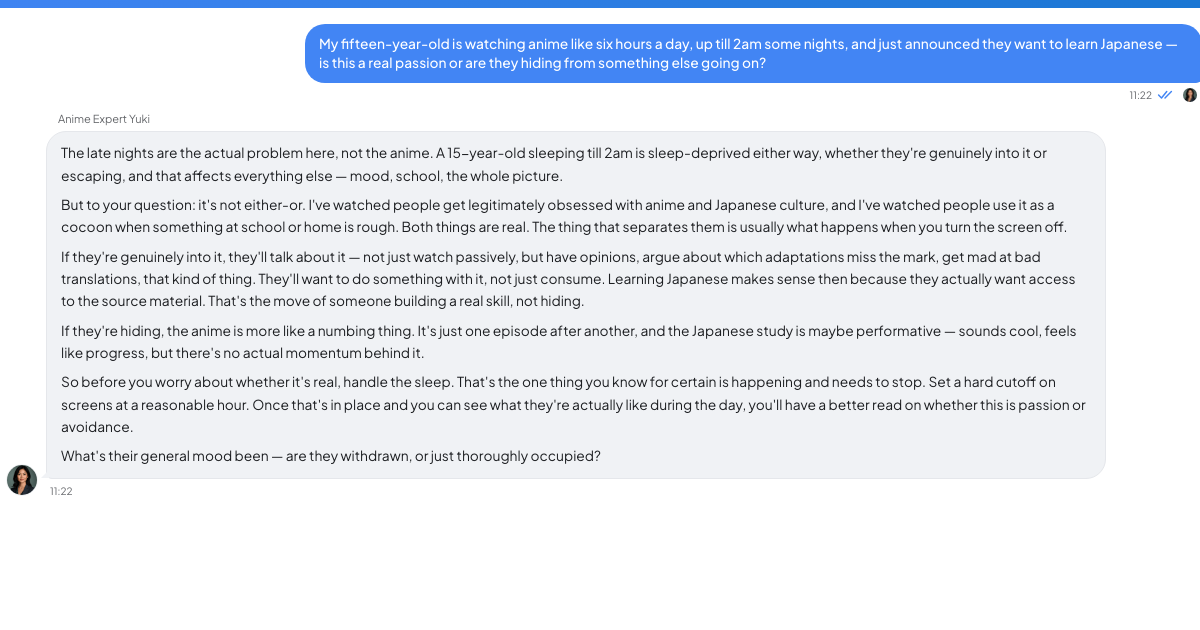
If none of these seven examples matches any of the six titles on their screen, Anime Expert Yuki is a TrueTalk AI advisor who can explain them before Sunday. The free tier includes ten conversations and one hundred messages per day.
Treat that reading as a clue, never a diagnosis; you can be badly wrong. Plenty of teenagers watch a title simply because their friends do, with no deeper meaning underneath. Go into the room having seen a film, not carrying a theory about their psyche.
Give the Japanese claim an eight-week test
Hear the Japanese plan as a testable ambition rather than an excuse. Find and pay for a real class with homework, other humans in the room, and a teacher whose job includes marking the work.
The offer is genuine, although it also produces evidence. Interest that survives eight weeks of grammar drills is real, and you have funded the most useful thing in their life; interest that dies after six weeks answers the question without a row or a parental no. For the whole term, your observable position will be on their side, whatever the outcome, and preserving that alliance matters more here than proving you were right.
Keep privacy intact; negotiate the school-night boundary
Do not ban anime. The viewing can move to an unseen phone or a friend's house, costing you information and turning a discussable interest into something they lie about.
Do not search their history or read Discord either. When they find out — eventually they do — the anime question becomes a years-long trust problem without giving you the answer you wanted.
The 2am viewing justifies a rule on sleep grounds. At fifteen, insufficient sleep affects mood and school more than most parents expect. The American Academy of Pediatrics says teenagers need 8 to 10 hours each night and that devices can disrupt both sleep length and quality, while the NHS gives the same 8-to-10-hour range and recommends half an hour to wind down between screens and bed. The American Academy of Sleep Medicine specifies 8 to 10 hours in every 24 for ages 13 to 18 and links routinely shorter sleep with attention, behaviour, and learning problems. Negotiate a school-night device curfew as a household sleep rule and let the rest go, so the argument does not become a judgement on what they love or who they are.
The conversation probably will not begin with a question. Watch something and get one detail wrong out loud — the studio name, a character arc, or which season was better — and let it begin when they cannot allow your mistake to stand.