Your Watch Said 190 and You Haven't Been Back to the Gym Since
A watch reading of 190 deserves context: check symptoms, understand what each ECG tests, compare sensors, and return to exercise with a measured plan.

The number followed you home
Seven minutes into spin class, you got off the bike while everyone else continued. With your back against the mirror by the water station, you watched 190 become 188 and then 191 while the instructor called the last hill. You told the front desk that you felt a bit off and went home.
Six weeks have passed with no exercise except one walk, cut short when a hill made your chest thump and you decided you would rather not find out.
Your GP recorded an ECG and called it normal; the appointment took six minutes door to door. The paper reassured you, but your physical fear did not follow.
Reassurance has not answered three practical questions: what 190 meant, what the ECG actually tested, and what to do when the watch runs high again.
Put 220 minus age back in its proper place
You had learned that maximum heart rate equals 220 minus age, so on the studio floor 190 looked over the line, or close enough to prove danger.
That equation is a population estimate, not an individual safety limit. The spread around it is wide: two people the same age can have genuinely different maximums in both directions, by a margin that makes the estimate close to useless for any individual. Exercise physiologists have proposed replacement equations over the years for exactly that reason. Those formulas still do not predict you: knowing your maximum means actually reaching it, usually under supervision, and almost nobody has.
The frightening comparison placed one wrist reading against a population average.
Test the wrist reading against an electrical sensor
An optical wrist sensor shines light into skin and infers pulse from the changing signal underneath. High intensity, high cadence, sweat, locked arms, and a loose band put an optical wrist sensor at its worst; movement rate can be mistaken for pulse while your legs turn and your hands grip in rhythm. In that case, the displayed number exists, but it is not your heartbeat.
Test that possibility before treating one data point as a diagnosis. A chest strap measures electrically rather than optically, which is why it holds up better through hard intervals: wear it and the watch in the same class, then compare both traces afterward. A wrist-only spike would give you concrete information about the equipment rather than a guess about your heart.
Apple says a high-rate notification can appear when the measured rate remains above your chosen threshold after at least 10 minutes of inactivity. If the alert arrived after you had stopped and were sitting on the floor, that timing fits the feature's design; show the record to a doctor and let them weigh it.
Match the ECG to the question
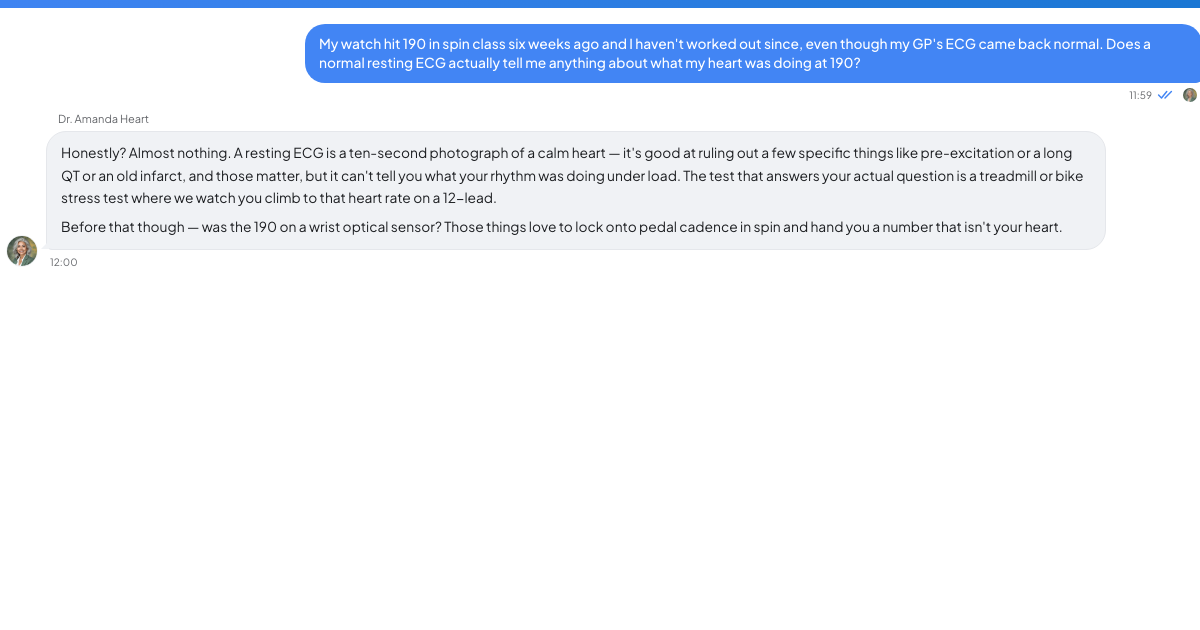
A resting ECG captures electrical activity while you lie still. A watch trace uses one lead and a clinic trace usually uses twelve, providing more angles and information, but both describe the heart at rest.
The unanswered question concerns your heart reaching 190 on a bike.
A normal resting ECG is a sensible first step that rules some things out, but it cannot directly reproduce that exercise question. Ambulatory monitors can record for a day, a week, or longer, so they can catch a problem that appears intermittently. Separately, the NHS describes three ECG routes: resting, portable monitoring, and exercise or medicine-induced stress testing. Its portable monitors are usually worn for 24 to 48 hours and sometimes up to 7 days, while an exercise ECG uses treadmill walking or an exercise bike with chest electrodes. Whether you warrant either test depends on symptoms, personal history, and family history, and only a doctor with all three should decide.
This does not mean you need either test. It means the resting trace did not record what your heart did at 190.
Symptoms that stop the experiment
Stop exercising and seek medical care if any item below occurs:
- Fainting, or nearly fainting, during or just after exercise.
- Chest pain, pressure, tightness or heaviness — including pain spreading to jaw, neck, back or arm. That's an emergency call, not a GP appointment, and don't drive yourself.
- Breathlessness far out of proportion to the effort.
- A heart rate that starts racing abruptly and won't come down — still high several minutes after you've stopped and are sitting quietly.
- Palpitations with dizziness or lightheadedness.
Also volunteer any relative who died suddenly and young or had a diagnosed heart-muscle or rhythm condition, even when nobody asks at the next appointment. Family history changes how symptoms are weighed.
The return plan below is only for the different situation in which you felt fine and stopped because the screen frightened you, not because your body produced those symptoms.
A fortnight without watching the display
Cover the watch with tape or a wristband, or switch off its display. The data remains recorded for review at home while you stop reading it during effort and turning exercise into surveillance. Leaving the watch in the locker is the other option.
For the next few weeks, judge effort by speech. Easy allows a full conversation; moderate allows sentences you would rather not deliver; hard reduces speech to groups of three or four words. The scale is crude but does not pretend you have an individual reference range.
Begin with a fortnight of easy walking or cycling while the conversation test remains intact. For the next couple of weeks, add a few moderate minutes; if nothing has bothered you, progress to one harder session each week and keep the others easy. The progression may feel slow, but it still gets you moving sooner than spending another six weeks inactive.
After sessions, track measures that respond to training: resting heart rate over months and the drop during the first minute after stopping. Both tend to move in the expected direction as fitness returns and tell you more than the day's peak.
If you have a diagnosed heart condition, do not use this progression; your cardiologist sets the programme, overriding general-audience advice.
Prepare the second appointment on paper
The six-minute appointment gave you one chance to ask a question you had not yet phrased, so you left with an answer to a different question.
Before returning, write three prompts: can your heart under load be measured; does an exercise test or ambulatory monitor fit your history and family history; and what should you do if the event repeats mid-class? You can rehearse those words with TrueTalk's Amanda Heart, an AI heart-health educator and fitness mentor. The free tier includes ten conversations and one hundred messages per day, but Amanda cannot read your ECG.
Do not let one unexplained reading become six more weeks
You were building fitness six weeks ago and are not building it now. Regular activity sits near the centre of cardiovascular-health guidance in the UK and elsewhere; no version of that advice makes six weeks of sitting still the better plan.
Buy the chest strap, wear both sensors to the same class, and bring any discrepancy plus your written questions to the clinician.