Your Yoga Teacher Says 'Listen to Your Body.' Your Back Isn't Speaking English.
After a back injury, use sensation, location, and the next 24 hours to adjust yoga—while treating leg weakness and bladder or bowel changes as medical issues.


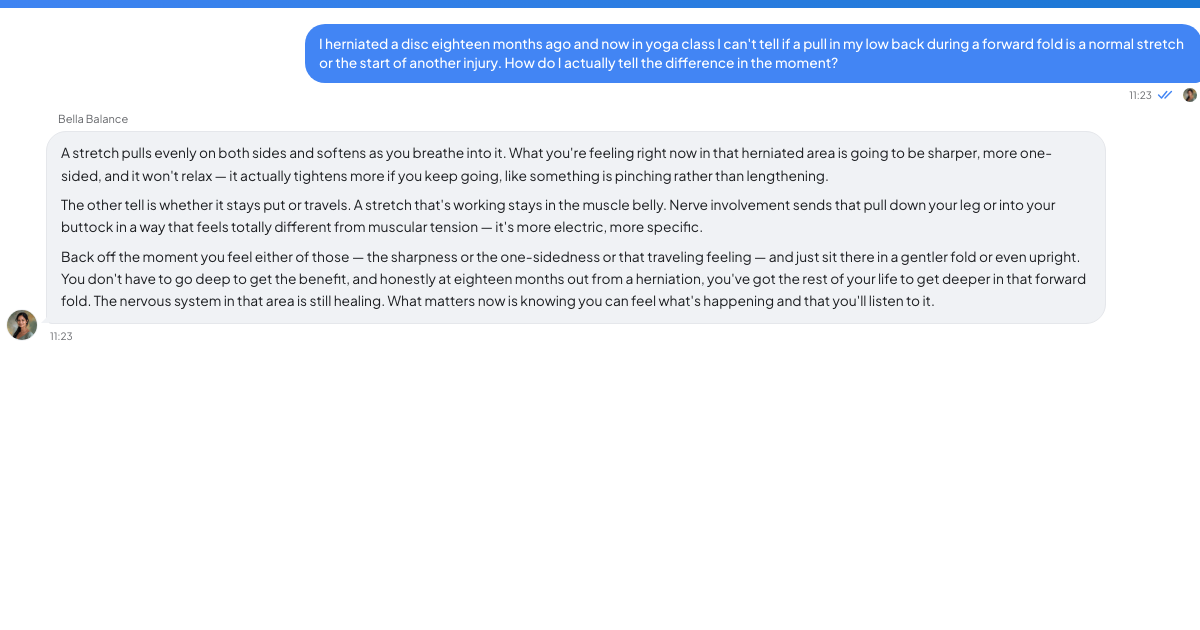
Halfway into the forward fold
In the third row of a twenty-person class, halfway down a forward fold, you feel a pull on the left side of your low back.
You stop because the signal is genuinely unreadable.
Eighteen months earlier, bending to collect a plug socket adapter left you unable to rise from the kitchen tiles for forty minutes. Its first two seconds felt like a small, low pull on the left before becoming anything but small.
Now you are holding 60% of a forward fold, comparing two sensations without enough information, while the teacher warmly says, "listen to your body." The last signal did not warn you clearly enough.
Turn the slogan into observable questions
The phrase assumes a skill you no longer trust. Reliable separation of helpful sensation from a warning would let you continue yoga without this uncertainty.
Your difficulty interpreting the signal comes from missing information; anxiety, oversensitivity, or both may still be present. After injury, the nervous system routinely increases its gain in the injured area, making formerly quiet signals arrive loudly. The sensation remains real rather than imaginary or dismissively "in your head," but it is no longer proportional to tissue events, so intensity alone cannot do the judging.
A scan has a similar limitation: scan findings and pain overlap far less than most people assume. Imaging studies routinely find disc bulges and degenerative changes in people with no back pain. NICE confirms that disc and joint degeneration are frequently found in people without symptoms, which is why non-specialist imaging is not routine unless serious pathology is suspected. The picture you were shown therefore cannot, by itself, identify which movement is dangerous today.
Direction matters more than a generic banned-pose list
Your last teacher prescribed skipping forward folds without enough information to know whether that suited your back.
The same pose can produce different responses depending on the symptoms' driver. Flexion can settle one back while extension flares it, and another back can do the exact reverse. Clinicians regularly see both patterns, so a sound assessment tests directional response instead of consulting a universal list. Cobra can feel comfortable for one person while aggravating another person's back for the following week.
Your repeated response supplies the missing individual information that a pose list cannot.
Grade sensation in class, then check again tomorrow
While holding the pose, take about three seconds to ask three questions.
First, describe its quality. A workable stretch tends to feel broad, warm, dull, and describable with your whole hand; sharp, electric, burning, tingling, or pins-and-needles sensation is different and must never be pushed through, regardless of how good you feel afterward.
Second, map its location and movement. A broad low-back feeling that stays where it began, resists one-finger localisation, and softens during the hold may be workable. Come out if symptoms travel into the buttock, down the back of the thigh, past the knee, or into the calf or foot, or if they creep outward during the pose; limb travel suggests nerve involvement, which you should not stretch harder into on a mat.
Third, give the 24-hour response the most weight, because class cannot settle the question. A common rehab rule of thumb treats soreness present the next morning but gone by the following evening as an acceptable dose; symptoms that are worse the next day and still worse the day after mean the dose, rather than necessarily the movement, was too large. Halve the amount and retry after a few days. The following morning, you can describe the location and movement of the sensation to TrueTalk's Bella Balance, an AI persona for yoga and body awareness. Bella cannot diagnose and is not a physiotherapist; leg symptoms belong with a clinician.
That 24-hour question is the difference between rebuilding and oscillating between inactivity and a three-day flare.
Slow the entry before changing the pose
A fast entry can carry you beyond the point you meant to evaluate.
Enter the fold at about half the room's pace so information arrives before the decision. Pause at roughly 70% of your available range, ask all three questions, and leave earlier than the class when needed; nobody is monitoring your hold time.
Keep your knees bent in every forward fold as a permanent choice, not a concession. Soft knees change the movement from the locked-knee version, which makes a meaningful difference for many backs.
Make modification socially ordinary
People often push through for social reasons: leaving a pose while nineteen classmates remain can feel like making an announcement.
Arrive early and choose a back-row place near a wall, with everyone visible and nobody behind you. Put two blocks beside the mat from the start. Preselect child's pose, hands on blocks, or one knee down as your default, use it without looking around, and skip the second side when the first supplied enough information; no explanation is required.
Before class, give the teacher about ten words: "I hurt my back badly eighteen months ago, so I'll be modifying." That sentence covers the next hour without repeated mid-flow negotiation. A worthwhile teacher will nod and may offer an alternative; a bad reaction gives you useful information about that class.
Build a weekly record of safe bending
Total avoidance cannot rebuild confidence because it never produces contrary evidence.
Choose the movement you fear most, probably some form of forward bending, and practise a very small range that produces almost nothing several times each week. Check 24 hours later; when the response stays quiet, increase it slightly the next week.
The progression is tediously slow, but it is how people regain use of their backs. For now, aim to build a repeated record of bending without harm so the alarm system can gradually stop treating movement as a threat; flexibility can come later. NICE recommends support for self-management, encouragement to continue normal activities, and exercise selected around the person's needs and capabilities.
Route neurological symptoms away from the mat
Neurological signs override the graded-movement framework.
Pain, numbness, or weakness travelling down one leg needs a doctor or physiotherapist rather than a yoga modification. Treat weakness especially seriously: a less responsive foot or a toe catching during walking needs urgent assessment the same day or next day, sooner when worsening.
Treat loss of bladder or bowel control, difficulty starting to pee, saddle-area numbness in the parts touching a bike seat, or new symptoms down both legs as a same-day emergency. Use A&E or your local emergency number. The NHS directs people with back pain plus symptoms in both legs, loss of feeling around the genitals or anus, or bladder or bowel changes to call 999 or attend A&E; do not join a physiotherapy waiting list or return to yoga. The condition is rare, but hours matter.
Check the next morning before increasing range
Some readings will be wrong: a session can feel fine and still cost three uncomfortable days. Finding an edge includes that risk, while never approaching it carries a slower, accumulating cost.
For now, bend your knees, stop at seventy per cent, and check the response tomorrow morning.