My Boyfriend Still Talks to His Ex: Is It a Problem?
Contact with an ex is not automatically a red flag. What matters is why they talk, how open he is about it, and whether it costs you anything.


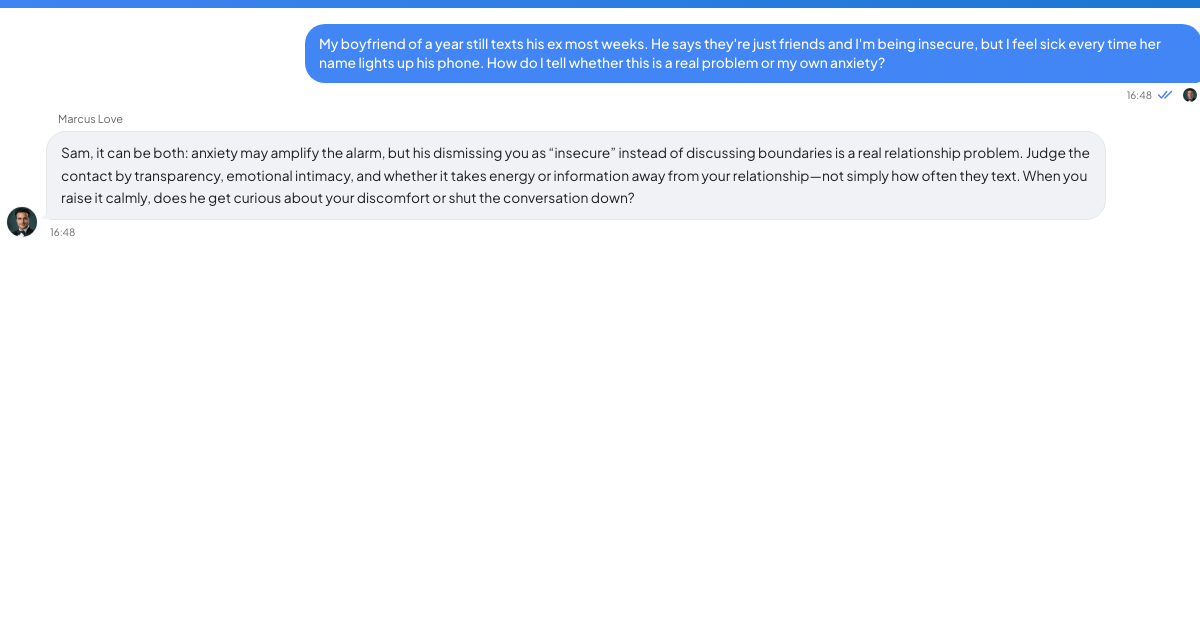
Is it a red flag if my boyfriend still talks to his ex?
Not by itself. Plenty of people stay in touch with an ex for ordinary reasons, and the research suggests the motive and the openness matter more than the contact. It becomes a problem when it is secret, when it is emotionally intimate in a way you are shut out of, or when it keeps one foot out of your relationship.
That gives you three questions to ask rather than one rule to apply: why are they in touch, is he open about it, and what is it costing you?
How common is it, and what does the research say?
It is common. A 2016 paper in Personal Relationships by Lindsey Rodriguez and colleagues, Communication with former romantic partners and current relationship outcomes among college students, found that roughly 40 percent of people in relationships talk with a former partner. The authors also looked at the reasons people keep in touch and how each reason relates to the health of the current relationship, and concluded that in certain situations and for certain people, contact with an ex can harm the current relationship.
The useful word there is certain. The study used college students, so it does not describe every couple, and it shows associations rather than proof that contact causes problems. What you can take from it is that “he talks to his ex” tells you very little until you know the reason. Co-parenting, a shared friend group, or a practical matter such as splitting a lease is a different thing from keeping an ex around as a possible backup if things go wrong with you.
When is contact with an ex harmless?
These usually are:
- Logistics. They share a child, a pet, a lease, a business, or belongings that still need sorting out.
- A real friendship. They were friends before and after, the contact is occasional, and he mentions it the way he mentions any other friend.
- It is out in the open. You know when they talk, you can see the messages if you ask, and he would not be embarrassed if you were in the room.
- It is flat in tone. Nothing flirty, nothing nostalgic, no “remember when” threads.
If all four apply and you still feel uneasy, that does not make you irrational. It may mean you need reassurance of your own, or that the ex is someone you find hard to be around. Both are fair to say out loud.
When does it become a real warning sign?
Look at the pattern, not the single text.
- He hides it, deletes threads, or changes the subject when her name comes up.
- The conversations are emotionally intimate: he tells her things he does not tell you.
- He is still venting to her about you, or comparing the two of you.
- She is a standing source of conflict and he calls you “crazy” for noticing.
- He talks to her more than to anyone else in his life.
- You asked for a boundary, calmly and once, and the answer was ridicule.
No single item is proof of cheating, and this list is not a verdict. The reason to take them seriously is that secrecy and dismissal damage trust regardless of what is in the messages. If your boyfriend keeps lying about contact with his ex, the affair-recovery post is worth reading on why checking his phone rarely settles anything.
How do I bring it up without starting a fight?
How you open decides most of what happens next. The Gottman Institute draws a clear line between a complaint, which deals with one specific issue, and criticism, which attacks someone's character, and its account of the four horsemen describes defensiveness as usually a response to criticism. In practice, that means you are far likelier to be heard if you describe your own reaction to a specific thing than if you announce what he is.
Compare:
- “You are obviously still into her, and you are lying about it.”
- “When I saw your name come up on her story, I felt a knot in my stomach. Can we talk about how you two keep in touch?”
Pick a calm time, not the moment after you have seen a notification. Then use three steps:
- Name the specific thing. “She texts you most evenings” is checkable. “You are always on your phone with her” is an accusation.
- Say how it lands, in one sentence. “I feel pushed out when I do not know what you talk about.”
- Ask for one concrete change. “Can you tell me when you have spoken to her, or let me meet her?”
Then let him answer. The first reply is often defensive, because he heard an accusation even if you did not intend one. Give it a day before you decide what it means.
What if he gets defensive or says I'm jealous?
Some defensiveness is normal. Look at what comes after it. A healthy response is “I get why that bothered you, here is how I'll handle it.” The worrying versions are “you are insecure,” “I'm not discussing this,” or a counter-attack about something you did last year. One bad response in a single conversation is not a pattern; the same response across three calm tries is.
It also helps to ask yourself what you actually need. If the answer is reassurance, say that: “I know you are not doing anything wrong. I just need to hear that I'm your priority.” If the answer is a boundary, say that plainly instead: “I'm not comfortable with late-night private messages. Can we stop those?” Reasonable people can agree to different boundaries, and a partner who respects you will negotiate rather than mock the request.
Should I ask to see his messages?
Demanding his phone usually backfires, even when your worry is justified, because it turns the conversation into a trial. A better first step is asking for openness: what they talk about, how often, and whether you can meet her. If he welcomes that, the contact is probably not what you feared. If he refuses every form of openness and treats your question as an insult, that refusal is information about how the two of you handle trust, and it is worth telling a counselor rather than checking his phone at night.
Is there a point where I should leave?
You are allowed to decide that a relationship with an ex permanently in the background is not one you want, even if nothing improper is happening. You are also allowed to decide it is fine. The deciding factors are how he responds to your concern over weeks and whether your trust is growing or shrinking. If you have asked clearly, offered a workable compromise, and still get secrecy or contempt, that is a reasonable place to talk to a couples counselor or to think hard about whether this is the relationship for you.
If you have started to feel afraid of how he reacts when you raise it, that is a different situation. In the US, the National Domestic Violence Hotline is free and confidential at 1-800-799-7233 (or text START to 88788), and you do not have to be certain it is abuse before you call.
Marcus Love, one of TrueTalk's AI advisors, can help you rehearse the opening sentence and plan for the different ways the conversation might go. If the jealousy itself has become overwhelming, an individual therapist can help more than any script.