Four Messages In, She Stops Replying. Every Single Time.
When chats repeatedly stop around message four, stop rewriting yourself. Track the four stages, change one variable, and read the result probabilistically.


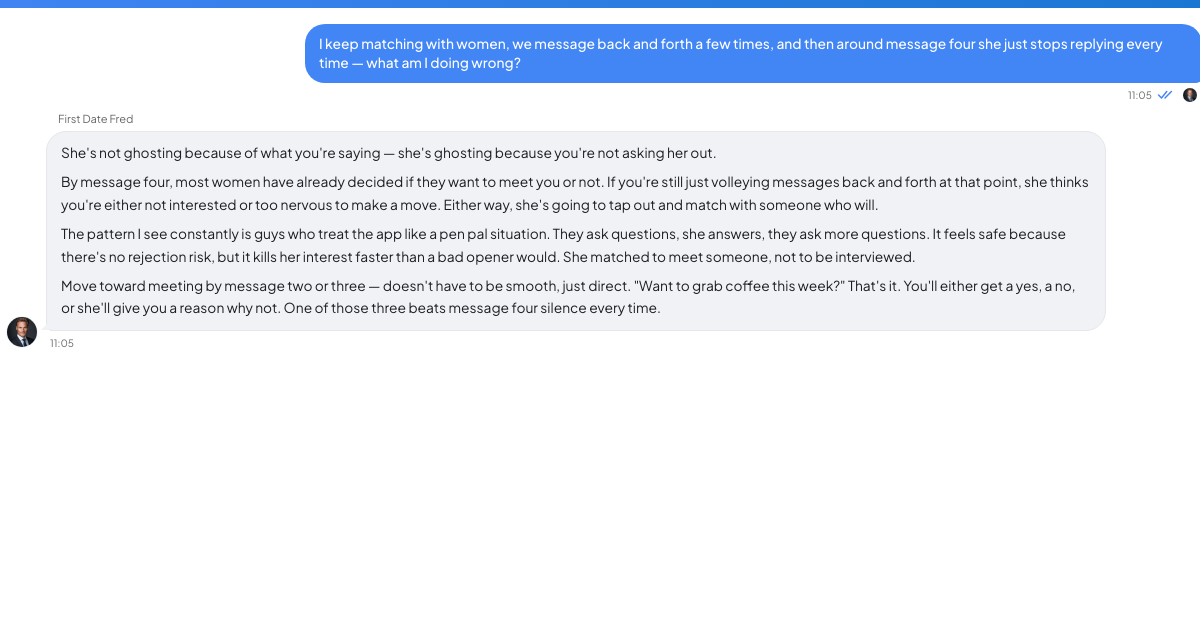
Four messages, then silence
You match on Sunday night and send something Monday morning. She replies by lunchtime. You trade two more messages: she is funny about her flatmate, you are funny about your job, and it seems to be going well. On Tuesday evening, your next message sits there. She has not unmatched or blocked you. She read it and left it.
It is always about four messages. Once it happens enough, you stop calling it luck and start reading it as a report card. At half eleven you rewrite "hiking" as "long walks I complain about," searching your bio for the flaw that made another woman leave. That self-blame feels diagnostic because it gives you something to edit, but a later silence does not tell you that your profile caused it.
Dating-app advice tends to focus on getting matches. You already have them. These conversations can fail in only four places: match, opener, middle, and ask. Mark those stages in your last ten chats. One is your bottleneck; changing all four at once prevents you from learning which one.
Separate ordinary endings from your repeat pattern
Your photos clear the first bar, so stop changing them in response to a conversation dying later. A match still is not proof of settled interest. People swipe loosely on a commute and reconsider later; some matches were never truly in play, and no message would have converted them. Take those out of your conscience without using them to explain every silence.
In Pew's 2022 survey of 6,034 U.S. adults, 54% of women who had used dating sites or apps in the previous year said they sometimes felt overwhelmed by messages, while 64% of men said they sometimes felt insecure from receiving too few (Pew Research Center). That gives context for the uneven experience, not a diagnosis of any one non-reply.
A pleasant exchange can end naturally because two strangers have exhausted the easy subjects, her week changed, or another conversation became a plan first. One ending contains almost no information about you. Ten conversations ending at the same stage contain a pattern worth testing, but still not proof of personal rejection. Treat the repeat as a process problem until your own evidence says otherwise.
Test the opener and middle in daylight
Count how many first messages receive any reply. If most do, leave the opener alone. If only a small minority do, check whether you send "hey," four sentences, a joke she has to decode, or a compliment about her face—the category she may receive constantly. A systematic review synthesising 86 studies found that short, personalised invitations referring to a profile trait and an earlier move from chat to a date were associated with better conversion (Khan and Chaudhry, 2015). Use that as an experiment rather than a guarantee: one specific profile reference, one answerable question, then stop.
Now read the last ten dead chats in daylight, rather than recalling them at midnight. Look for an interview rhythm: question, answer, unrelated question, answer. She supplies all the material and receives nothing to react to. Offer something about yourself before asking the next question.
Compare message lengths. When she sends one line and you return a paragraph twice, answering becomes a task. Also watch for an audition—the running joke that only works if she sets it up. It is tiring to become someone's audience before meeting him.
Many of those chats will be fine: warm, easy, and free of an identifiable mistake. That matters because a natural ending needs a next step, not forensic rewriting. If the repeat pattern appears only when no plan was proposed, the missing variable is the ask.
Run one controlled month
For four weeks, keep a note with the date, match, whether the opener got a reply, whether the chat passed two exchanges, the message number where you asked, the specific plan you offered, her response, and whether a date happened. Do not change your photos, bio, opener style, message length, and timing together. Hold the profile steady and change one behaviour: after three or four decent exchanges, make a small, specific ask.
If you matched at eleven on Sunday, she replied warmly Monday, and the exchange still has momentum Tuesday afternoon, try: "This is much better in person—drink Thursday? There's a place near London Bridge I keep meaning to try." This is not a universal 48-hour rule. Day, activity, and place make the invitation easy to answer without opening a negotiation. If Thursday is bad and she wants to meet, she may offer Saturday. If she goes quiet, you have converted an unknown into useful information without proving anything about your value.
At the end of the month, compare stages rather than individual women. If most openers receive replies but nearly every chat reaches six messages without an ask, ask earlier. If you ask ten or eleven people and one agrees, your observed lever may be volume rather than another wording change. If specific asks get yeses but dates do not happen, the failure is after the ask. If replies collapse only with paragraphs or interview chains, test shorter, reciprocal exchanges next month. Your sample will be small, so read it probabilistically: it estimates where friction sits; it cannot certify why any particular person stopped.
There is no reliable industry conversion number to judge yourself against. Apps do not publish comparable figures, and many circulating numbers are self-reported. Your note creates a personal baseline without turning one woman's deadline, friend's crisis, shift, changing interest, or other date into a verdict about you.
Know when the format is the problem
A non-reply says far less than it feels like it says, including whether "hiking" was wrong. Stop the midnight rewrites because editing from noise makes every version more careful and less like a person.
Apps compress you into six photos and a line of text. Some people perform poorly in that format and much better in a room. If you have held the profile steady, tracked the four stages, asked clearly around message four, and given the experiment a real stretch without improvement, the qualified conclusion is that this format may not suit you. It is not evidence that you do not suit anyone.
TrueTalk has an AI advisor called First Date Fred, built around dating psychology, attraction dynamics, and first-date strategy. He can examine what you sent, where it stalled, and how the ask could have been phrased. He is an AI persona rather than a human coach, available at half eleven when you are tempted to rewrite everything. The free tier includes ten conversations and one hundred messages per day. Start the note tonight with Sunday's match and a column for whether you asked.