My Boyfriend Won't Propose: How Long Is Too Long to Wait?
If you want marriage and he keeps stalling, stop waiting for a ring and ask for a date by which you will both know. Here is how to have that talk.


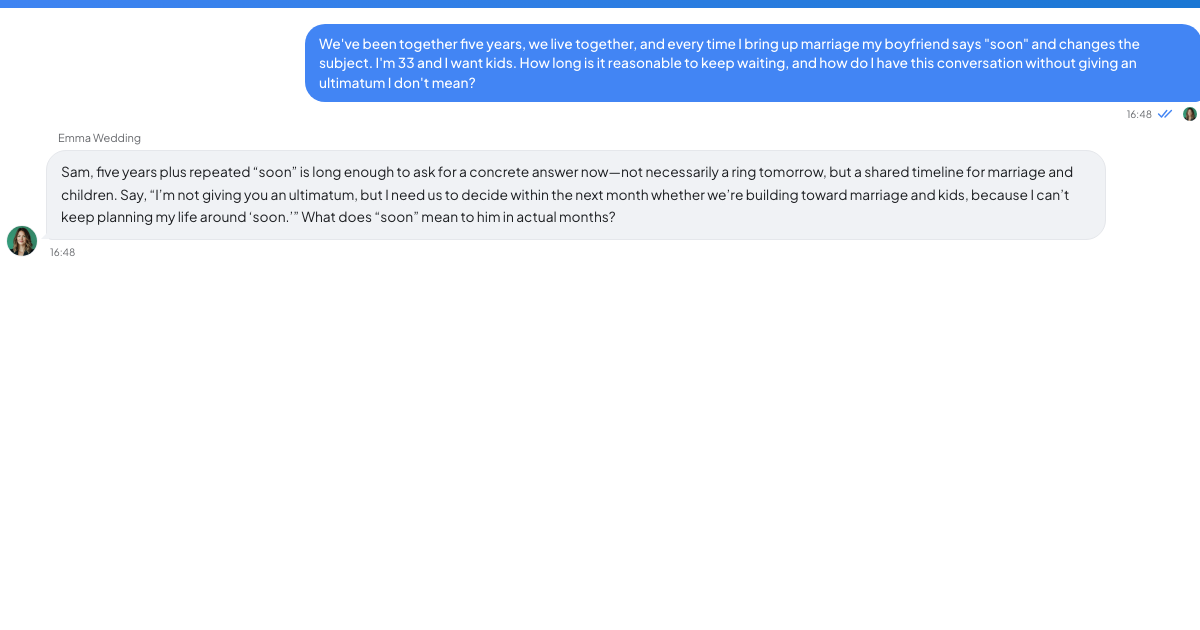
Why won't my boyfriend propose, and how long should I wait?
There are only a few real reasons, and you cannot learn which one applies by waiting. Have one direct conversation about marriage, ask for an honest answer and a rough timeline, and decide how long you are willing to wait before you have it. If the answer stays vague after a clear, calm ask, the vagueness is the answer.
Most advice on this topic tells you to be patient or to give an ultimatum. Neither is a plan. A plan is a conversation with a specific question in it, followed by your own decision about what you will do with what he says.
What are the usual reasons he hasn't proposed?
Try to sort him honestly into one of these, because each calls for a different response:
- He wants to marry you but is waiting on something external. Money, a job change, a visa, finishing a degree, a family situation. This is the most hopeful case, and it should come with details: what he is waiting for and roughly when it will be done.
- He has not decided. He loves you and is not sure about marriage, or about marriage with you. He may not say this because he does not want to lose you or to be the person who ends it.
- He does not want to marry at all. Some people mean it when they say marriage is not for them. If he has said so more than once, believe him rather than hoping he will change.
- He is afraid. A messy divorce in his family or his own past can make marriage feel like a trap even when he wants to stay with you.
- He is drifting. He has not made a decision either way. Living together, sharing a lease and a routine made staying the easy option.
That last one is more common than people admit. Scott Stanley, a research professor at the University of Denver, and his colleagues call it sliding versus deciding: moving through relationship stages, such as moving in together, without a clear conversation about what it means. The same university article notes that sliding is not always harmful and that many couples who drift into living together build strong relationships, and says commitment, communication and clarity matter more than whether you live together. The point for you is that a relationship can run for years on momentum without either person ever deciding anything.
What should I say to him?
Pick a calm, private moment that is not after an argument, a wedding, or a friend's engagement. Do not hint. A hint gives him room to hear what he wants to hear.
Something like:
“I want to talk about where we are headed. I want to be married one day, and I want to know whether you see that with me. I am not asking you to propose tomorrow. I am asking you to tell me honestly what you think, so I can make good decisions about my own life.”
Then ask two specific things:
- “Do you want to marry me?”
- “If yes, what are you waiting for, and when do you think you will be ready?”
A short, clear question gets a more useful answer than a long speech. It also keeps the conversation a complaint about one issue rather than an attack on his character, which is a distinction the Gottman Institute makes in its writing on criticism and defensiveness: a complaint stays on a single topic, while criticism goes after the person, and defensiveness tends to follow criticism. “You are scared of commitment” will probably get you a wall. “I want this, and I need to know if you do” leaves him somewhere to stand.
How do I tell a real answer from a stall?
Listen for content, not tone.
Good signs: he names something concrete (“I want to pay off the loan first, I think about eighteen months”), asks you what timeline you had in mind, brings the topic back himself later, or has already been thinking about rings or telling family.
Stalling signs: “I just don't like pressure,” “why can't we just be happy as we are,” a joke, a change of subject, or agreeing warmly and then never mentioning it again. Also watch for “soon” with no content behind it, repeated across several conversations.
One vague answer is normal, since people are often caught off guard. The same vague answer after three clear asks, spread over a few months, is a pattern.
How long is too long to wait?
There is no number that applies to everybody, and I'd distrust anyone who gives you one. What matters is your own deadline, set before the conversation and not after. Ask yourself:
- Do I want to be married, or do I want to be married to him? If you could choose only one, which?
- Do I want children, and does my biology or my age make timing a constraint?
- How much more time can I give this without resenting him?
Write the answer down. If you decide that a year from now you will want clarity, tell him so: “I need to know by next autumn whether we are on the same path. If we are not, I will have to make a different plan.” That is not an ultimatum in the manipulative sense. It is information about what you will do, which is the only thing you control.
If you find yourself repeatedly moving the date, that is worth noticing too. The post on cold feet before a wedding covers how to tell hesitation that passes from hesitation that is trying to tell you something, and some of the same questions apply from the other side.
What if he says he doesn't want to get married?
Take it at face value. It hurts, and it can feel as if you are being rejected personally, but it is also the clearest answer you can get. Ask what the reasons are, and whether he would still want a lifelong commitment without the legal part. Some couples build a durable partnership with no wedding and are happy; some find that what the wedding represents (a public promise, a family, legal protection) is what they needed. You are entitled to need it.
If you do, the options are uncomfortable but simple: accept his position and stay, knowing it will not change, or leave. Staying while quietly hoping he will change usually produces resentment in both people. If you are weighing leaving, the posts on telling him or calling a lawyer first and breaking up with someone you live with cover the practical order of operations.
Should I propose myself?
You can, and nothing prevents it. It is worth deciding what you want from the act. If the point is to find out whether he wants marriage, a direct conversation is simpler and tells you more. If you want to ask him, do that as a real question that he can answer no to, without arranging a public moment where he cannot.
When should I get outside help?
If the conversation keeps ending in silence, tears or a fight, a couples counselor can run a structured talk that neither of you can derail. A therapist on your own can help if the waiting has begun to affect your sleep, your work or your sense of yourself.
Emma Wedding, one of TrueTalk's AI advisors, works on marriage preparation and commitment questions, and can help you write the opening of this conversation and rehearse the answers you are afraid of. The decision about how long to wait belongs to you.